Table of Contents
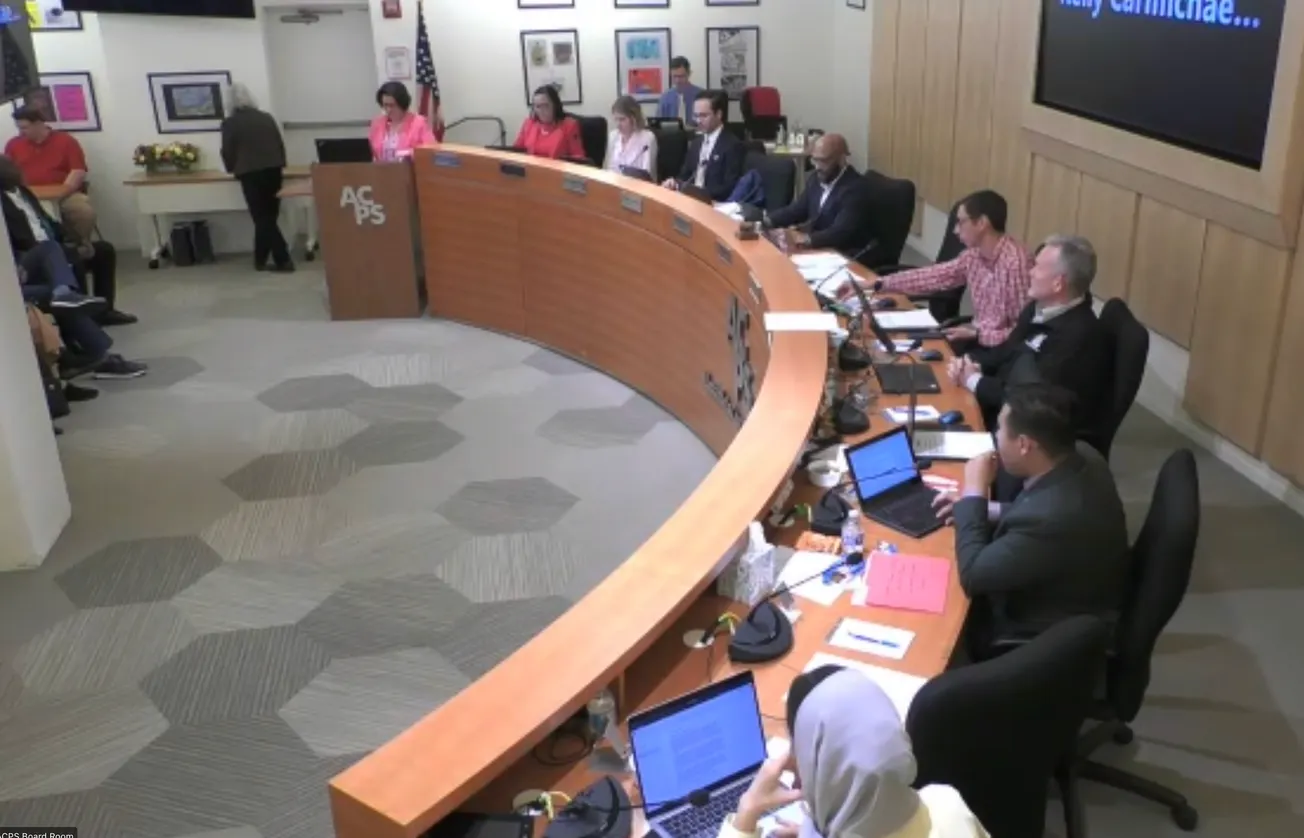
ALEXANDRIA, Va. — Superintendent Melanie Kay-Wyatt on Thursday recommended closing a $5.6 million budget gap by eliminating 45.6 positions and reducing the raises included in the school division's first collectively bargained agreement, calling the package "the hardest part of this presentation for me personally."
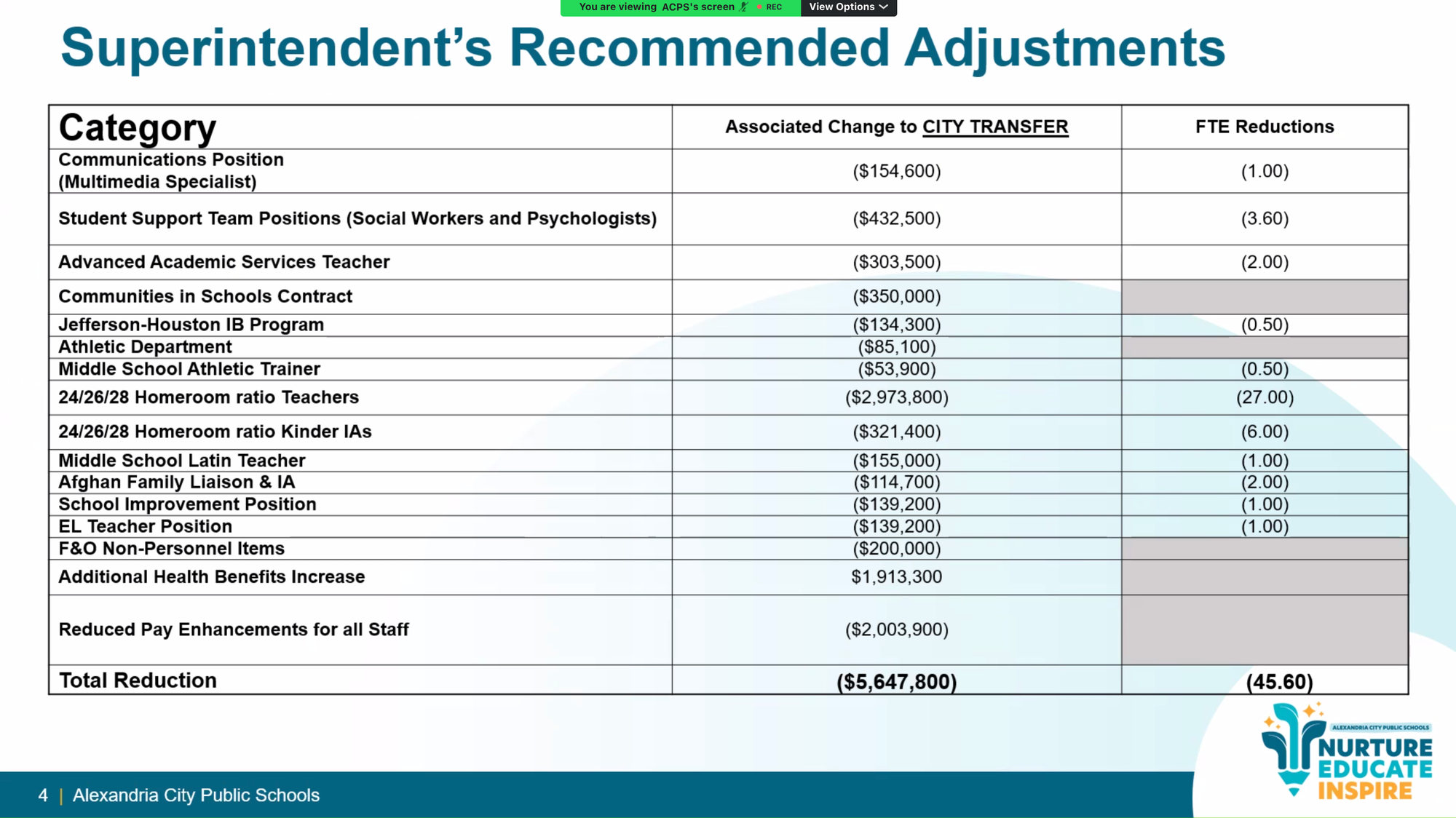
The recommended adjustments to Alexandria City Public Schools' FY 2027 combined funds budget — Kay-Wyatt's response to a city operating transfer that came in $5.6 million below what the school board had requested — would cut 27 homeroom teachers, six kindergarten instructional assistants, and 3.6 student support team positions, including social workers and psychologists. Two Afghan family liaison positions, two advanced academic services teachers, an English Learner teacher, and the city's only middle school Latin teacher are also on the list.
"They represent real people, real programs and real impacts on our students," Kay-Wyatt told the board. "None of these cuts were easy. I want to make sure that that is clear: none of these cuts were easy for us."
Under the adjusted plan, both bargaining units would receive an average raise of 4.2%. For teachers and other licensed personnel, that is down from the 5.35% negotiated in March. For education support professionals — instructional assistants, custodians, food service workers, and bus drivers — it is down from 6.42%, a figure that included a $2,000 longevity bonus paid at every five-year service anniversary as part of the original tentative agreement.
The original $12.7 million package, the first ever between ACPS and the Education Association of Alexandria, was contingent on the city appropriating sufficient funds. Under the agreement's terms, the deal automatically reopened when the City Council adopted a 1.5% increase in the operating transfer rather than the 3.5% the school board had requested, with any renegotiation due by the first school board meeting in May. Thursday was that meeting.
"Our team has continued to collaborate with EAA and have a pay raise that averages 4.2% for all employees," Kay-Wyatt told the board. "That's $8.4 million for licensed staff and $2 million for support personnel."
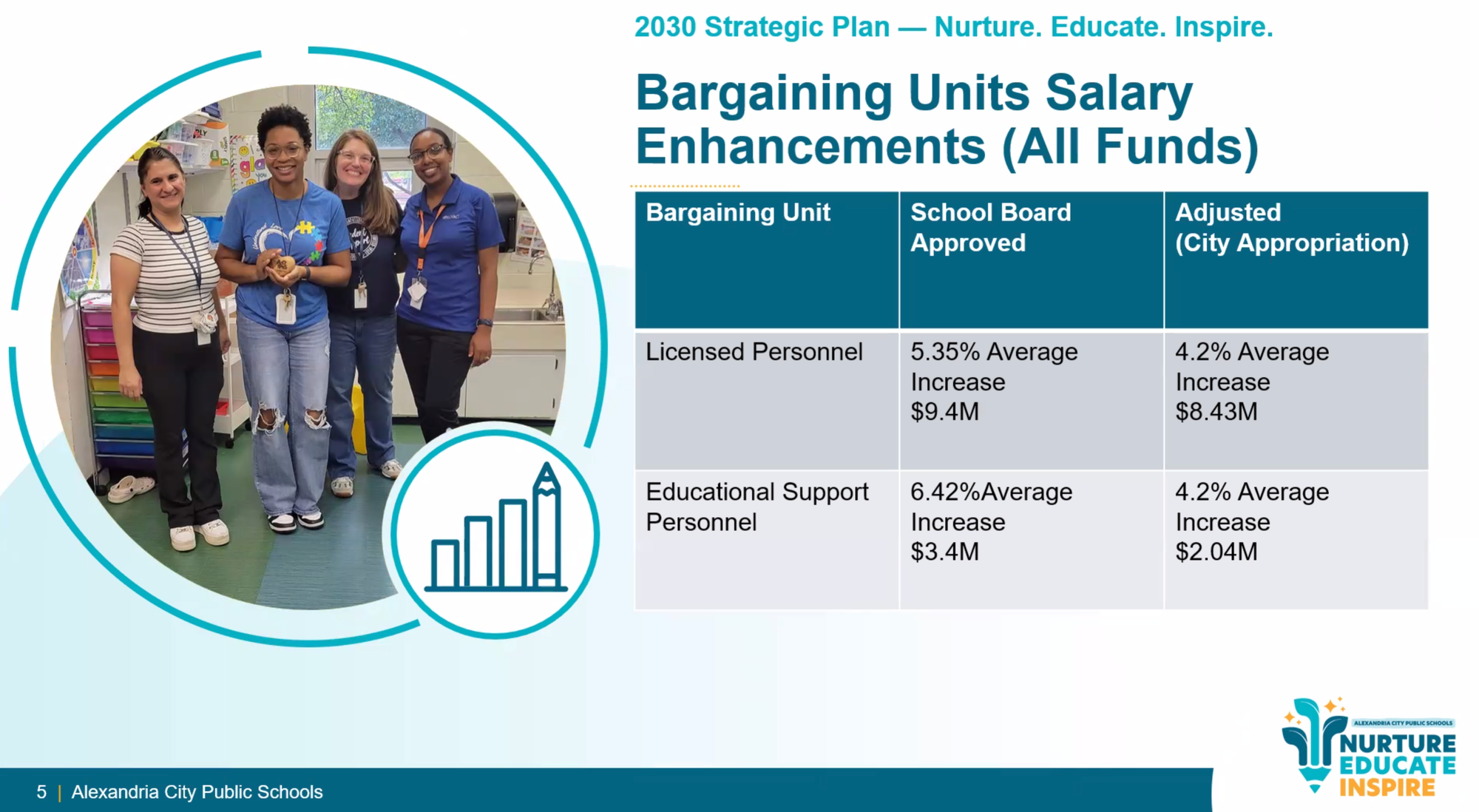
The adjusted plan dedicates more than $10 million to pay increases across both bargaining units, Kay-Wyatt said, and incorporates an additional $507,929 in state Standards of Quality bonus carryover funds that will be paid to staff as an "equivalent pay action."
"This is not a solution to our broader budget challenges, but it is a meaningful addition to our resources," she said of the state funds.
The board took no questions on Thursday, per its standard practice on budget presentations. Members will pose written questions due by noon Monday, with the first work session scheduled for Tuesday at 6:15 p.m. and a public hearing the same evening at 6 p.m. A second work session is set for May 14. Final adoption is scheduled for June 11.
The full operating fund stands at $371 million, with the combined funds budget — which also includes the school nutrition fund and grants and special projects fund — totaling roughly $402.8 million. The city transfer of $286.6 million accounts for 79.1% of the operating fund.
Cuts to programs the board had defended
Several of the reductions land in categories the school board itself spent the spring publicly defending. In a March 9 post on the board's blog, Strategy and Accountability Committee Chair Ryan Reyna argued that ACPS had not been adding administrative layers at the expense of classroom staff. Reyna's analysis showed the largest staffing increases over five years had occurred in student services — counselors, social workers, and student support staff added in response to post-pandemic mental health needs — along with special education and English Learner positions. Reyna described those as direct investments in student outcomes.
Thursday's recommendations cut 3.6 student support team positions, one EL teacher, and 33 classroom-facing roles between the homeroom teachers and kindergarten instructional assistants.
"The reduction in the student support team positions is one I carry with a particular weight," Kay-Wyatt said, "where our students need mental health supports, and we will continue to explore every possible option and resource available to meet those needs."
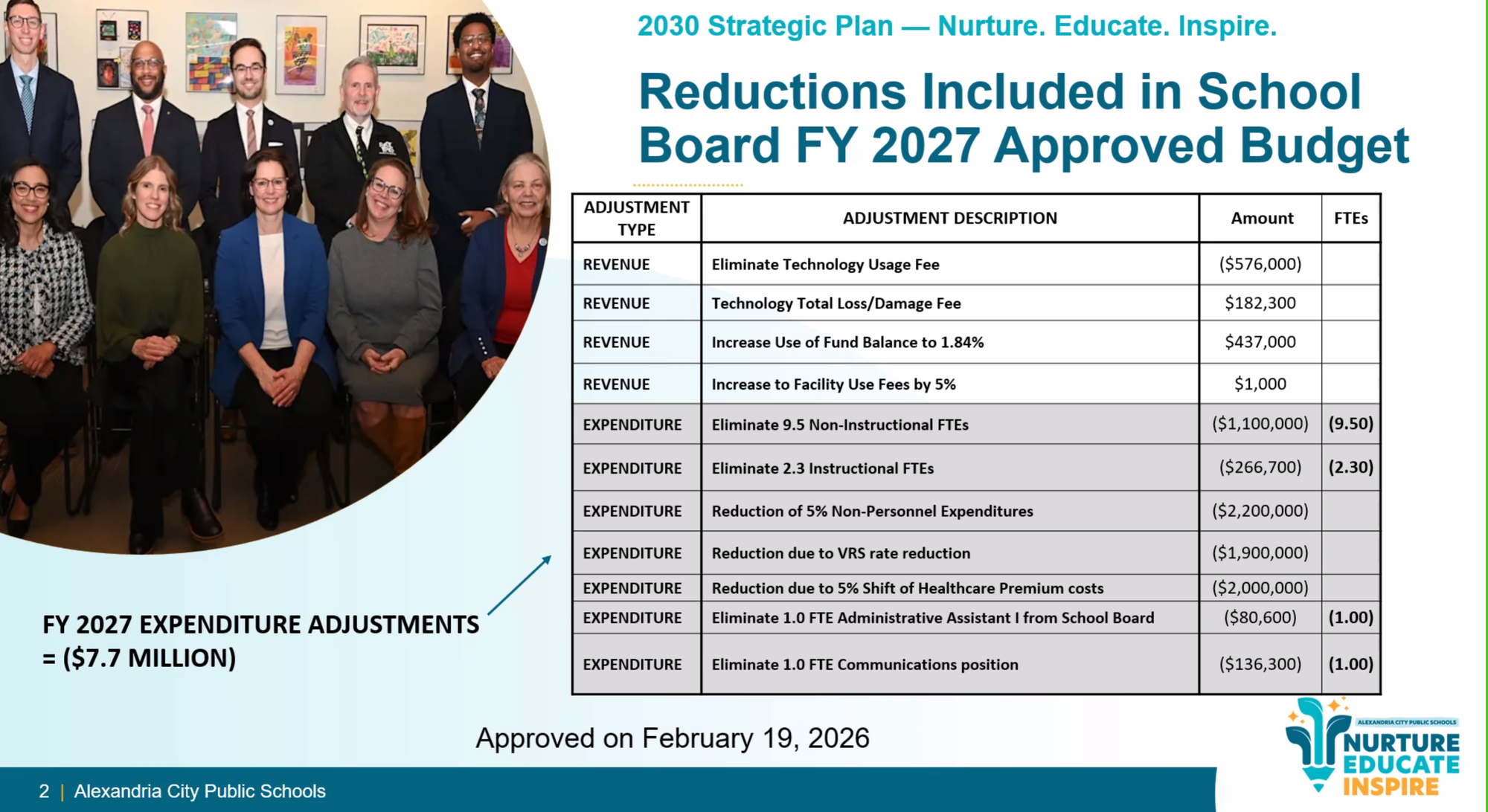
The cuts package includes one position coded to central office: a multimedia specialist in the communications department, at $154,600 in salary and benefits. That follows two earlier rounds of central office reductions absorbed in Kay-Wyatt's original January proposal and the school board's February adoption — together totaling roughly 11.5 non-instructional positions, two superintendent leadership team positions, a school board administrative assistant and a separate Communications position eliminated in the February round — before the city appropriation forced Thursday's additional round.
Middle school sports preserved
One reduction floated at the March 4 joint city-school meeting did not survive into Thursday's recommendation. The middle school athletic program, listed for a $500,000 cut on the March balancing list, was largely spared. The athletic department line on Thursday's slide showed an $85,100 reduction, and a 0.5 FTE middle school athletic trainer was eliminated.
"In addition to the cuts that were shared on March 4, our team did the work to ensure that middle school athletic programs could continue," Kay-Wyatt said. "Let me say that again: our team did the work to ensure that middle school athletic programs could continue."
Sarah Mumbauer, a middle school swim coach, had spoken in support of the program during public comment earlier in the meeting, describing students who learned to swim during the season and finished it racing 50-yard freestyles in front of teammates.
ACPS responds on staffing impacts
In a statement issued Friday after the meeting, Kay-Wyatt addressed the homeroom staffing changes and what they mean for affected employees.
"At the school board meeting on May 7, 2026, the superintendent's adjusted FY 2027 budget included changes to elementary homeroom staffing in response to ongoing budget constraints and declining student enrollment," Kay-Wyatt said. "We are committed to supporting our employees throughout this process and are working closely with the Department of Human Resources to minimize disruption for current staff members. Affected employees may be considered for available placement opportunities across the school division, based on organizational needs, employee qualifications and the goal of supporting continuity for schools and stability for staff."
Healthcare cost shift dominates public comment
Most of the eight in-person speakers and one Zoom speaker who addressed the board on Thursday, which took place before the superintendent's presentation, focused not on the recommended position cuts but on the 5% healthcare premium shift the board approved as part of the February budget adoption. Several teachers said their premiums rose by roughly 50% rather than the 16% rate increase they expected, citing both the rate change and the cost shift hitting at once.
The teachers' frustration carries an additional sting in context. The roughly $2 million ACPS saved in February by shifting more healthcare costs onto employees was earmarked specifically to fund the collective bargaining agreement. That agreement was renegotiated this week to deliver smaller raises than originally promised.
"We'll never see a penny of the raise that's being widely talked about because you decided to have your cake and eat it too at our budgetary expense," said teacher Allison Smith.
Teacher Jose Sanchez told the board the framing of the healthcare decision — shift costs onto employees or reduce teacher positions — "suggested there were no other viable options," and called the change "an average 2% reduction of the entire pay scale" that would compound over the length of careers.
David Paladin-Fernandez told the board he had expected his per-paycheck contribution to rise from about $95 to $110 under the announced 16% rate increase. Instead, he said, his bill came to $143.84 — what he called "more than a 50% increase."
Howard Van der Sluis, a 25-year ACPS veteran, urged the board to revisit the funding picture. "What concerns me and worries me is that we're going to just allow that to be destroyed by lack of compensation, by not taking care of our staff the right way," he said.
Closing
Kay-Wyatt closed her presentation by addressing the staff directly.
"To every teacher, every instructional assistant, bus monitor, mechanic, nurse, dean, every counselor, every support staff member who walks into school buildings every day and who will walk into school buildings this fall and give everything they have for our students, I thank you," she said. "This budget has not been easy, and I know change and constraints are hard to carry. But I have seen what Alexandria educators do when things get hard. You rise."
Board Chair Michelle Rief reminded members that written questions are due Monday and encouraged the community to attend the public hearing on Tuesday. The board will adopt the FY 2027 budget on June 11 — Kay-Wyatt's final budget cycle as superintendent before her scheduled Oct. 1 retirement.
Update, May 8, 5 a.m.: This story has been updated to clarify that the Office of Communications is losing two positions across the FY 2027 budget process — one through the Feb. 19 board adoption and the multimedia specialist position recommended Thursday. The earlier version of this story noted the February round in aggregate but did not separately identify the Communications position. The dollar figures associated with each position represent total compensation, including salary and benefits.
The Alexandria Brief
Alexandria, Va., news and information you won't find anywhere else.
Publisher: Ryan Belmore, an Alexandria resident and journalist.
The Alexandria Brief has no ads, no paywall, and no corporate owner. Support this work with a monthly or annual subscription, or a one-time contribution.
Send feedback, story ideas, news, and tips to ryan@alexandriabrief.com.