Table of Contents
On the same morning that Alexandria's state legislators told a room full of business leaders that Virginia needs $400 million a year to meaningfully address its housing crisis, a group of Alexandria faith congregations pledged to raise $1 million to keep hundreds of families from losing their homes.
Mayor Alyia Gaskins and the Mayor's Interfaith Council announced Thursday the Fresh Start Initiative — a privately funded partnership that will clear approximately $1 million in back rent owed by close to 500 households at the Alexandria Redevelopment and Housing Authority, connect residents to financial empowerment resources, and require ARHA to strengthen its own internal systems. Alfred Street Baptist Church has pledged to lead the fundraising effort, committing to raise the full amount.
"This is about more than clearing balances — it's about creating pathways to stability," Gaskins said. In a follow-up message to The Alexandria Brief, she framed the initiative as a reset for both sides. "This should be both a fresh start for residents and for ARHA. Residents will receive ongoing financial empowerment programming and support. ARHA will focus on new internal systems and management."
No taxpayer money is involved. ACT for Alexandria will manage an independent charitable fund and disburse payments directly to ARHA and participating partners.
A church that has been doing this for 17 years
To understand what Alfred Street Baptist's pledge means, it helps to understand what the church has already done.
In 2009, the congregation purchased 77 affordable housing units across three Old Town West properties — units built as part of a 1970s urban renewal project — and has operated them as affordable housing ever since. The properties are at 901 Wolfe Street (22 units), 598 S. Alfred St. (34 units), and 601 S. Alfred Street (19 units).
Now the church is going further, partnering with The Community Builders to redevelop 598 S. Alfred St. into a 145-unit affordable housing building for residents earning 30 to 60 percent of the Area Median Income — a project City Council approved in December. Subsequent phases covering the church's other two properties are planned to follow.
The church's history with Alexandria's public housing story runs deeper still. The $120 million Samuel Madden Homes redevelopment that broke ground in November — replacing 66 aging ARHA townhomes with a 207-unit permanently affordable community — is named for Rev. Samuel Madden, a former pastor of Alfred Street Baptist Church. ARHA Board of Commissioners Chair Mark Jinks, quoted in Thursday's release, stood at that groundbreaking four months ago.
Thursday's pledge, then, is not a moment of charity. It is the latest act of a congregation that has been investing in Alexandria's housing stock for nearly two decades.
Senior Pastor Rev. Dr. Howard-John Wesley said the initiative reflects putting "love into action," and expressed hope it would become "a new beginning — not just financially, but for the long-term stability and well-being of families throughout our city."
A generation of loss, a year of pressure
Alexandria has lost 41.6 percent of its available affordable housing over the past 25 years, with roughly 10,500 market or committed affordable units remaining and approximately 900 of those set to expire within the next 15 years — a crisis documented in the city's draft Housing 2040 plan. That erosion did not happen overnight, and the crisis the Fresh Start Initiative addresses did not either.
The city's unemployment rate reached 3.8 percent in 2025, up from 2.8 percent a year earlier, as federal workforce reductions rippled through the regional economy. City Manager James Parajon has warned in consecutive monthly reports to Council that official figures may not yet capture the full impact of federal buyouts and administrative leave. Vice Mayor Sarah Bagley flagged earlier this year that a 44 percent jump in active home listings could signal that federal workers are beginning to leave.
ARHA residents pay federally set rent amounts calculated as a share of household income. Their rents are already calibrated to what they can afford. That close to 500 households fell behind anyway is a measure of how much the ground has shifted beneath them.
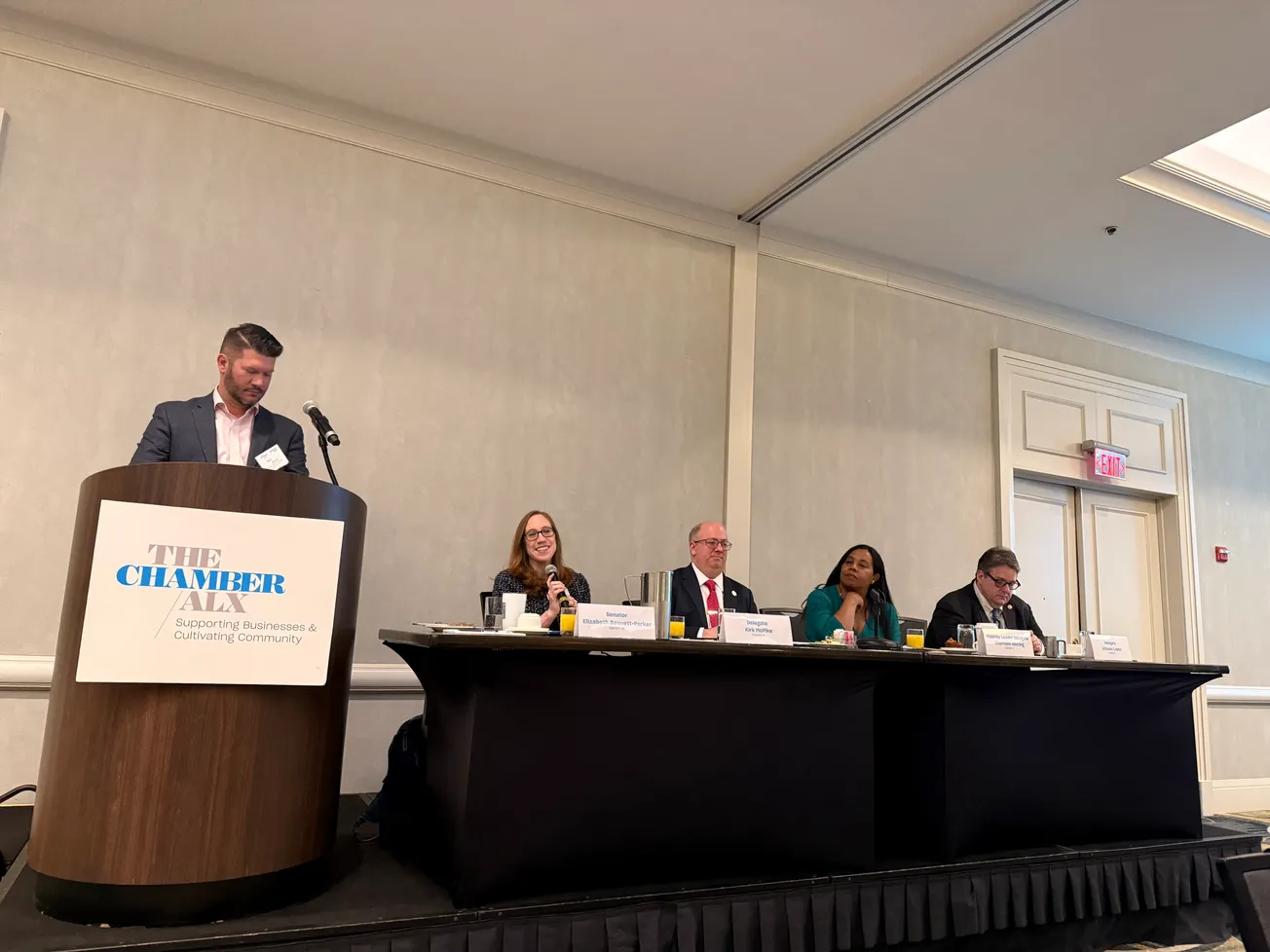
At Thursday morning's Chamber ALX General Assembly Breakfast — held just hours before the Fresh Start announcement — Del. Alfonso Lopez, who created Virginia's Affordable Housing Trust Fund in 2013, told the room plainly: Virginia needs $400 million a year to address its housing crisis. Majority Leader Del. Charniele Herring noted that new tenant protections passed this session — including eliminating the requirement that residents in uninhabitable units post back rent before pursuing a claim — would benefit West End residents directly. Del. Kirk McPike, one month into office and still carrying four years of Council budget debates in his memory, cut to the point: "Right now we have a federal government in D.C. that is not providing a lot of stability."
What the eviction data shows
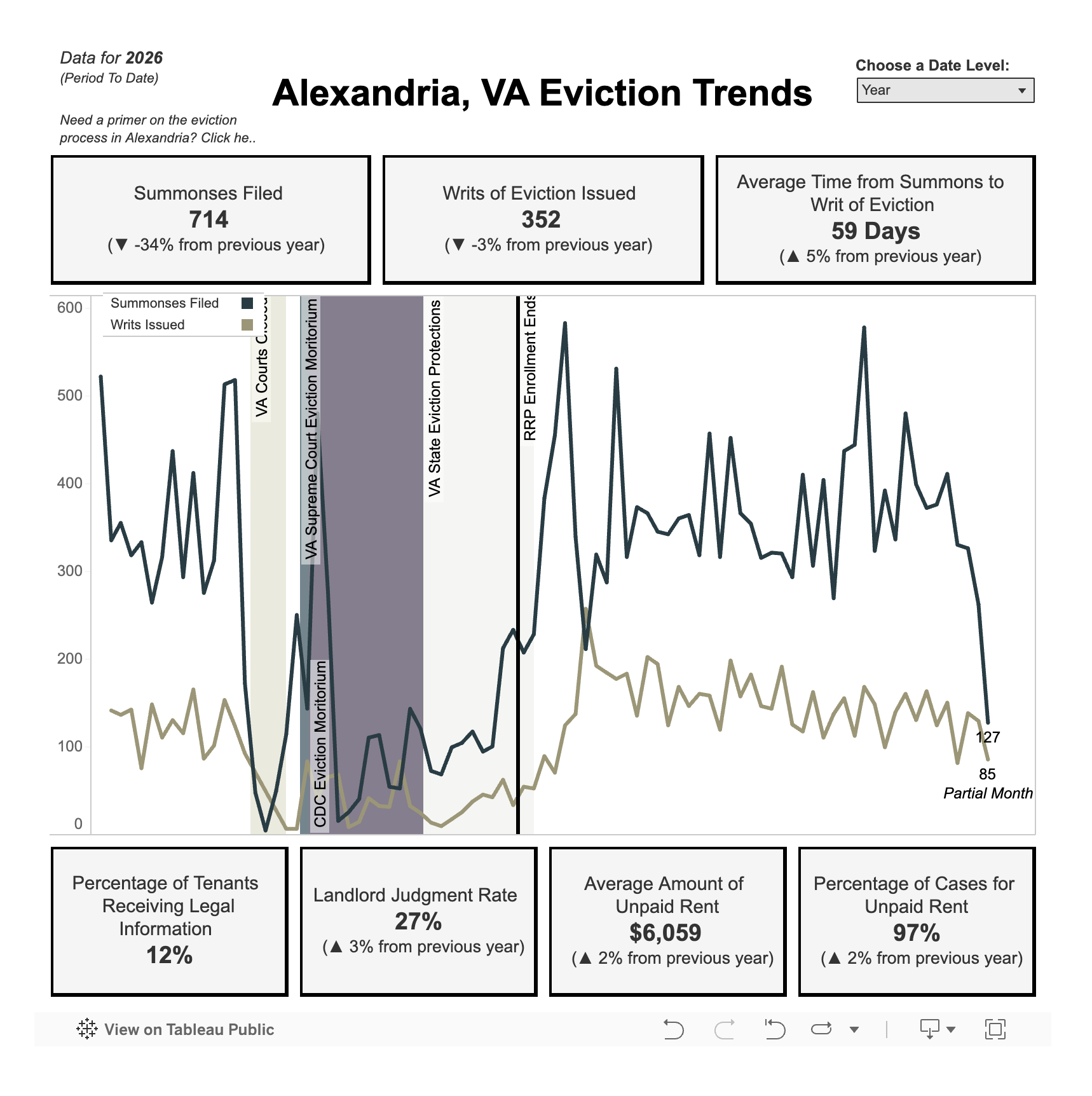
Alexandria's own public eviction tracking dashboard adds numbers to what the broader picture suggests. So far in 2026, 714 eviction summonses have been filed in the city — down 34 percent from the prior year — and 352 writs of eviction have been issued, down 3 percent. The average amount of unpaid rent in those cases is $6,059, up 2 percent year over year. Ninety-seven percent of all eviction cases in Alexandria involve unpaid rent. Only 12 percent of tenants in those cases are receiving any legal information.
That $6,059 average — roughly double the average payment Alexandria's rental assistance program makes per household — shows how quickly arrears can outpace the tools designed to address them.
One day after the budget debate
The Fresh Start announcement landed the morning after City Council wrapped a 2 hour and 23 minute budget work session that was, in part, a sustained confrontation with the limits of what the city can currently offer families in housing distress.
Alexandria's rental assistance program operates on approximately $775,000 in combined city and federal funding. It served roughly 245 households last year at an average payment of about $3,100 — approximately 31 households per additional $100,000. Housing advocates sought a $5 million increase. It is not in the proposed FY 2027 budget.
The close to 500 ARHA households in Thursday's announcement represent nearly twice the number of households that the program served all of last year. The $1 million in arrears equals the program's entire annual budget.
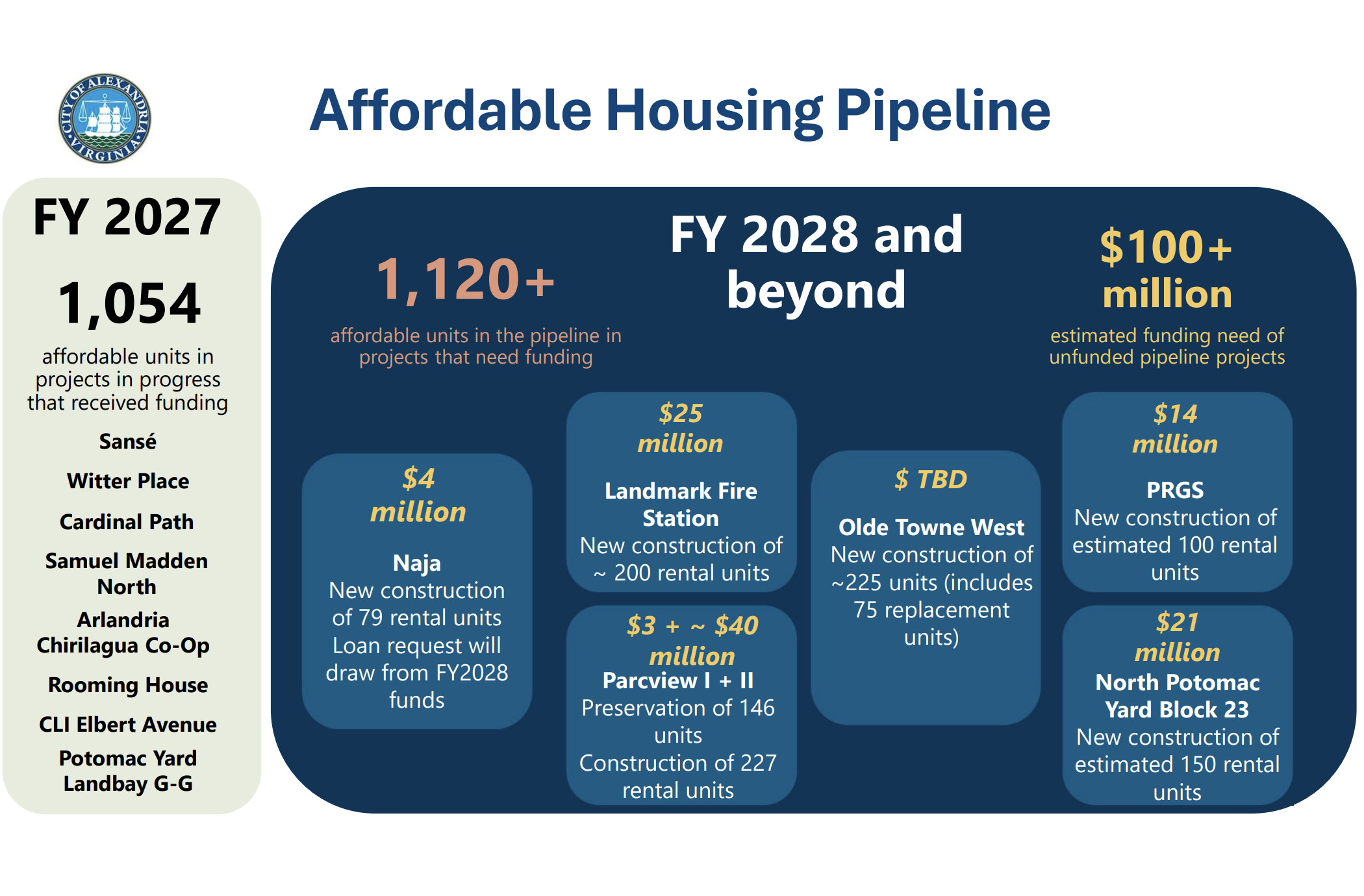
Also at Wednesday's session, Office of Housing staff presented a pipeline of more than 1,120 affordable units waiting for city funding — a gap exceeding $100 million over the next decade — with all funds coming in this year already committed to projects under construction.
DCHS Director Kate Garvey flagged that ongoing changes to federal SNAP and Medicaid programs could further strain residents' ability to qualify for assistance. Vice Mayor Bagley and Council Member Abdel-Rahman Elnoubi pressed staff on whether rental assistance could be restructured to reach families before an eviction notice arrives, not only after. No new money is currently on the table.
The Fresh Start Initiative operates entirely outside that budget process. But it is, in some sense, a precise accounting of the distance between what the city can provide and what the moment requires.
How it works — and what it requires
ACT for Alexandria will manage an independent charitable fund and disburse payments to ARHA and financial empowerment partners. DCHS and community partners will provide financial literacy and economic mobility support to participating families throughout the following year.
Eligibility is limited to ARHA residents identified as carrying outstanding balances as of March 10. Residents must attend an information session and complete the required documentation. Those who receive assistance must remain current on rent beginning April 1, 2026; normal lease enforcement applies if they fall behind again.
The formal agreements underpinning the initiative will require ARHA to verify arrearages, improve ledger management and communication, and increase operational transparency. That accountability component is not incidental — both the release and Jinks' statement acknowledge that allowing $1 million in arrears to accumulate reflects institutional challenges alongside economic ones.
"ARHA staff have taken responsibility to strengthen ARHA's internal systems, improve communication, and expand supports so residents have both clarity and the tools they need to remain stably housed without the fear of eviction," Jinks said. "This partnership allows us to build a responsible and sustainable model that supports both residents and the long-term health of public housing in Alexandria."
A community showing up
Several congregations have committed to providing financial empowerment and wealth-building programming beyond the debt clearance. Dr. Taft Quincey Heatley, Senior Pastor of Shiloh Baptist Church of Alexandria — whose affiliate nonprofit, the Harambee Community and Economic Development Corporation, already provides affordable senior housing through Beasley Square — also committed. So did Pastor Nathan Irving, Executive Pastor of Groveton Baptist Church, and Rabbi Steven I. Rein of Agudas Achim Congregation. Additional institutions are expected to join through the end of March.
Heather Peeler, President and CEO of ACT for Alexandria, said the moment reflects what this community is capable of. "A truly thriving community is one where every resident has the financial security to reach their full potential," she said.
What comes next
Close to 500 families will stay housed because of what was announced on Thursday. That is not a small thing. It is the most immediate and concrete outcome of an initiative that, whatever its limitations, responds to a real and urgent need with real and privately raised money.
The Fresh Start Initiative is time-limited, and by the city's own FAQ, explicitly one-time. The formal agreements will require ARHA to verify arrearages, improve its internal systems, and increase transparency — commitments that, if kept, make the next crisis less likely.
The harder structural work continues on a parallel track. Council has until April 9 to finalize add-delete priorities ahead of the April 29 budget vote. The rental assistance program, the affordable housing pipeline, and the question of how Alexandria sustains the services that keep families stable — all of it is still open, still being debated, still possible to address.
What Thursday showed is that this community is capable of acting with speed and generosity when the need is clear. Alfred Street Baptist Church has been proving that for 17 years. The Mayor's Interfaith Council organized the broader faith community around it. ACT for Alexandria stepped in to manage it responsibly.
The question budget season is now asking is whether the city's institutions can match that same sense of urgency — not just once, but in the sustained, structural ways that make initiatives like this one less necessary over time.