Table of Contents
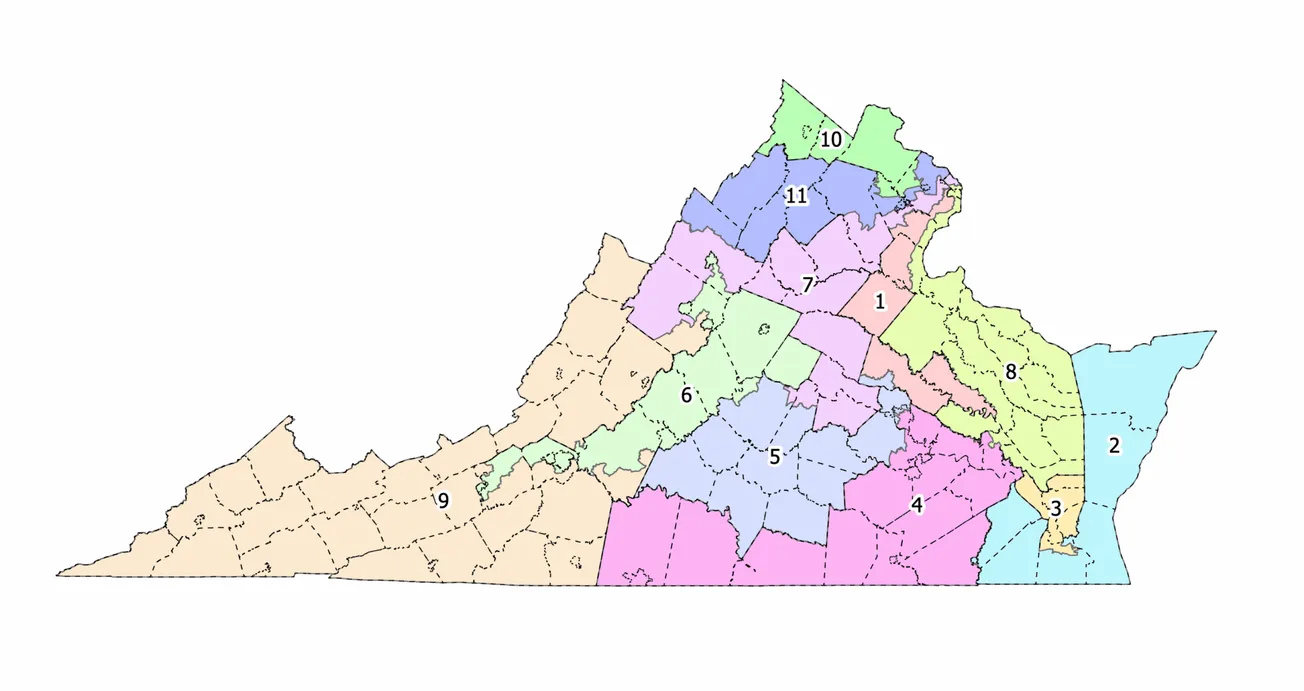
Under Virginia's proposed redistricting plan, Alexandria would remain in the 8th Congressional District. What it would no longer have is the 8th Congressional District it knows.
No district in the proposed Democratic map would be more dramatically reshaped than the one Alexandria calls home.
If approved, the change would be temporary. The amendment includes a sunset clause returning redistricting authority to the bipartisan commission after the 2030 census.
The most Democratic district in Virginia
Virginia's 8th is not simply a safe Democratic seat. It is the most Democratic congressional district in the entire state, with a Cook Partisan Voting Index of D+26. In 2020, Joe Biden carried it by more than 55 points. In last year's gubernatorial race, Abigail Spanberger won the district 80 percent to 20 percent. Across every statewide election since 2008, Democratic candidates have consistently carried VA-8 by margins ranging from the high 60s to the high 70s.
The district's partisan dominance is rooted in its demographics and economy. Nearly a quarter of its working population is employed by the federal government, and the district is home to the Pentagon and the CIA — anchors of a sprawling aerospace and defense ecosystem that includes major employers such as Northrop Grumman. It has one of the highest concentrations of college-educated residents in the country. And it is majority nonwhite, with a Hispanic population of 20.5 percent, a Black population of 12.3 percent, and an Asian population of 12.2 percent. The median household income is $133,323.
Now picture it stretched to Yorktown
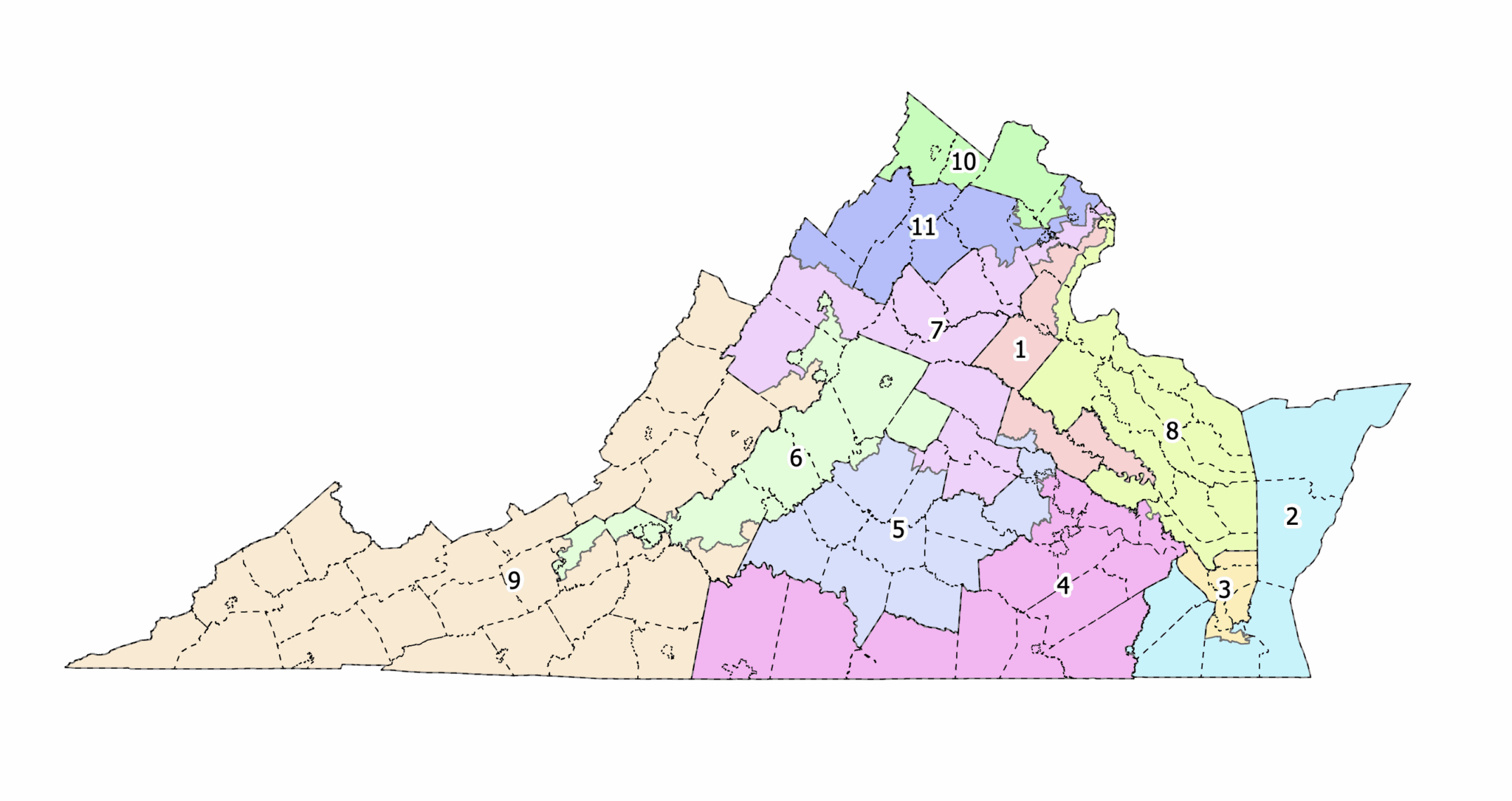
The proposed Democratic map doesn't eliminate that district. It uses it as an anchor and extends it more than 100 miles south.
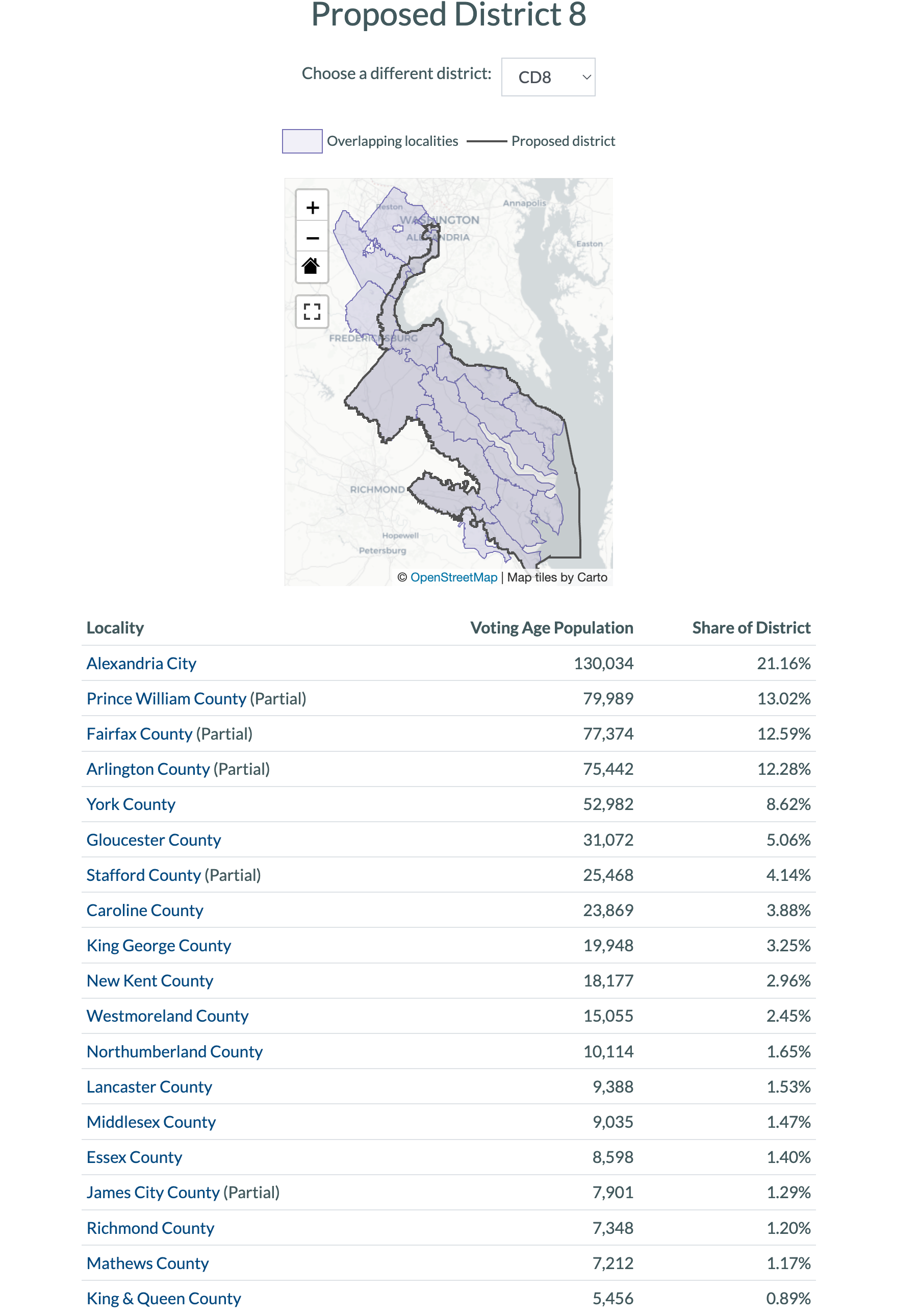
According to the nonpartisan Virginia Public Access Project, Alexandria City would have the largest share of the new 8th's voting-age population — 130,034 residents, or 21.16 percent of the district. But the proposed 8th would also draw in Prince William County (partial, 13.02 percent), a partial slice of Fairfax County (12.59 percent), and only a partial share of Arlington (12.28 percent). Then it continues south and east: York County at 8.62 percent, Gloucester County at 5.06 percent, Stafford County (partial) at 4.14 percent, Caroline County at 3.88 percent, King George County at 3.25 percent, New Kent County at 2.96 percent, and a string of Northern Neck and Middle Peninsula localities — Westmoreland, Northumberland, Lancaster, Middlesex, Essex, James City (partial), Richmond County, Mathews and King & Queen — each contributing between 0.89 percent and 2.45 percent.
The VPAP map makes the geography vivid: a narrow corridor snaking from the Washington suburbs down through Fredericksburg's orbit and into the Peninsula, terminating near Williamsburg. It is, by design, a long lever — deep-blue weight at one end, competitive territory at the other.
A 31-point swing: the largest in the state
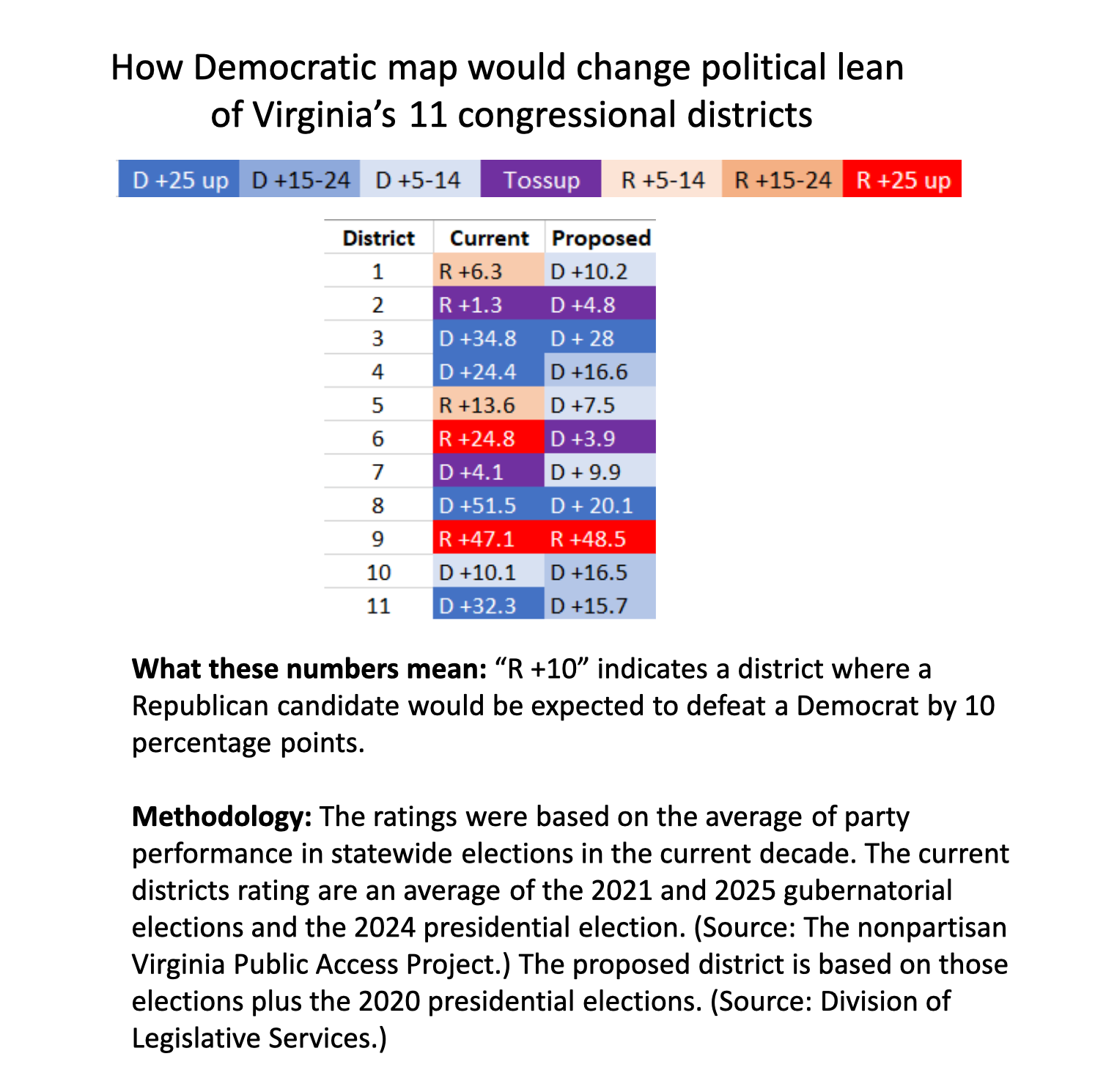
The Virginia Mercury's voter's guide to the redistricting push, which includes a partisan-lean chart compiled using data from VPAP and the Division of Legislative Services, captures the consequences in a single number.
Under the current map, VA-8 carries a partisan lean of D+51.5 — reflecting those supermajority margins in elections from 2020 through 2025. Under the proposed map, that lean drops to D+20.1.
That is a 31-point shift. No other district on the proposed map comes anywhere close.
VPAP's past election results for the proposed district put flesh on that number. In the proposed new 8th, Spanberger's 2025 margin drops from 80 percent in the current district to 63 percent. Kamala Harris's 2024 presidential margin falls to 57.6 percent, down from 58.1 percent, while Donald Trump's margin remains 40.1 percent. Congressional Democrats carried the proposed district in the mid-50s in both 2022 and 2024.
Those are healthy Democratic margins — enough to make the seat reliably blue. But they represent a fundamental change in the nature of the district, and in the kind of representative it would produce. A candidate running in the proposed 8th would need to be competitive in York County and Gloucester County, not just Arlington and Old Town.
Arlington split, Falls Church cut loose
The reshaping doesn't only pull the district south. It also breaks apart the current district's Northern Virginia coherence.
Today, VA-8 is compact: it includes Fairfax County (partial), Arlington County, Alexandria City and Falls Church City, which together account for the entirety of the district's registered voters. Under the proposed map, Arlington is split between two districts, and Falls Church — which has long been part of VA-8 — drops out of the 8th entirely.
For Alexandria specifically, the result is that the city remains the single largest locality in its congressional district by voting-age population — but it is now tethered to a geography that has almost nothing in common with it. A representative of the proposed 8th would be accountable to waterfront communities in Mathews County, commuter suburbs in Prince William, and rural farming counties in the Northern Neck, all at the same time. Alexandria would be the anchor, but it would not be the center.
Beyer commits — and faces a crowded field
Rep. Don Beyer, D-Va., confirmed he will seek reelection in Virginia's 8th Congressional District even as a proposed redistricting map could dramatically reshape the seat he has held since 2015.
The Virginia political establishment has moved quickly to fortify him. Sens. Mark Warner and Tim Kaine both endorsed the seven-term incumbent in the Democratic primary. Warner cited their joint work responding to last year's fatal midair collision at Reagan National Airport and protecting the federal workforce. Kaine pointed to shared efforts on war powers and tariffs. Gov. Spanberger endorsed Beyer earlier the same week.
The endorsements have not cleared the field. Beyer, 75, faces five Democratic challengers: former Alexandria City Council member Mohamed "Mo" Seifeldein, Arlington energy manager Daniel Gray, Adam Dunigan, Michael Duffin and Frank Ferreira. Seifeldein, who served a single term on council from 2019 to 2021 as the first Muslim and Sudanese American elected to the position, has been the most visible challenger. Three Republicans — Heerak Christian Kim, Luke Nathan Phillips and Tony Sabio — are also running.
Virginia's 8th District is home to one of the largest concentrations of federal workers in the country — a constituency that has taken on added political weight amid the Trump administration's efforts to reduce the size of the federal workforce.
The primary was pushed from June 16 to Aug. 4 to accommodate the ongoing redistricting fight.
All six Democratic members of Virginia's congressional delegation — including Beyer — published an op-ed arguing that Trump's pressure on Republican-controlled states to redraw congressional maps amounts to an attempt to lock in a House majority before a single 2026 ballot is cast. They are urging a yes vote.
What's actually at stake for Alexandria
The proposed map's defenders would argue that D+20.1 is still a safe seat and that flipping a historically Republican district is worth the trade-off. That is a reasonable argument on national terms.
But for Alexandria, the calculation is different. Today, the city holds a commanding share of one of the safest Democratic seats in the country, represented by someone who has built his political identity around this community. Under the proposed map, Alexandria anchors a district that stretches through 19 localities it has little in common with. Whether that is a good deal depends on what you believe a congressional district is for: concentrating a community's voice, or extending partisan reach at the cost of that concentration.
The legal cloud — and the ballot language
Early voting begins Friday despite a thicket of ongoing legal challenges — and registrars across Virginia say they are pressing ahead regardless.
So far, Republican-led challenges in Tazewell County, Lynchburg, Richmond and Washington County have not resulted in a delay. A Lynchburg judge delayed a ruling until after the April 21 ballot, and VPM News reported that the Supreme Court of Virginia said a separate case would not prevent voting from going forward. Multiple registrars told VPM News the Virginia Department of Elections directed them to continue preparations, noting a Tazewell County injunction applies only to named defendants in that county.
If the referendum does proceed to a vote, Alexandria voters will see the following question on their ballot:
"Should the Constitution of Virginia be amended to allow the General Assembly to temporarily adopt new congressional districts to restore fairness in the upcoming elections, while ensuring Virginia's standard redistricting process resumes for all future redistricting after the 2030 census?"
The ballot language itself has become a flashpoint. According to the Virginia Mercury, Republicans sought to amend the wording on the House floor, arguing the phrase "restore fairness" is designed to lead voters to a predetermined conclusion. Democrats cut off debate and approved the language on a party-line vote. Former Republican Del. Mark Cole, who chaired the House elections committee for a decade, told the Mercury he had never seen a ballot question so loaded. Democrats counter that the maps were released in advance and that voters are capable of judging the question for themselves.
On the money side, the pro-amendment effort has grown substantially. VPM News reported that Virginians for Fair Elections has received nearly $20 million in contributions from Democrat-aligned groups. The opposition group, Virginians for Fair Maps — which includes former Virginia Attorney General Jason Miyares — had not filed public campaign finance disclosures as of this writing.
A Roanoke College poll found 52 percent of surveyed Virginians would vote no and 44 percent would vote yes, even as 61 percent disapprove of Trump.
If voters say no, the current map stays and Alexandria's supermajority seat remains intact. If they say yes and the Supreme Court concurs, the most Democratic district in Virginia becomes something considerably more complicated — still blue, still safe, but stretched across a swath of the Commonwealth that has little in common with the city that anchors it.
If you're voting on April 21
Alexandria voters will decide two things on April 21: the statewide redistricting referendum and the special election for the City Council seat vacated by Del. Kirk McPike.
City Council special election candidates
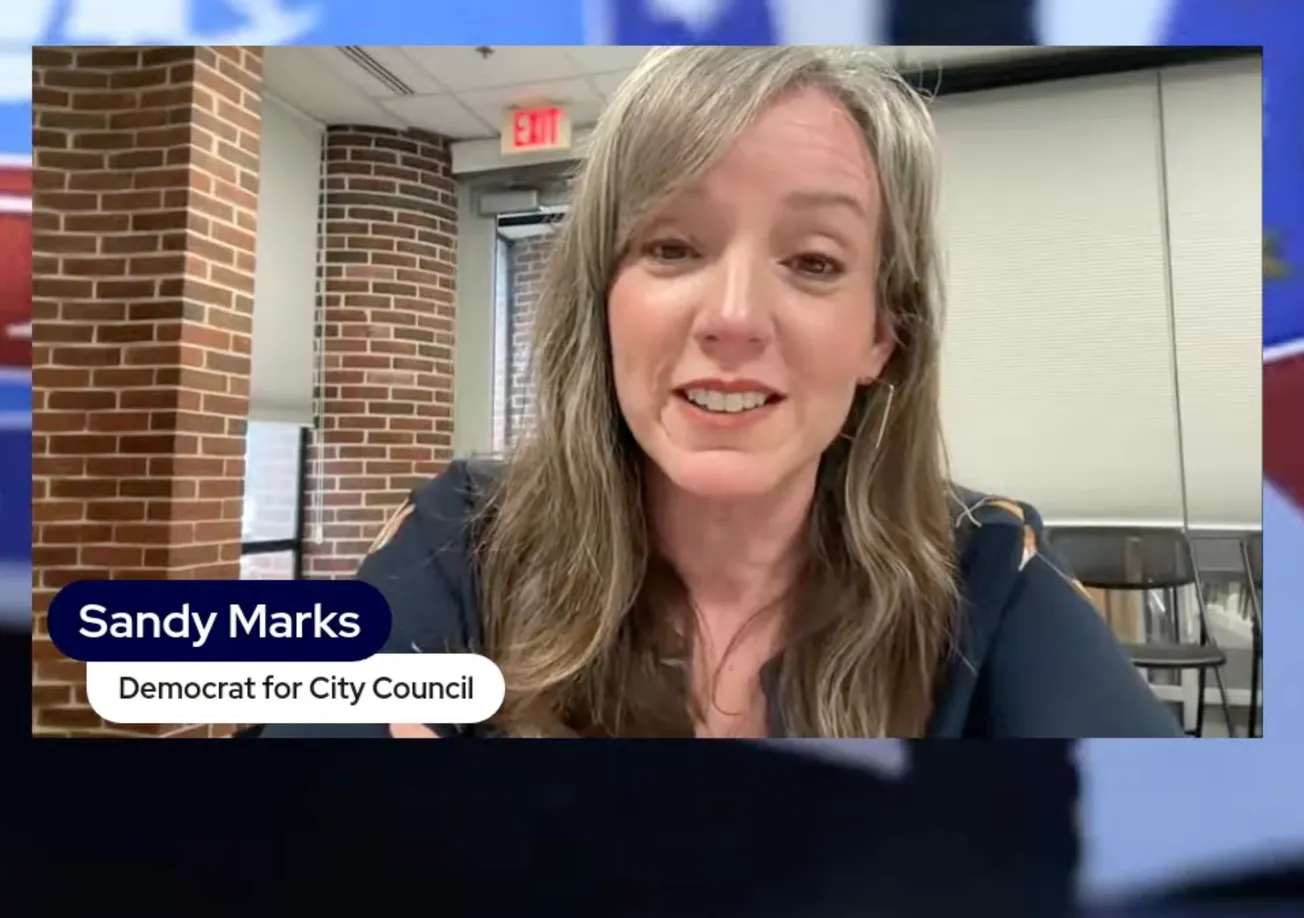
The Democratic nominee is Sandy Marks, who won the Feb. 21 firehouse primary with 39.6 percent of the vote in a five-way field. Marks received 1,573 votes, followed by Tim Laderach with 947 (23.8 percent), Roberto Gomez with 876 (22 percent), Charles Sumpter with 467 (11.7 percent) and Cesar Madison Tapia with 112 (2.8 percent). A total of 3,975 voters cast ballots — nearly 30 percent of them online, the first time Alexandria Democrats offered that option.
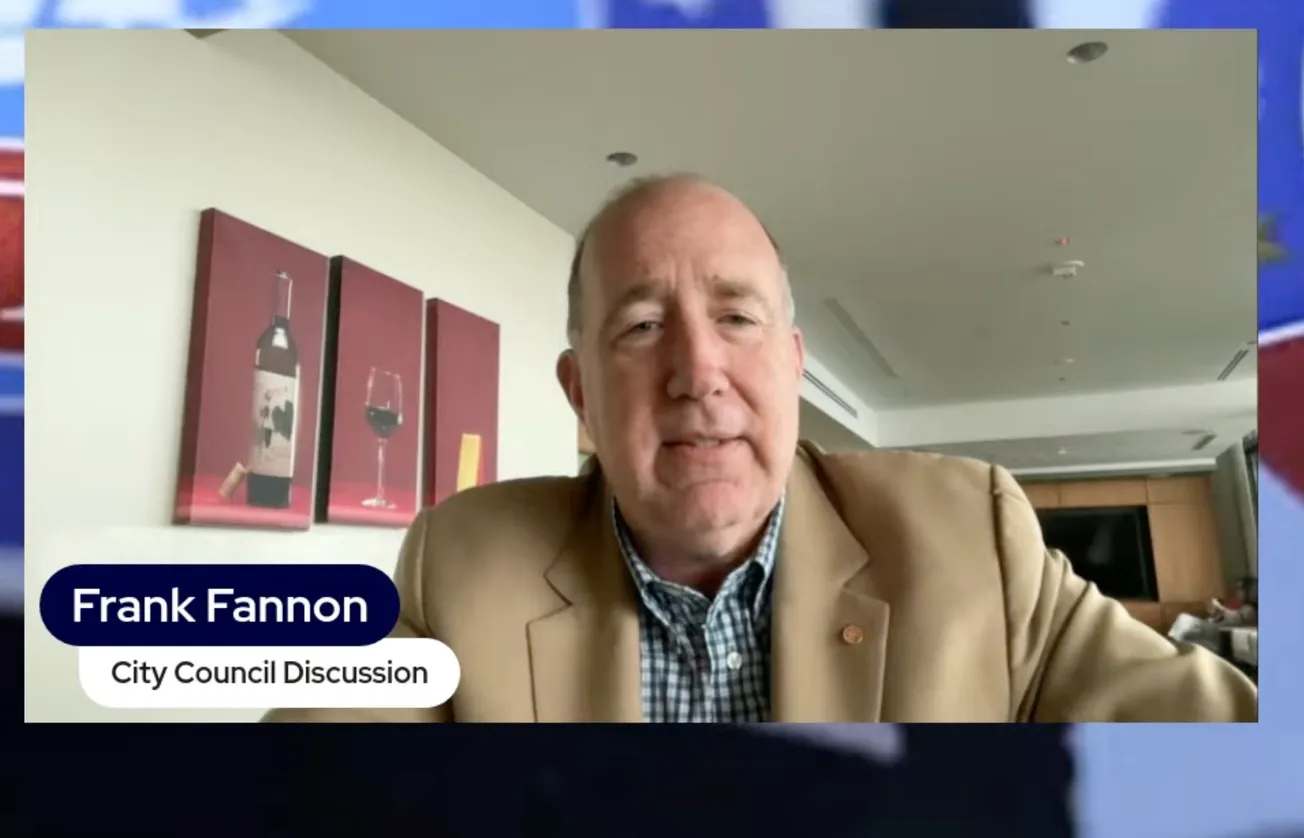
Marks will face two independents on the April 21 ballot: Frank Fannon, a former Republican council member who served from 2009 to 2012, and Alison Virginia O'Connell. The Republican Party of Alexandria confirmed it will not have a candidate on the ballot.
Key deadlines (Virginia Department of Elections)
- Register or update registration: by 5 p.m., April 10. Register online at the Citizen Portal. Voters who miss the deadline may register and vote by provisional ballot in person through Election Day.
- Apply for a mail ballot: by 5 p.m., April 10, via the Citizen Portal.
- Early in-person voting: start date TBD through 5 p.m., April 18. Voter registration offices open for early voting Saturday, April 11. Contact the Alexandria Office of Voter Registration and Elections for hours and satellite locations.
- Early voting for the redistricting referendum: begins Friday, March 6.
Use VPAP's redistricting lookup tool to see how your specific address would change under the proposed map.