Editor's note: This story has been updated since publication. See notes at bottom of story.
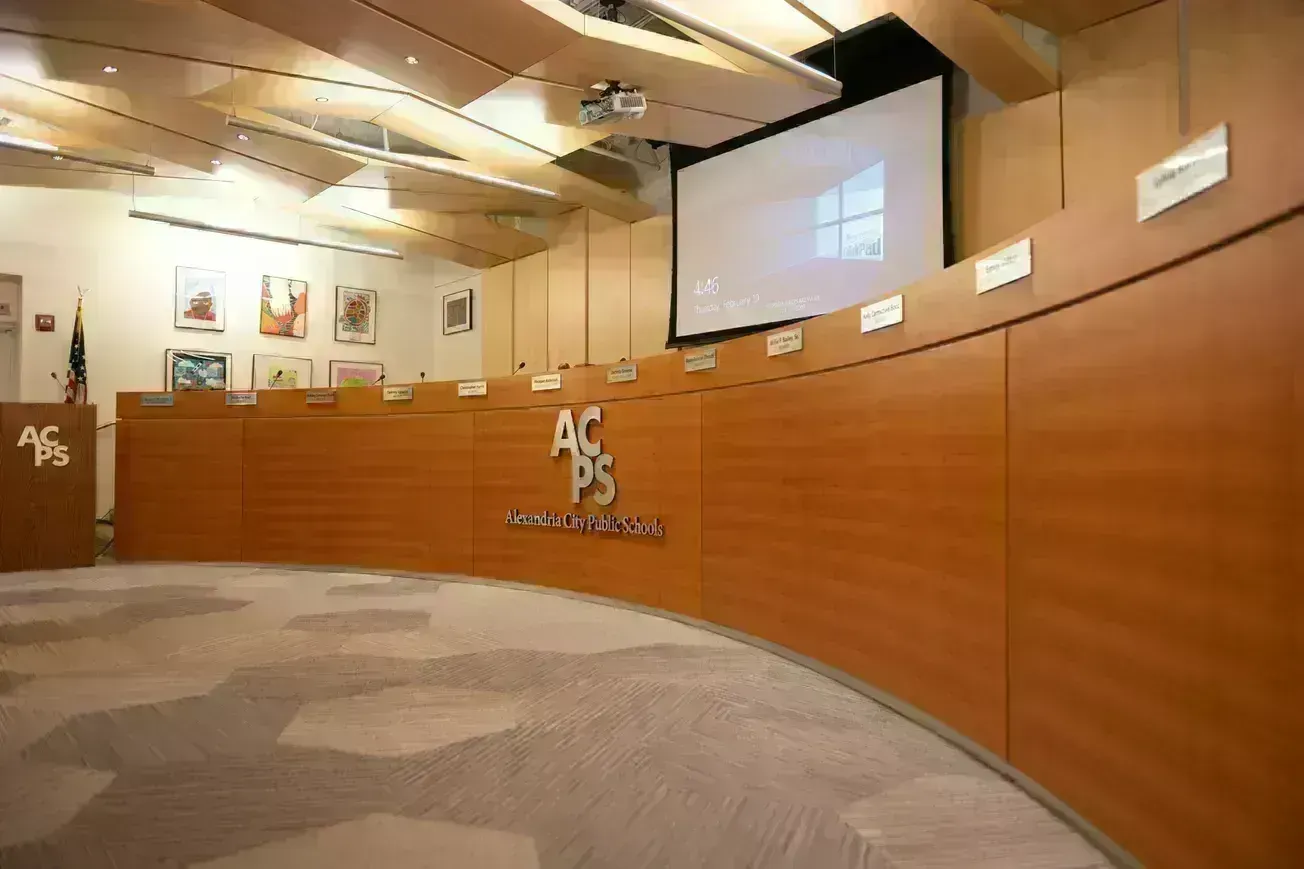
ALEXANDRIA, Va. - A late legal warning about collective bargaining reshaped the Alexandria City School Board's final add/delete work session Tuesday night, steering members away from the compensation restorations many had proposed and toward a narrower set of changes — two Afghan Family Liaison positions, one advanced academic teacher, and a partial down payment on Communities In Schools — before the board adopts the FY 2027 budget Thursday.
The board went into the June 9 session with 45 add/delete proposals, 38 of which had cleared the four-co-sponsor threshold needed for priority discussion under the budget process rules. By the time Chair Michelle Rief gaveled out at 8:51 p.m., the net change to the bottom line was zero. At this stage of the process, it has to be: because the board is legally required to adopt a balanced budget, every proposed addition must be paired with an offsetting cut, so the night's work amounted to shifting money between categories rather than adding to the total.
The bargaining warning that changed the night
Early in the meeting, CFO Dominic Turner delivered an update that "drove the process differently," as Superintendent Melanie Kay-Wyatt put it. ACPS's outside counsel had advised that because the board adopted a collective bargaining resolution, the division must negotiate any compensation change with its employee unions — even though no contract has been signed. The board could not, in other words, use add/delete to unilaterally raise pay.
Turner and Kay-Wyatt warned that forcing compensation changes 48 hours before adoption would blow past the timeline to reach an agreement, leaving ACPS with no collective bargaining deal at all for FY 2027. "It has to be at the start of negotiations," Turner told the board, explaining that the time for setting bargaining priorities had already passed.
Several members pushed back on the interpretation. Ashley Simpson Baird, who helped draft the resolution, noted that its reopener language refers to a contract already in place — "We don't have a CBA in place," she said. Reyna pressed the same point: the board hasn't signed anything until it votes. But Tim Beaty, drawing on four decades of contract negotiating, largely backed staff, explaining that once workers choose union representation, an employer is barred from making unilateral changes to wages even before a first contract is reached.
The practical upshot: the pay-related proposals were withdrawn — among them a move to delete the added top step ($700,000) that had been built into the superintendent's tentative agreement, along with proposals to raise the COLA and restore longevity bonuses and steps. The board agreed instead to route those priorities to bargaining and signaled that any state money should go toward compensation, likely as a one-time bonus.
What the board added
Members reached consensus, by show of thumbs, on a short list that will be formalized Thursday:
Both Afghan Family Liaison positions — one at Francis C. Hammond Middle School, one at the high school — were restored unanimously through the superintendent's own adjustment, paid for by cutting $113,000 from the School Board's management services account and $37,600 from division-wide travel. Donna Kenley said the positions, which serve roughly 100 Afghan students who entered ACPS this year, link families to social services after their federal grant funding lapsed.
One itinerant Advanced Academic Services teacher was added back, 8-1, at $147,200, though staff cautioned that all current AAS positions are filled and the division would have to reallocate teachers across schools as redistricting numbers settle.
The board put $83,800 toward the Communities In Schools contract, 9-0 — a partial sum against the full $350,000. The city has signaled interest in helping with about $327,000 from projected parking and traffic fees but can't commit until it sees actual revenue in September. Dr. Pierrette Finney told the board that CIS could scale services to whatever funding ultimately materializes rather than ending the program outright, and warned that paying for CIS out of operating dollars would disqualify schools from using Title I funds for it.
Members also unanimously approved a benchmarking study of central office staffing by an outside national consultant, funded from existing school board money. Reyna framed it as a tool for the incoming superintendent to understand how ACPS positions compare with similar divisions — and a way to avoid "this type of scenario in future years."
What the board rejected
A proposal to delete the vacant Executive Director of Support Operations position failed 8-1 after Kay-Wyatt said the role is essential to transportation and safety operations and that remaining staff are burned out covering it; interviews are underway. By contrast, the board voted — over audible confusion about the tally, which members and the chair restated several times before settling on roughly 5-3 with one abstention — to delete a vacant Technology Services position, freeing about $104,000 that was folded into the roughly $231,000 the board ultimately had available for its additions. Staff had noted the three vacant tech positions were already filled for next year. The board declined, 5-4, to go line-by-line through remaining central office vacancies to find further cuts — the benchmarking study became the substitute.
A recurring snag was the gap between board members' estimated dollar figures and staff's actuals. The two Afghan liaison positions, listed at $114,700 in the board's documents, actually cost $150,600, Turner said; a single liaison penciled in at $57,500 was closer to $75,000. The discrepancies repeatedly tangled the discussion, with Kenley at one point saying she was "getting" confused by the shifting math.
Thursday's adoption vote
The board meets Thursday, June 11, at 6 p.m. at 1340 Braddock Place to take final action on three companion items: the FY 2027 Final Combined Funds Budget, the FY 2027–2036 Capital Improvement Program, and ACPS 2030 Year 2 strategy adjustments. Turner will provide a memo summarizing Tuesday's agreed-upon changes ahead of the vote. Budget documents were not posted at the time the agenda was published.
It will be Kay-Wyatt's final budget cycle as superintendent before her scheduled Oct. 1 retirement. And it won't be the last word on FY 2027: with the state budget still unadopted — the House reconvenes June 18, the Senate June 22 — ACPS could see anywhere from zero to about $3.1 million in additional funding. The board can revisit compensation, the CIS gap and restored positions at its July 9 organizational meeting or a special session.
"We really need more money," board member Alexander Crider Scioscia said, reflecting on a year of cuts. "It's frankly just not the budget I ever wanted to have to preside over. But that's part of the job, to make the hard choices."
Editor's note: This story has been updated since publication. At 6:12 a.m. on Wednesday, June 10, it was corrected to fix the spelling of Dr. Pierrette Finney's name. It was updated again 12:30 p.m. to clarify the outcome of the board's vote on deleting a vacant Technology Services position, which carried; to clarify the description of the top-step proposal, which would have deleted the added step from the superintendent's tentative agreement; and to clarify that the board is legally required to adopt a balanced budget, meaning each addition at this stage must be offset by a corresponding cut.