Table of Contents
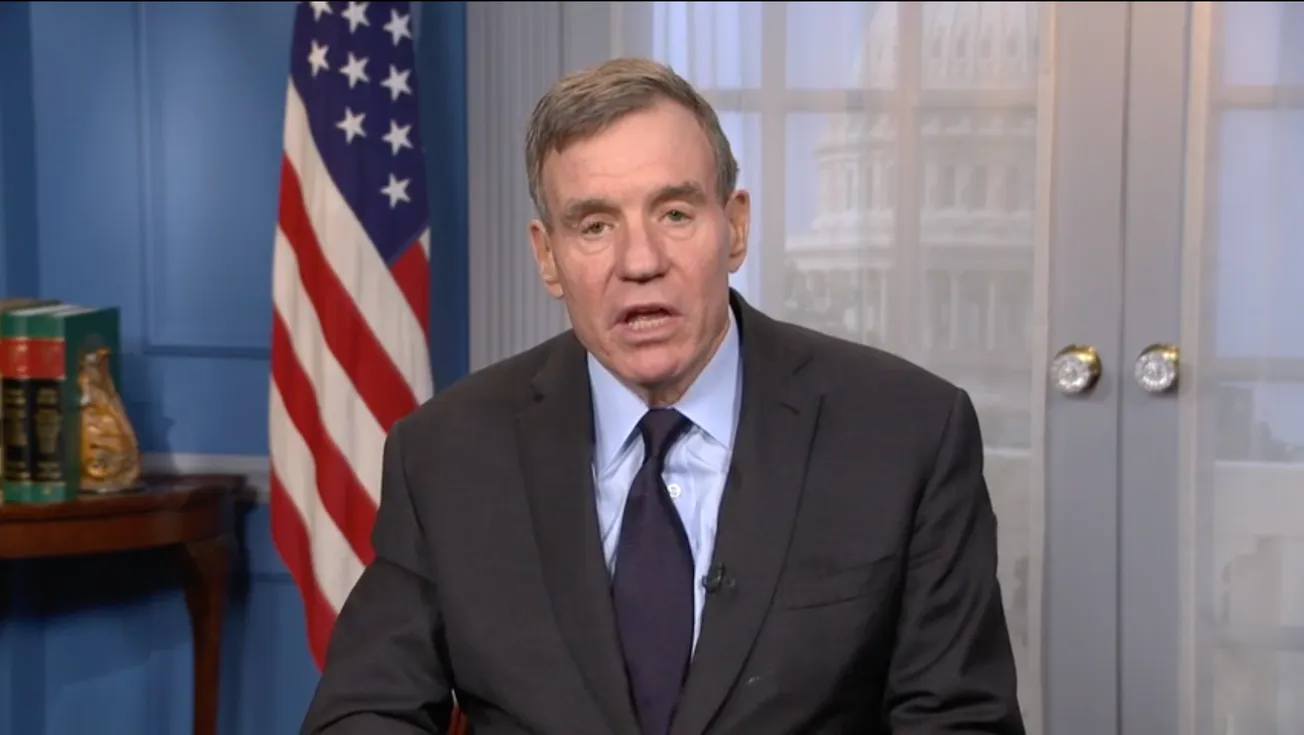
Senator Mark Warner (D-VA) opened his Thursday morning media availability with a direct message to Virginia reporters: the men and women of Hampton Roads are in harm's way in a war the administration cannot coherently explain, and Congress has an obligation to demand answers.
"We are now on day six of President Trump's war of choice against Iran," Warner said, addressing reporters from the U.S. Capitol Senate Media Center. The senator, who serves as Vice Chair of the Senate Intelligence Committee and sits on the bipartisan "Gang of Eight" intelligence oversight group, said he has received classified briefings this week from Secretary of State Marco Rubio, Defense Secretary Pete Hegseth, and other senior Trump officials — and still cannot identify a clear military objective.
Warner traced four different justifications he said the administration has offered: Iran's nuclear capabilities, its ballistic missile program, a newly raised concern about the Iranian navy, and regime change. "Four different answers," he said. "And since the president has asked the Iranian people to take back their government — if 100,000 protesters show up in Tehran and the Iranian Republican Guard kills 10,000 of them, does America have an obligation to go in and protect those protesters? We don't have an answer on that."
The senator drew pointed attention to the USS Gerald Ford, the Navy's largest carrier, home-ported at Naval Station Norfolk. Warner said the ship is now approaching its ninth month of deployment — originally scheduled for the Mediterranean, then diverted to Venezuela, now back in the Middle East conflict zone. He described meeting with Hampton Roads residents on Sunday while traveling through Norfolk, Virginia Beach, and Chesapeake.
"At least half the people at every meeting I was at had loved ones who were deployed," Warner said. He recounted speaking with a Navy reservist and mother of four young children who was struggling to explain to her kids why their father's February homecoming had been postponed indefinitely. "I talked to a Navy mom on Sunday with four kids under 10, trying to explain to her children why their dad wasn't coming home at the end of February. She was on the Ford." He added that he has heard reports of deteriorating conditions aboard the Ford — malfunctioning toilets and mounting crew stress — and pledged to post information about Hampton Roads military family support organizations on his Senate website.
Warner voted Wednesday for Senator Tim Kaine's War Powers Resolution, a bipartisan measure that would have blocked the president from continuing military operations against Iran without explicit congressional authorization. The measure failed in the Senate; the House was expected to take it up Thursday. "If the president is choosing to take our nation to war, he ought to come to the American public and Congress and ask for a declaration of war," Warner said. "He has not done so."
On a case closer to home, Warner addressed a question about Virginia Governor Abigail Spanberger's policy requiring ICE to obtain judicial warrants before detaining undocumented immigrants — a policy that came under scrutiny after an undocumented individual with a prior violent criminal history was later accused of killing a woman in Virginia. Warner said he supports deportation for those with violent criminal records, but cautioned that the broad sweep of recent ICE activity in the Commonwealth has largely targeted people with no criminal history. "Over 80% of individuals picked up by ICE in Virginia as they try to hit their daily quotas have had no criminal history or record other than entering our country," he said.
On the financial toll, Warner pointed to a squeeze already hitting Virginia drivers: gas prices have risen 27 cents in a week, with further increases expected heading into spring and summer. He warned that if Iran moves to block the Strait of Hormuz, energy costs could spike dramatically. "I have not heard of any reasonable plan where you could have escorts of tankers through that narrow stretch of sea," he said. A single Tomahawk cruise missile costs approximately $2.4 million; Warner noted it has cost close to a billion dollars just to assemble forces in the region — money he contrasted with recent administration cuts to health care, Medicaid, food assistance, and research funding.
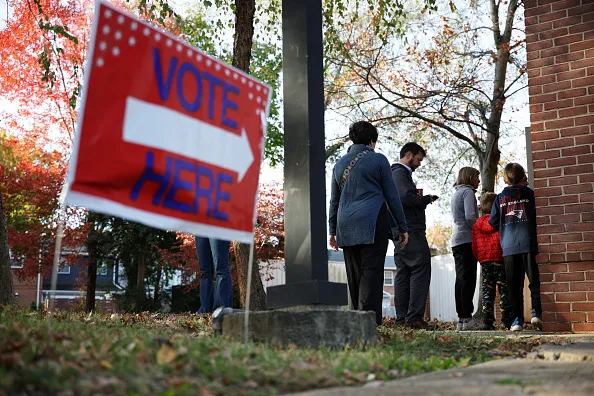
On Virginia's April redistricting referendum, Warner said the ballot measure is a direct consequence of mid-decade redistricting pushed by the Trump administration in Texas and North Carolina for partisan ends. Unlike those states, Virginia's referendum lets voters — not politicians — decide whether to return to nonpartisan redistricting in time for the 2030 census. "The end of the day, Virginians are going to be able to make that choice, not politicians," he said.
Warner closed where he began: with the sailors and families of Hampton Roads. "They'll do their duty," he said. "But the stress on the community, on the family — and on the sailors who've been deployed for more than 250 days — is real."