Table of Contents
ALEXANDRIA, Va. — The Alexandria City School Board meets tonight for an add/delete work session on the FY 2027 budget, the last major shaping session before Thursday's scheduled final adoption vote — and the documents board members will discuss show real disagreement on compensation, central office staffing, and how to address the $7.6 million in adjustments Superintendent Dr. Melanie Kay-Wyatt proposed in May to close the gap.
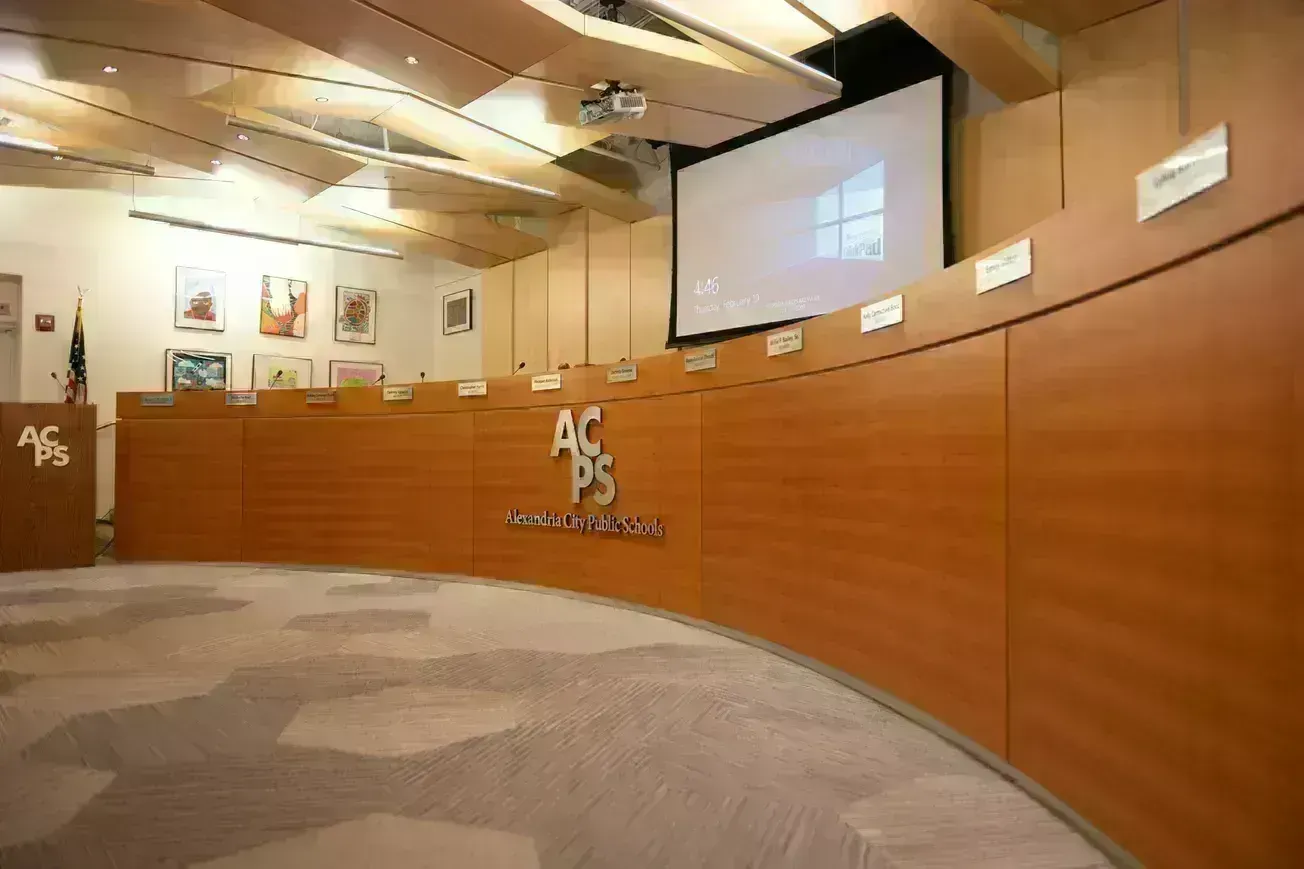
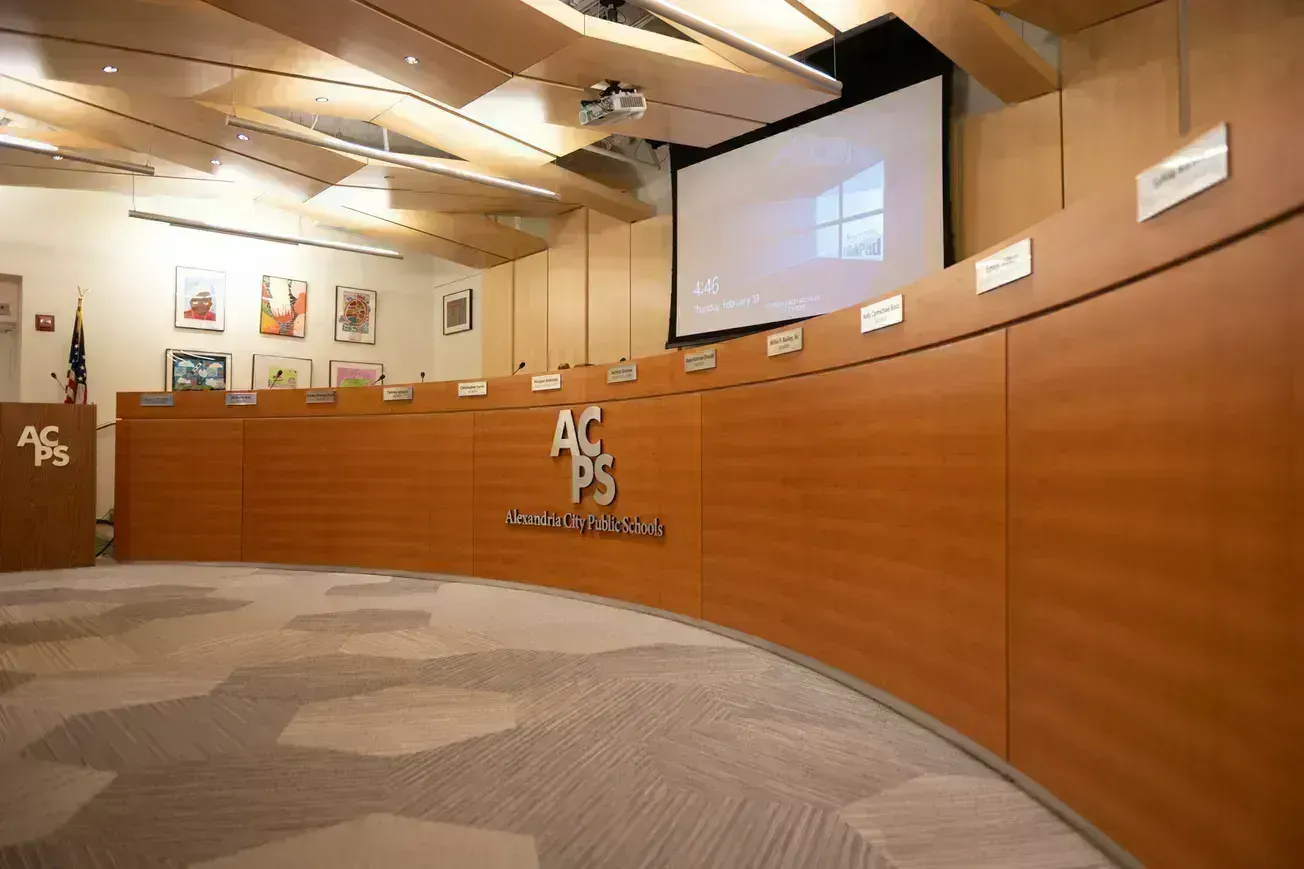
The session runs from 6 to 10 p.m. at the School Board Meeting Room, 1340 Braddock Place, with the agenda and documents available on BoardDocs and the meeting livestreamed via Zoom.
The backdrop: a $7.6 million gap and a renegotiated bargaining agreement
Tonight's add/delete debate cannot be separated from the structural gap the school division has spent the spring working to close. The City Manager's October 6 budget guidance asked ACPS to limit its operating transfer request to a 1.5% increase, citing constrained city revenue. The school board nonetheless approved a request 2.0% above the guidance, totaling $292.27 million, with the additional $5.6 million directed entirely to staff increases negotiated in the tentative collective bargaining agreement. On April 29, the City Council adopted an operating transfer of $286.6 million — the original 1.5% guidance level. No council member proposed an add/delete amendment with the required co-sponsor support to increase the allocation to ACPS during the city's budget process.
That left a $5.6 million shortfall. Between February and May, projected FY 2027 healthcare costs also rose by approximately $2 million above the budget assumptions in the board's original February-approved package. The total the superintendent had to close in the adjusted budget reached approximately $7.6 million.
Kay-Wyatt's May 7 presentation closed that gap by eliminating 45.6 full-time positions and renegotiating the tentative collective bargaining agreement to a smaller compensation package. The original $12.73 million tentative agreement was scaled back to $10.5 million — a 4.2% average raise for both bargaining units, down from 5.35% for licensed staff and 6.42% for support staff in the original agreement. The original agreement included terms that automatically reopened if the city's appropriation came in below the school board's request, triggering the renegotiation.
Many of the items board members will discuss tonight are direct attempts to restore positions, programs, or pay that were trimmed on May 7.
The bargaining unit pay dispute
Several board members want to push beyond the renegotiated package and move toward fulfilling the original tentative agreements. Board member Kelly Carmichael Booz has proposed restoring the $220,000 longevity bonus for support staff at 5-year anniversaries, the $1.15 million additional step for licensed bargaining unit staff employed since 2010-11, $500,000 in partial COLA restoration for licensed staff (from 1.25% to 1.5%), and $745,000 for support staff (from 1.25% to 2.75%).
Per ACPS staff costing, fully restoring all of the original bargained terms would require an additional $13.7 million — $10.5 million for licensed staff and $3.2 million for support staff. Staff have pushed back on each of those items, citing the City Manager and City Council's communication that funding above 1-1.5% is not sustainable, and warning that going above that level could force position cuts in FY 2028.
Public comment at the May 7 meeting focused heavily on the renegotiated agreement and a related issue: the 5% healthcare premium shift the board approved in February. Teachers told the board that the cost shift — combined with the smaller raises in the renegotiated CBA — meant their per-paycheck contributions were rising by closer to 50% than the 16% rate increase they had been told to expect. The roughly $2 million ACPS saved by shifting more healthcare costs onto employees in February had been earmarked specifically to fund the collective bargaining agreement, which was then renegotiated to deliver smaller raises.
The "top step" fight
The most procedurally contested item on tonight's agenda is a new top step the superintendent added to all three salary scales (licensed, support, non-union), at a cost of $700,000. Three board members — Booz, Ashley Simpson Baird, and Tim Beaty — have separately proposed eliminating the addition and redirecting those funds either to a broader 0.25% COLA increase for all employees or to bargaining unit salary increases.
Staff oppose this strongly. In repeated notes across the form, staff argue that removing the top step would lower the salary scale ceiling by more than $3,000 on all three scales, making ACPS less competitive with surrounding divisions and hurting both short-term retention and long-term pension calculations for senior staff, whose retirement pay is based on top salary earned.
Position reductions: more nuanced than the headlines
A key clarification from the Board's Strategy and Accountability Committee's May 14 explainer is that most of the 45.6 position reductions on the school side reflect vacant positions handled through natural attrition — retirements, resignations, and transfers — rather than terminations. ACPS classrooms have been operating at 24/26/28 students per homeroom for the past two years, and the adjusted budget changes the budgeting formula to match the ratios classrooms are already running at, board members Kelly Carmichael Booz, Christopher Harris and Ryan Reyna wrote in a May 14 explainer for the Strategy and Accountability Committee. As a result, "a family walking into an ACPS elementary classroom in September will see the same class sizes they have been seeing," they wrote.
The central office reductions are different. Those include filled positions, meaning some current ACPS employees will be affected. The multimedia specialist in the Office of Communications eliminated on May 7, at $154,600 in salary and benefits, is the central office position most often cited in board discussions.
The Afghan Family Liaisons — a partial restoration
In a moment of striking board unity, five members independently proposed restoring the two Afghan Family Liaison positions at Francis Hammond Middle School and the International Academy. The positions were among those Kay-Wyatt eliminated on May 7. Board member Donna L. Kenley, who submitted the most detailed version of the request, noted that 100 Afghan children entered ACPS schools during the 2025-26 school year, calling the positions essential to ongoing federal refugee resettlement programs whose grant funding from the Virginia Department of Social Services has expired.
The superintendent has now proposed funding both positions, at a cost of $114,700, through reductions to the School Board's Management Services account and additional cuts to division-wide travel accounts. That proposal will be discussed tonight.
Communities in Schools
Several board members are also pressing for the restoration of the $350,000 Communities in Schools (CIS) NOVA contract, which provides wraparound services for students at multiple Alexandria schools. Patrick Brennan, CIS NOVA's executive director, told the school board that ending the contract would result in the loss of more than $800,000 in grant funding and over $170,000 in basic-needs support for students, eliminating more than $1.3 million in direct resources for Alexandria students.
"Elimination would not save $350,000 — it would trigger the loss of more than twice that amount in grant dollars currently flowing into our schools," Brennan said.
School Board Chair Michelle Rief, in a May 18 letter to Mayor Alyia Gaskins and the City Council, requested city help in preserving "support for some of Alexandria's highest need students in partnership with CIS NOVA." A formal request from board member Ryan Reyna proposes $327,000 in city reserve funds — money the city has projected from parking and traffic fee increases — to maintain the CIS contract. The request has been sent to City Council.
Restoring positions cut in May
Beyond Afghan Family Liaisons and CIS, board members are proposing restoration of several other positions and programs Kay-Wyatt cut on May 7. Reyna has asked the board to maintain a 1.0 FTE itinerant Advanced Academic Services teacher. Simpson Baird has proposed deleting a Technology Services FTE and converting it to a middle school Latin teacher. Board member Abdulahi Abdalla has proposed adding back a social worker, an English Learner teacher, and the CIS contract.
The proposals echo the program areas the board itself spent the spring publicly defending. Reyna, then Strategy and Accountability Committee Chair, posted a March 9 analysis on the school board's blog showing that ACPS's largest staffing increases over five years had occurred in student services — counselors, social workers, and student support staff added in response to post-pandemic mental health needs — along with special education and English Learner positions. Several of those program areas were directly affected by the May 7 cuts.
The central office cuts debate
Multiple board members have proposed reducing central office staffing further, with the most aggressive being Abdalla's proposal to cut six non-student-facing positions for a $1 million savings. Smaller proposals from Kenley, Beaty, and Alexander Crider Scioscia would eliminate two to three positions each. Booz has separately proposed eliminating the vacant Executive Director of Support Operations position for $229,400 in savings.
The central office staffing debate is more nuanced than it appears. ACPS CFO Dominic Turner explained at the May 12 work session that the budget shows roughly 420 FTEs budgeted at central office, but about half of those — roughly 211 FTEs — work in schools directly every day, not in the central office building. These include special education teachers and instructional assistants assigned to specific students, occupational and physical therapists, speech-language pathologists, English Learner teachers, technology integration specialists, building engineers, and substance abuse counselors. They are budgeted centrally because their assignments shift across schools based on student need or because they serve multiple buildings.
The roughly 213 FTEs that work in the actual central office building — Finance, Human Resources, Communications, Facilities and Operations, Technology, Community Relations, and the School Board Office — are a different set of positions. Staff notes pushing back on the central office cuts raise two concerns: eliminated positions need to be specifically identified, and reducing leadership compensation increases could prompt central office administrators to form their own union. Several previous rounds of central office reductions — totaling roughly 11.5 non-instructional positions across Kay-Wyatt's original January proposal, the board's February adoption, and Kay-Wyatt's May 7 adjustments — have already been absorbed before tonight's debate.
The 97 questions and what's left to decide
Ahead of the May 12 work session, the board collectively submitted 97 written questions to staff covering position and program cuts, vacant positions across the division, healthcare cost trends and the proposed shift in employee/employer cost-sharing, central office staffing patterns, technology spending, and what staff would recommend restoring first if additional state or local funding materializes. The full set of board questions and staff responses was posted publicly on May 15. ACPS is also awaiting the Virginia state budget, which could materially affect available funding.
What happens next
Tonight's work session is the last formal opportunity for board members to refine the budget before Thursday's adoption vote. On Thursday, June 11, the school board is scheduled to take action on three companion items: the final FY 2027 Combined Funds budget, the FY 2027-2036 Capital Improvement Program budget, and ACPS 2030 Year 2 adjustments. It will be Kay-Wyatt's final budget cycle as superintendent before her scheduled Oct. 1 retirement.
Thursday's meeting begins at 6 p.m. at the School Board Meeting Room, 1340 Braddock Place, with sign-up to speak available through the ACPS website and the meeting livestreamed via Zoom.
The tentative totals on tonight's add/delete document indicate roughly $193,600 in net expenditure reductions and $342,000 in revenue requests — though those figures will shift substantially based on tonight's votes.
The full add/delete document, salary increase attachment, and historical bonus payments attachment are available on BoardDocs. The work session begins at 6 p.m. and is open to the public.
For more background, see "Kay-Wyatt unveils $5.6M in ACPS budget cuts" and the school board's May 14 explainer on the FY27 budget status.