ALEXANDRIA, Va. — The Alexandria City Council on Tuesday unanimously approved the city's draft FY 2027 to FY 2031 Five-Year Consolidated Plan for Housing and Community Development and the accompanying one-year action plan, authorizing the Office of Housing to apply for $1,055,741 in Community Development Block Grant funds and $588,874 in HOME Investment Partnerships funds from the U.S. Department of Housing and Urban Development.
The five-year plan also includes a $5,278,705 Section 108 loan to support the construction of Housing Alexandria's 495-unit Sansé/Naja affordable rental development in Arlandria. Section 108 loans are repaid through future CDBG entitlement funds.
The numbers, as the Office of Housing staff acknowledged, are not large. The city's average yearly CDBG allocation is roughly $1 million; the average HOME allocation is about $590,000. With most CDBG funds restricted to construction or rehabilitation, and HOME funds restricted to housing activities, the plan is largely an exercise in choosing among constrained options.
Council approved the plan unanimously following a presentation by Aspasia Xypolia, deputy director of the Office of Housing, who introduced housing analyst Kim Cadena. Cadena prepared the plan and the city's annual reports to HUD.
A shrinking federal formula
Mayor Alyia Gaskins pressed staff to explain a trend that has shaped Alexandria's housing strategy: the city's CDBG allocation has been declining over time, even as housing need in Alexandria has grown.
"Our need is going up, our population is going up. All of these things that I imagine would be factors in a formula are changing, but our numbers are not going up or making any significant movements," Gaskins said. "So I guess, what other factors is HUD plugging into that formula that isn't changing for us, that doesn't allow for us to get more funds?"
Xypolia explained that HUD uses two formulas to allocate CDBG funds, both of which work against Alexandria.
"For CDBG specifically, there are two formulas HUD uses. One intends to favor cities that have a growing poverty ratio, and the other intends to favor cities that have a declining population," Xypolia said. "So, although it feels like the need is growing in Alexandria, which it does, it grows more in other cities, so their issues look more skewed. So in theory, the fact that the city's CDBG allocation goes down talks about the city's overall stronger position, although the need is still very high."
Gaskins confirmed her understanding: "Because our poverty ratio is not going down and our population is not declining, we are not in a place that could be eligible for more."
The same dynamic affects the city's home rehabilitation loan program. Vice Mayor Sarah Bagley asked Xypolia how the FY 2027 goal of six rehabilitated households compares to prior years.
"That goal is based on how much money we have available, and it captures only the work we can do with the CDBG money," Xypolia said. "So we are not really working towards what we would like to do. We're working towards how far that budget of money can get."
Asked directly whether the number is going down, Xypolia confirmed: "It is going down."
She said construction costs have continued to rise, and noted a separate gap during the pandemic when homeowners did not want renovation crews in their homes. The home rehabilitation loan program is funded at $266,716 for FY 2027 — $91,716 in new CDBG entitlement and $175,000 in program income.
The five-year strategic priorities
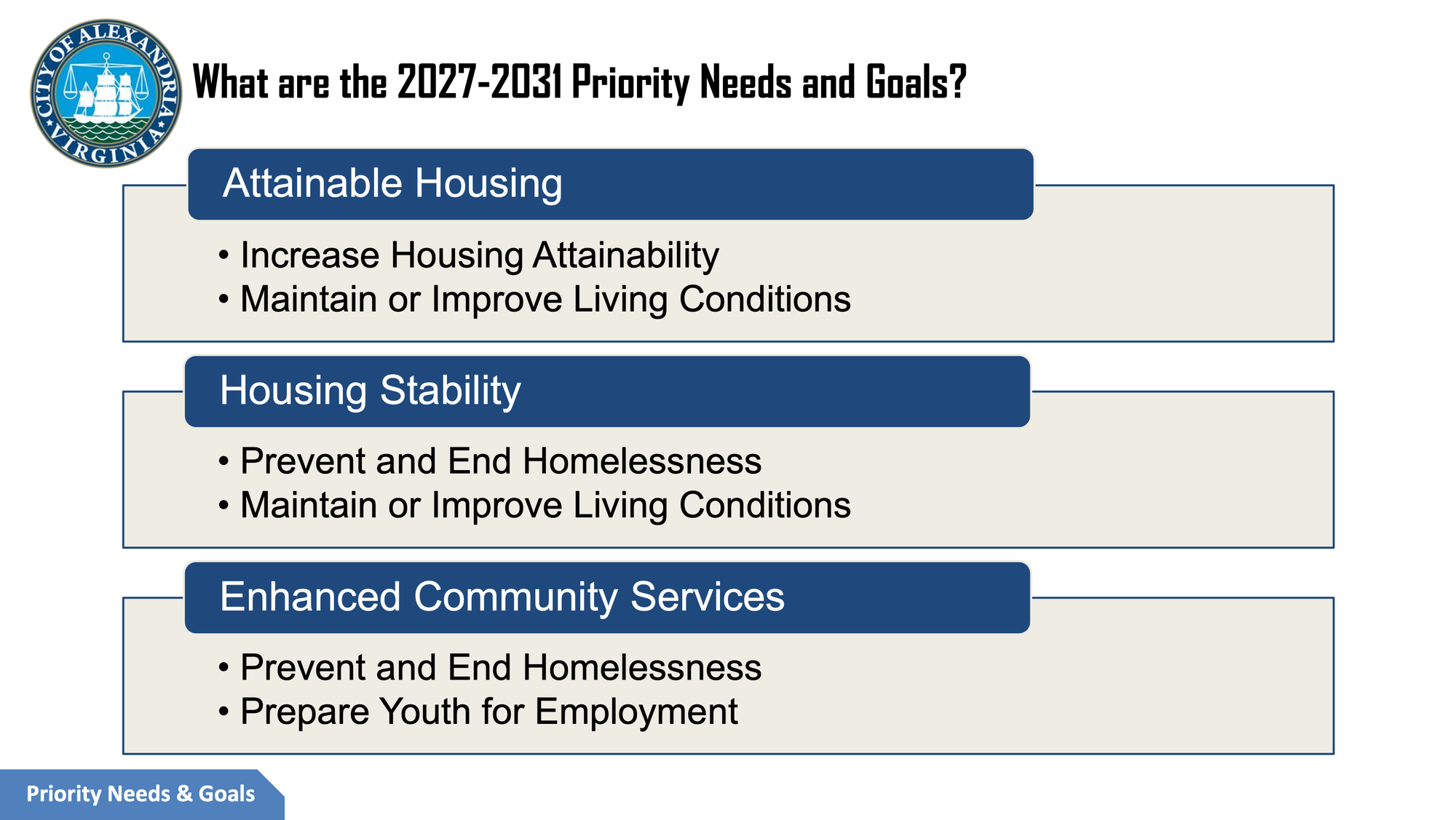
The consolidated plan establishes three priority needs for the FY 2027 to FY 2031 period: attainable housing, maintaining housing stability, and enhanced community services. The plan was developed in coordination with the Department of Community and Human Services, the Department of Planning and Zoning, the Alexandria Redevelopment and Housing Authority and outside service providers, and incorporates findings from the Housing 2040 plan adopted earlier this year.
According to the plan's executive summary, during the FY 2022 to FY 2025 period, Alexandria rehabilitated 152 affordable rental units — far above its goal — provided winter shelter to 1,252 persons, and helped 241 persons avoid homelessness. The city assisted 26 first-time homebuyer households during that period. It fell short of its goal of 300 new affordable rental units constructed, but anticipates at least 495 new units to be completed during the FY 2027 to FY 2031 cycle.
FY 2027 program allocations
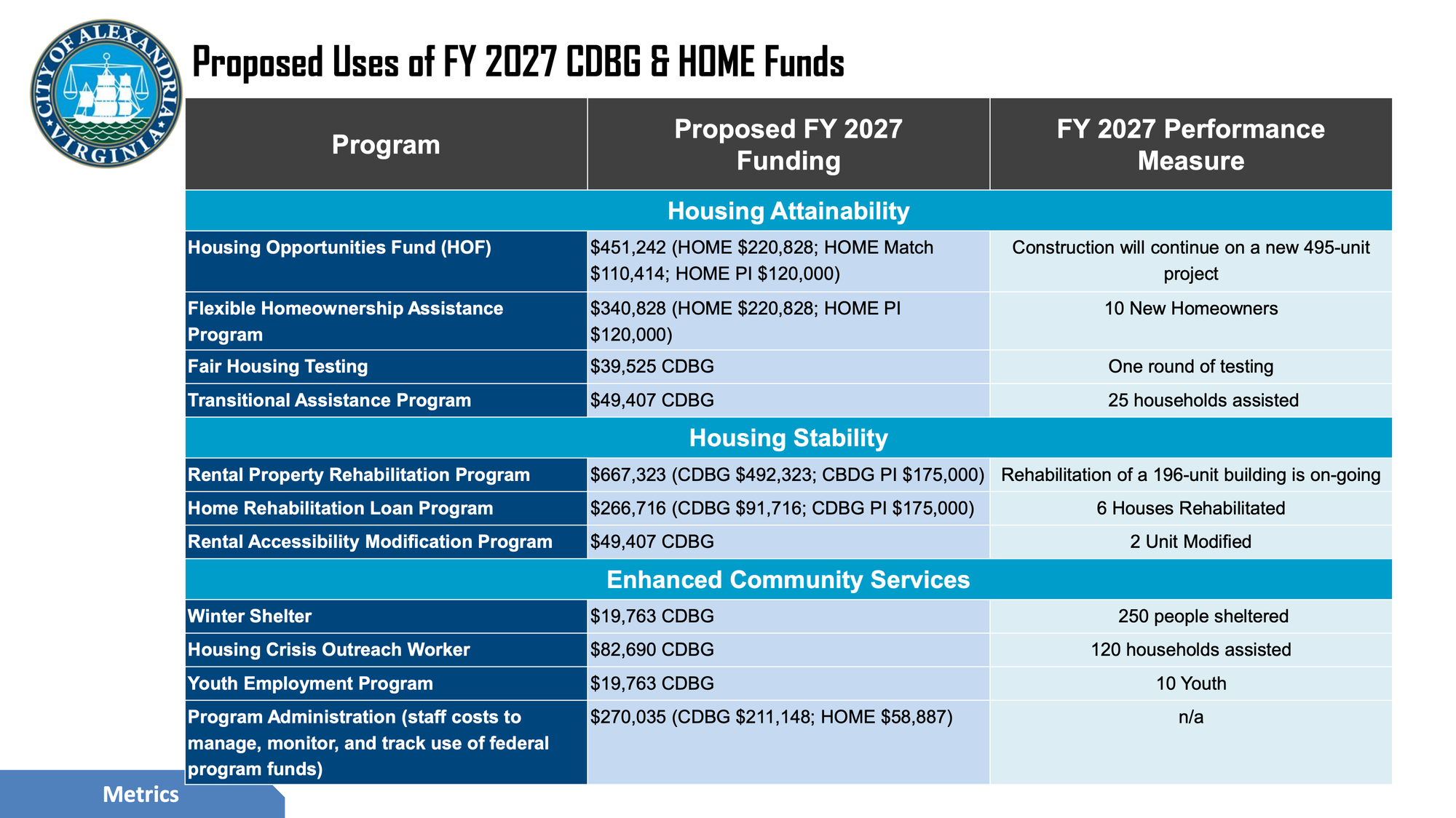
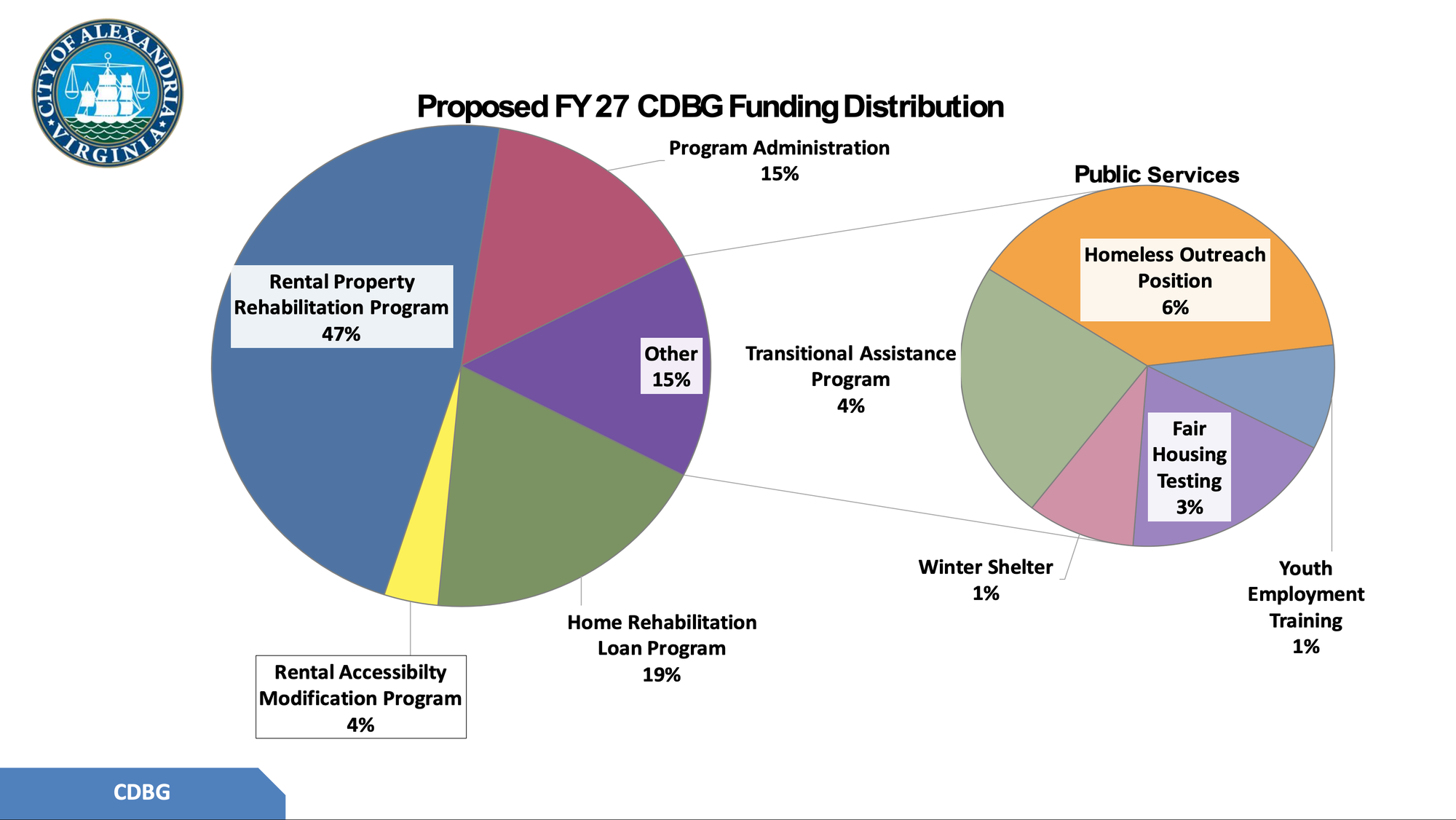
The largest single FY 2027 program allocation is $667,323 for the Rental Property Rehabilitation Program — $492,323 in new CDBG entitlement plus $175,000 in CDBG program income. The program provides nonprofit affordable housing providers with funds to rehabilitate buildings without raising rents to pay for capital repairs. In FY 2027, the funds will continue the rehabilitation of a 196-unit building.
HOME Program funds totaling $220,828 are allocated to the city's Housing Opportunities Fund, which, along with HOME match dollars and program income, brings the total HOF investment to $451,242. An equal $220,828 in HOME funds — bolstered by $120,000 in program income — will support the Flexible Homeownership Assistance Program, which targets 10 new homeowners in FY 2027 through down payment and closing-cost assistance.
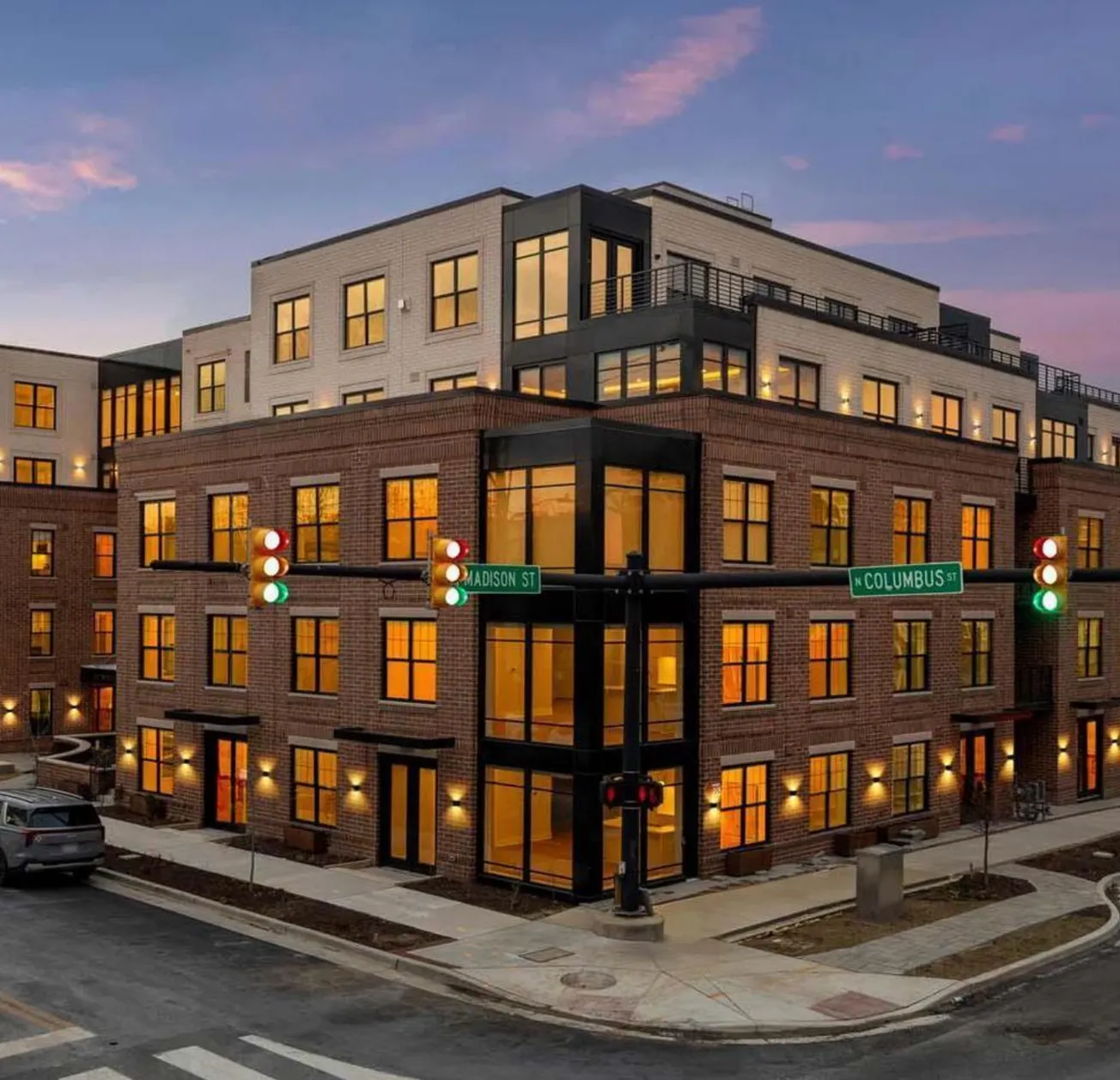
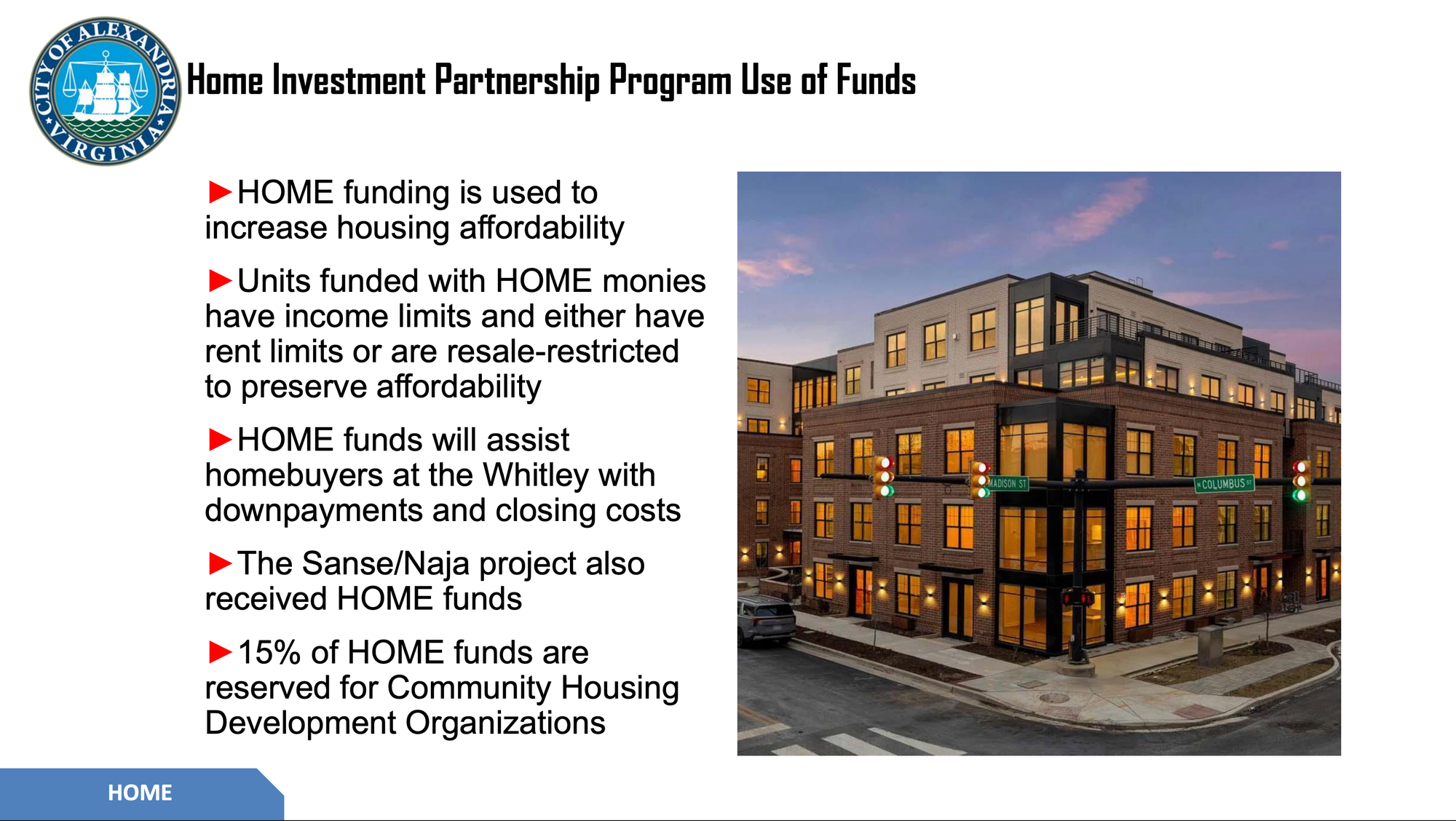
The plan documents 40 affordable homeownership closings currently in process - 31 at Carindal Path and nine at The Whitley, the affordable condominium development at Madison and North Columbus streets in Old Town North - with future homebuyers receiving down payment assistance funded through the HOME program.
Smaller CDBG allocations include $49,407 for the Rental Accessibility Modification Program, which funds accessibility modifications in privately owned rental properties for two disabled tenants in the coming year; $49,407 for the Transitional Assistance Program, which provides security deposits and rental assistance to 25 households experiencing or at risk of homelessness; and $19,763 for the city's Winter Shelter program, which is expected to serve 250 people.
The city is adding two new activities to the CDBG program in FY 2027: a Housing Crisis Outreach Worker, funded at $82,690 in partnership with DCHS and targeting 120 households assisted, and a youth employment program funded at $19,763 to support 10 youth. Xypolia said both additions reflect priorities that surfaced during the Housing 2040 community engagement process.
The youth employment training
Councilwoman Jacinta Greene asked Xypolia to explain the youth employment training and its relationship to the city's existing summer youth employment program.
"We will partially fund the work of one full-time member to work with the youth during their workforce development summer training so they learn about housing," Xypolia said. "This is under the public service category, where we are able to fund salaries of other agencies so they can deliver a service."
Xypolia clarified that the funds go to staff working with youth, not directly to participants. The program ties to economic mobility strategies in the Housing 2040 plan.
"It's not money directly going to youth," Xypolia said. "For someone who will work with the youth within this program."
Fair housing testing and cross-program partnerships
Councilman Canek Aguirre asked whether fair housing testing — for which $39,525 is allocated — is conducted in multiple languages. Xypolia confirmed it is and noted a fair housing event scheduled for Thursday evening.
Bagley raised a separate set of questions, asking whether the home rehabilitation loan program could partner with the Office of Climate Action and the city's stormwater credit program, since renovation crews working on homes could surface multiple needs at once.
"It has started happening, and we hope after the budget season and all of that to sit down and see where the synergies exist," Xypolia said.
"That would be great," Bagley said. "Because if we are talking to homeowners, it would be great to do as much as we can at one time and maximize these opportunities to renovate those homes."
Bagley closed by referencing Aguirre's earlier question and noting that the city has also added form of payment as a fair housing testing category, in addition to language testing.
The SHARE Safe task force
Gaskins used the discussion to flag two coordination efforts that have not previously been the subject of council discussion.
The first is a working group of the Alexandria Redevelopment and Housing Authority, the Office of Housing, the Department of Community and Human Services, Code Enforcement, and the Office of Climate Action that meets quarterly to identify cross-program opportunities. Gaskins said the group will give a presentation to ARHA staff on how to make residents aware of housing-related programs when city workers are conducting renovations or engagement.
The second is SHARE — Safe Housing Alert Response and Engage — a multi-agency task force focused on multifamily properties. Gaskins said that the city council may take up SHARE in a future meeting.
What's next
A 30-day public comment period on the draft consolidated plan ended April 22; a public hearing for verbal comments was held at the April 9 meeting of the Alexandria Housing Affordability Advisory Committee. The final FY 2027 Action Plan will be submitted to HUD via its online portal following Tuesday's approval. Funds are expected to be released to the city in the summer of 2026.
The McIlvaine memo
The staff memo accompanying the consolidated plan was signed by Helen S. McIlvaine, director of the Office of Housing, who retires tomorrow after 20 years with the city. The memo, dated April 23, 2026, was among McIlvaine's final official documents as housing director.
Xypolia, who answered most of Tuesday's substantive questions, will serve as acting director of housing beginning May 1.
Correction: An earlier version of this story said the city was in the process of closing on 14 new affordable homeownership opportunities at The Whitley. The Five-Year Consolidated Plan documents 40 closings currently in process - 31 at Carindal Path and nine at The Whitley.