Table of Contents
ALEXANDRIA, Va. — The Alexandria City Council on Tuesday unanimously authorized the Alexandria Redevelopment and Housing Authority to issue up to $20 million in revenue bonds to finance the rehabilitation of The Ladrey, the 11-story affordable senior housing building at 300 Wythe Street in Old Town.
The unanimous vote preserves 159 deeply affordable apartments serving senior and disabled households and clears one of the final local hurdles before construction can begin in January 2027. All current residents were relocated by January 2026 and have a guaranteed right to return to the rehabilitated building, which is scheduled for completion in the third quarter of 2028.
Councilman Canek Aguirre pulled the item from the council's consent agenda to request a presentation, citing how much the project has evolved from earlier proposals.
"I would like a short presentation just given how much we've been paying attention to the Ladrey project, what the original project we had taken in and thought that we were going to get and now what we are working on currently," Aguirre said.
The project
The Ladrey rehabilitation is a co-development by ARHA, Winn Companies and IBF Development. The architect is Hord Coplan Macht and the general contractor is Bozzuto.
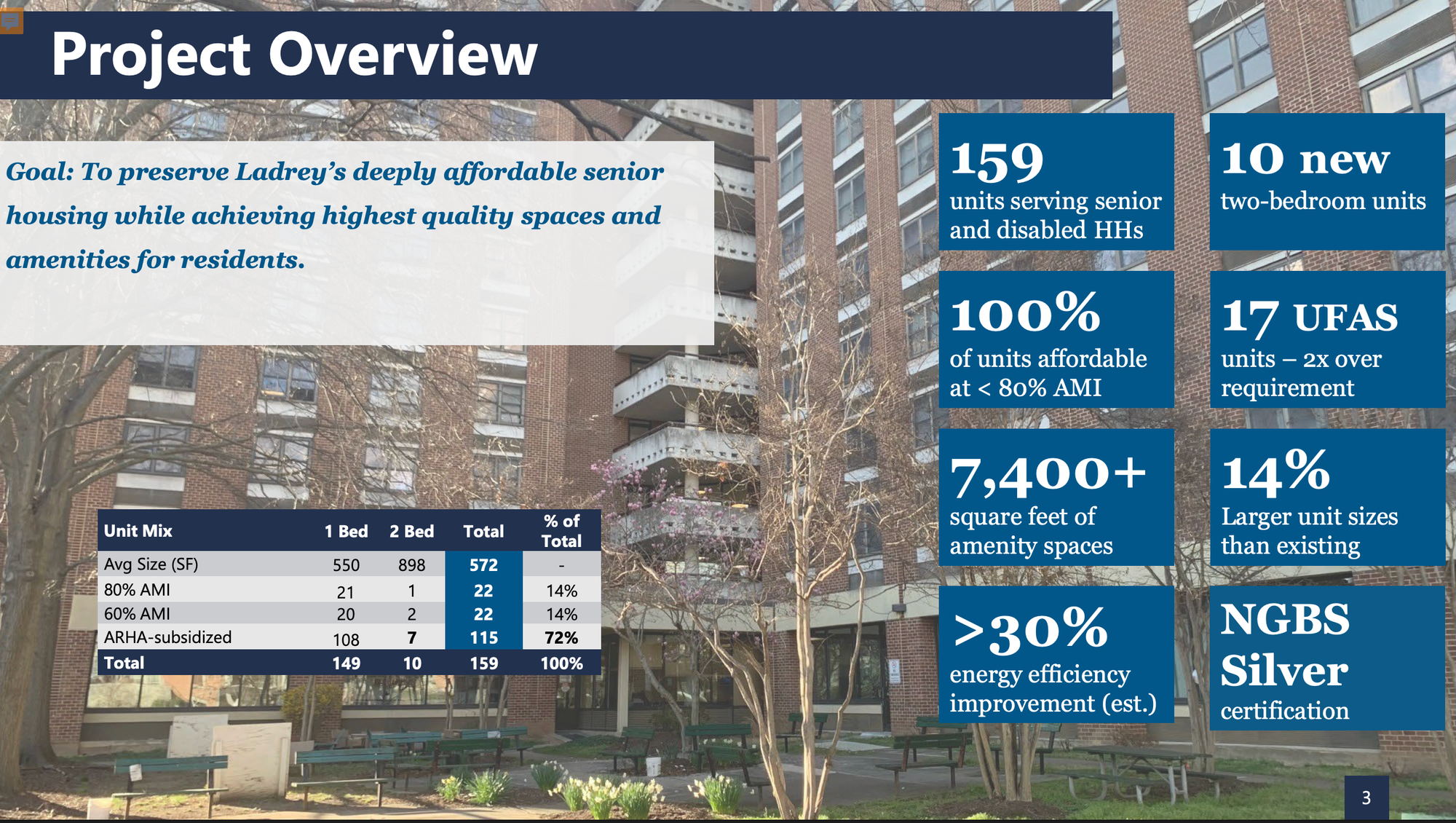
According to the developer's presentation to ARHA in February, the project's stated goal is "to preserve Ladrey's deeply affordable senior housing while achieving highest quality spaces and amenities for residents."
All 159 units in the rehabilitated building will be affordable to households earning at or below 80% of the area median income. The unit mix includes 22 units at 80% AMI, 22 units at 60% AMI, and 115 ARHA-subsidized units, which represent 72% of the total. The building will offer 149 one-bedroom units and 10 new two-bedroom, two-bath units to accommodate live-in aides. Average unit sizes will be 14% larger than the existing units. The total floor area is approximately 130,900 square feet.
The developer presented several design changes to council. Existing studio units, described in the developer's materials as "unpopular among residents and becoming less marketable," will be eliminated. Seventeen units will be fully accessible — more than double the 5% minimum requirement. New one-bedroom units will be added in underutilized elevator lobby space. The project is targeting NGBS Silver certification and an estimated energy efficiency improvement of more than 30%.
Resident services and amenities
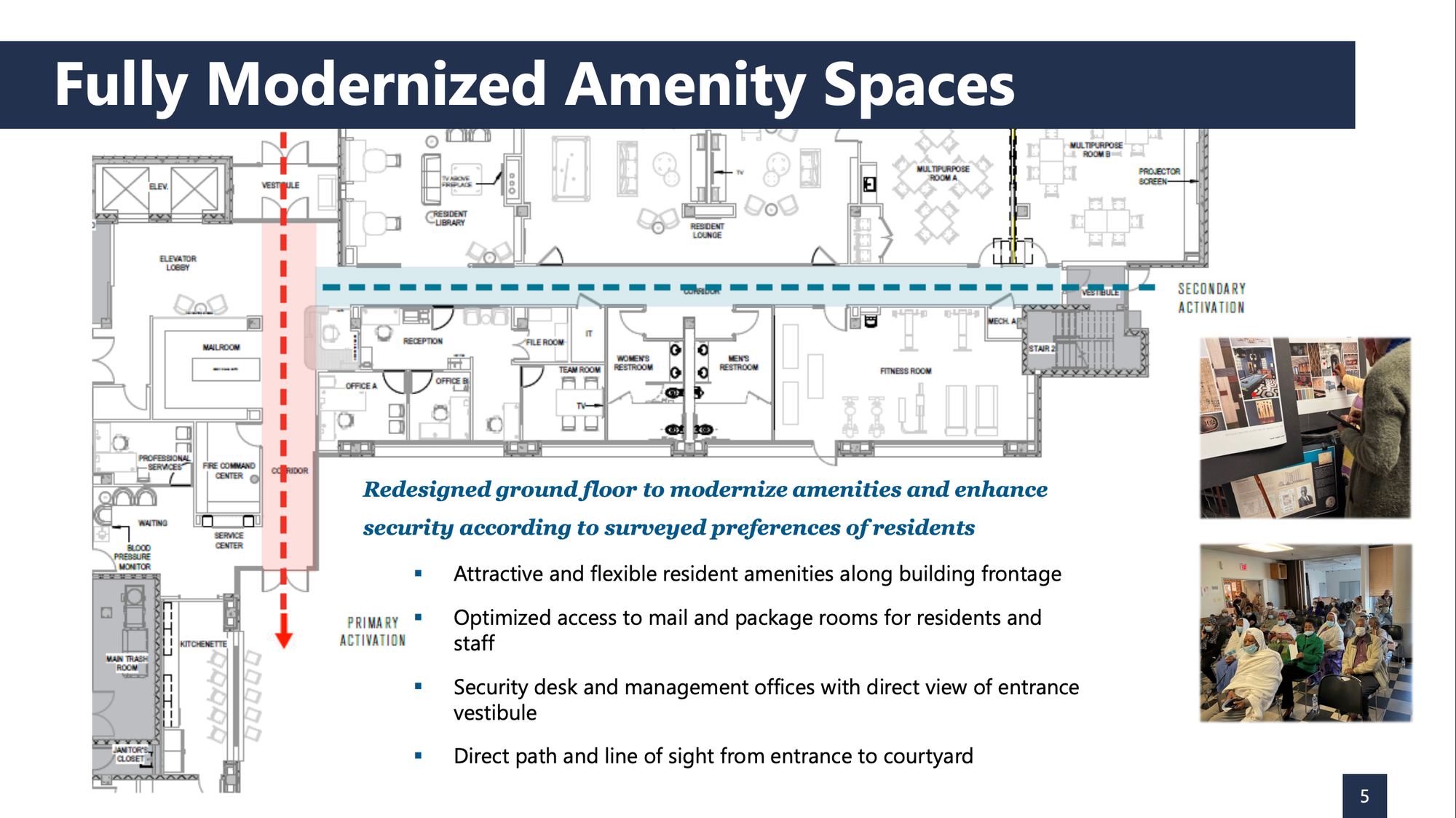
The redesigned ground floor will include more than 7,400 square feet of amenity space, a security desk and management offices with direct sight lines to the entrance vestibule, a fitness room, multipurpose rooms, a resident library and a resident lounge.
A new 11th-floor lounge will provide additional amenity space and views of the Potomac River. The existing courtyard will be redesigned with a grill and outdoor eating spaces, shaded seating preserved by existing trees, a synthetic lawn area for active recreation, and lounge areas with flexible seating.
A representative for the development team — identified in the meeting record as Aspasia Xypolia, deputy director of the Office of Housing — told council that on-site amenities will include a library, business center and a blood pressure machine, and that Winn Companies' nonprofit affiliate Connected Communities will provide on-site support services. There will be no on-site pharmacy.
The most-requested amenity from residents, according to the development team, is a pool table — which will be included in the rehabilitated building.
Aguirre asked whether the project might include space for medical services such as a pharmacy. Told that there would not be a commercial pharmacy on site, he said the absence felt like "a little bit of a missed opportunity," but said he appreciated the inclusion of health-related amenities including the blood pressure monitor.
The polling place question
Vice Mayor Sarah Bagley asked whether the renovated building could once again serve as a polling site, as it did before the COVID-19 pandemic.
"Before the pandemic we used to vote at Ladrey," Bagley said. "I know that's a little bit of a left field question, but it dawned on me. As a person who's currently floating around as an Old Town North resident in Charles Houston, I just wanted to put it out there as you guys are completing the renovation."
Sarah Mohammed of ARHA said the development team would consider the polling site option, noting that the spaces are being reconfigured but will include some "big open spaces" that could potentially accommodate voting.
With Ladrey unavailable as a polling place since the pandemic, voters in that area have been displaced to Charles Houston Recreation Center.
HUD obsolescence and the structural review
Bagley also pressed the development team on a question that has dogged the project: a HUD finding that the building was "obsolete." For Bagley, the answer was important to put on the record for the residents and advocates who attended a 2024 council presentation expressing concern about the building's condition.
"There was an application to HUD in which HUD determined the building obsolete," Xypolia said. "To clarify, HUD's definition of obsolescence does not mean that the building is not structurally sound. It has a different definition."
Xypolia said the development team commissioned a structural report as part of the renovation scope. As part of the project, the building will receive new HVAC systems, new windows and new elevators.
Mayor Alyia Gaskins added that ARHA had also commissioned its own structural engineer review at the request of Councilman John Taylor Chapman and herself.
"ARHA did go back and have a structural engineer do a report that went through not only all the systems, but structures to kind of do a re-review as to whether or not a renovation could be supported," Gaskins said.
Bagley said the clarification mattered for the community.
"I think for all those tenants who showed up, you know, and for all the advocacy in the community, that the obsolescence that you referred to is a standard that obviously does not apply if you are doing all of the work that the development community now plans to do in the building," Bagley said. "So I'm excited, I'm supportive of this. I don't want the question to imply otherwise. I just thought we owed that to the community to make clear that we really had reevaluated the situation."
Why the bonds — and why now
The financing structure presented to council reflects a recent change in Virginia Housing's underwriting practices. According to the developer's presentation, Virginia Housing — the state's housing finance agency — no longer underwrites to project-based voucher rents, a change that the developer estimated would have cost the Ladrey project more than $16 million in loan proceeds had it relied on the standard Virginia Housing financing path.
The alternative is local issuance through ARHA. The $20 million in qualified private activity bonds is the minimum needed to meet the 25% test for 4% Low Income Housing Tax Credits, according to the developer's materials.
Xypolia told council that Virginia Housing's financing model "would have created a bigger gap on the project," and that the development team is using the ARHA model "rightfully so" because it creates a larger debt capacity. Virginia DHCD has already provided $5 million to the project through a congressional appropriation, Xypolia said.
The bonds are conduit revenue bonds — also called private activity bonds — payable solely from project revenues. They do not constitute a debt or pledge of the faith and credit of the City of Alexandria, the Commonwealth of Virginia, or any political subdivision, according to ARHA documents and city staff materials. ARHA itself has no taxing power.
Section 147(f) of the Internal Revenue Code requires the highest elected governmental unit — in this case, the Alexandria City Council — to approve the issuance of private activity bonds before they can be issued. ARHA held its public hearing on the bond financing on March 23, 2026, with notice published. According to the ARHA record, no one appeared in opposition.
The financing timeline is tight. The bond cap application is due to Virginia DHCD no later than July 1, making Tuesday's council approval a critical step in keeping the project on schedule. With the council action complete, the development team will submit its DHCD bond cap allocation application between April and July, apply for building permits in May, begin construction in January 2027, and complete the project in the third quarter of 2028.
ARHA approved the inducement resolution at its March 23 board meeting, signed by Chair Mark Jinks — the city's former city manager — and Interim CEO Rickie Maddox. The borrower of record is Ladrey Rehab LLC, an entity affiliated with WinnCompanies.
The right to return
All current Ladrey residents were relocated by January 2026, according to the developer's presentation. The team has continued to maintain contact with relocated residents through Housing to Home, the project's relocation firm, and has held community meetings with former residents to share updates on the renovation.
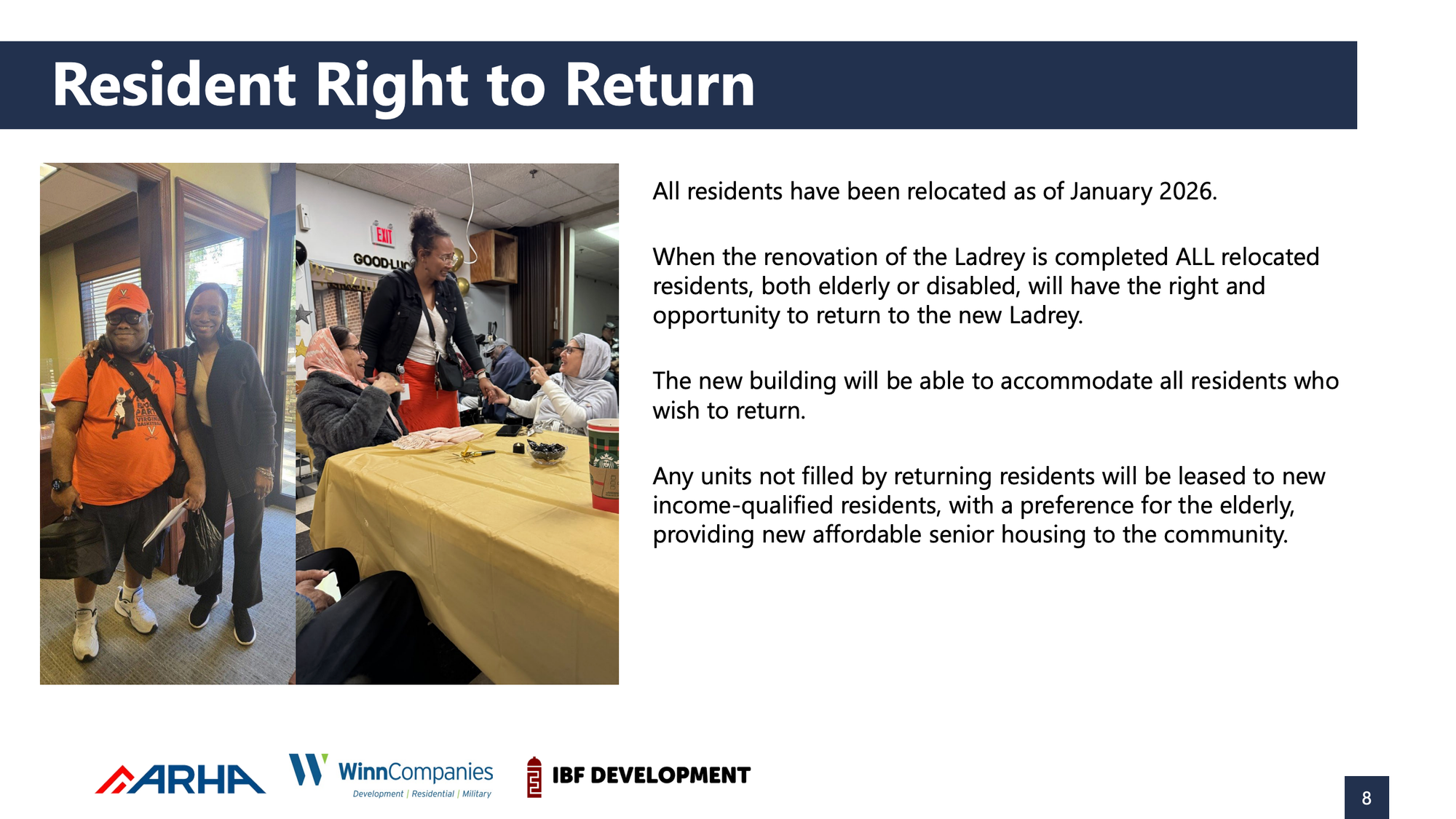
"When the renovation of the Ladrey is completed, all relocated residents, both elderly or disabled, will have the right and opportunity to return to the new Ladrey," the developer's presentation states.
Aguirre asked who would coordinate communications with displaced residents about the right to return.
"Every resident who lived at Ladrey has a right to return," Xypolia said. "We utilize our relocation company, Housing to Home, and so we remain in contact. We've even had community meetings with all these residents to just show updates on the plans. So once the building's ready, projected to be ready six months before, we'll start contacting everyone and see who's interested in coming back. It would be no cost to come back."
Any units not filled by returning residents will be leased to new income-qualified residents, with a preference for the elderly.
McIlvaine's last legislative meeting
Helen S. McIlvaine, director of the Office of Housing, was in the council chamber for Tuesday's vote. McIlvaine, who joined the city in 2006 and was appointed director in 2015, will retire April 30 after 20 years with the city. The city has said she oversaw more than a dozen affordable housing development and preservation projects during her tenure and led implementation of the Housing Master Plan.
She signed the staff memo accompanying the Ladrey item, dated April 23, 2026 — five days before her last legislative meeting.
Mayor Gaskins recognized McIlvaine earlier in the meeting during council oral reports.
"I know a round of applause barely captures all of the decades of work that you have done for our city," Gaskins said. "But I think it's just so important that we continue to acknowledge and celebrate the impact that you have had that will last for generations, both internally in our city, but on the many, many different affordable housing projects, plans and efforts across our community. So we're so grateful for you. We're going to miss you."
Aspasia Xypolia, the deputy director who answered most of the council's substantive questions on the Ladrey project Tuesday, will serve as acting director of housing beginning May 1.