ALEXANDRIA, Va. — Mayor Alyia Gaskins on Wednesday morning made the public case for a proposed $135 million tax increment financing deal to redevelop the former Potomac River Generating Station, opening a six-week community engagement period that will culminate in a council vote June 13.
In a video posted to her social media accounts, Gaskins walked residents through the proposal that the City Council received Tuesday night as an oral report from City Manager James Parajon and his staff. The video and a new news item, "Developer Seeks City Support for Potomac River Site Revival", on the city's website are among the first pieces of public-facing communication from the city since the Tuesday presentation.
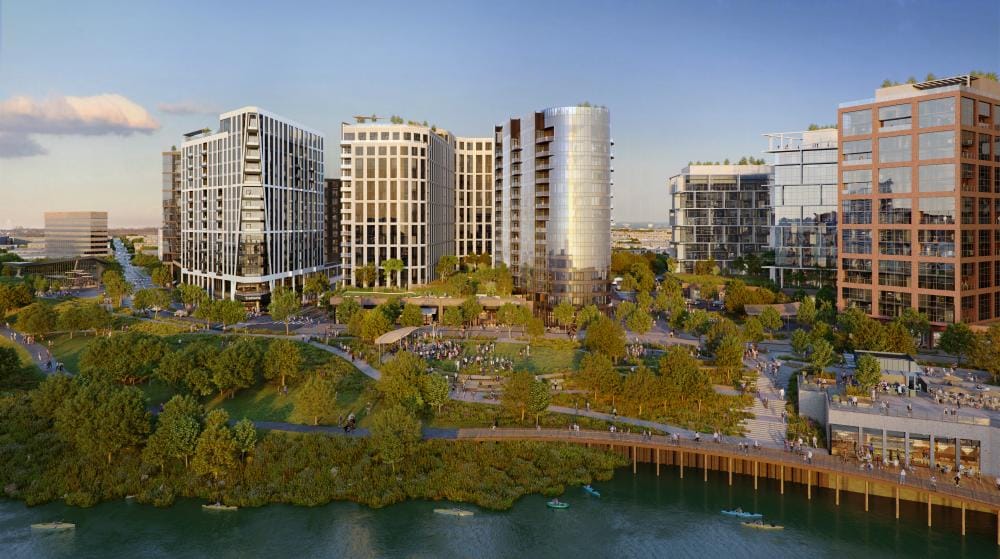
"If you missed last night's council meeting, then you missed an important update on the Potomac River Generating site, also known as the old power plant," Gaskins said in the video. "This site is 19 acres along the Potomac River, located in Old Town North."
Gaskins framed the project as a continuation of community advocacy that began with the closure of the coal-fired power plant in 2012 and continued through the 2017 Old Town North Small Area Plan and the 2022 council approval of the site's rezoning.
"The community then came together to create the Old Town North Small Area Plan, which envisioned taking back our connection to the water, creating open space, housing, retail, restaurants, and arts," Gaskins said. "Essentially a new place where people could gather, live, work, and play along our waterfront."
She acknowledged that the project has stalled.
"In 2022, the city council then approved the rezonings that would be necessary to move this vision to reality. However, the project stalled. Why? Because an environmental remediation of this size is significant. Also, the type of technical and skilled work that is necessary to deconstruct an old power plant is huge, huge and has significant cost."
Three benefits
Gaskins emphasized three features of the proposed financing structure that she said make it a good deal for the city.
"What's important to know about this model is that it has a couple of benefits to the city," Gaskins said. "One, it uses no existing revenue. Two, because of the CDA and this different financing structure, it does not impact our AAA bond rating, nor does it impact our bond issuance capacity."
The third benefit she cited was the reimbursement model.
"This agreement would also be based on a reimbursement model. So the developer would deconstruct the power plant, build open space, utilities, streets and other public infrastructure, and then based on their performance targets, they would be reimbursed with the funds from the CDA."
The $770 million pitch
Gaskins closed the video by pointing to the projected return on investment.
"This project is expected to generate over a billion dollars in new revenue. When we subtract the money that the city would have to pay for the debt service on the bonds, that's about $770 million in new revenue for our community," Gaskins said. "Think about the needs that we have from schools, parks, roads, other infrastructure investments. This would be new resources to help us achieve those goals."
The $1 billion gross and $770 million net figures match the projections city staff presented to council Tuesday. The remaining roughly $300 million in the gap between gross and net represents debt service on the $135 million in bonds, including interest, over the approximately 30-year financing period.
Last night, the Council got an update on the Potomac River Generating Station (PRGS) Power Plant Redevelopment. Learn more about what’s being proposed to help move this important project forward: https://t.co/S9hG9AZLjb#alexandriava #mayorofalx #alyiaforalx pic.twitter.com/KLaBYqKuJm
— Alyia Gaskins (@Alyia4ALX) April 29, 2026
How TIF works
Tax increment financing is a public finance tool authorized under Virginia Code § 15.2-5158 that allows local governments to use new tax revenue generated by a redevelopment project to fund eligible public infrastructure.
Under the proposal, a newly created Community Development Authority — a separate political subdivision of the commonwealth — would issue bonds to finance the $135 million in public infrastructure costs. The bonds would be repaid using new tax revenue generated by the redevelopment, including real property tax, sales and use tax, discretionary meals tax and transient lodging tax on the site.
No existing Alexandria tax revenue would pay debt service on the bonds. If the project failed to generate sufficient new revenue, the CDA could levy a special assessment on properties within the project boundaries — currently owned by the developer, HRP Group — but no other Alexandria property would be affected.
The structure differs from how the city handled its only previous TIF deal, the Landmark Mall redevelopment on the West End. That project used general obligation bonds backed by existing taxes. The PRGS proposal would not.
The deal is structured in two phases — up to $70 million in Phase I and up to $65 million in Phase II — with the developer carrying approximately $155 million in upfront site readiness costs across the two phases before any city reimbursement.
What happens now
Gaskins emphasized that the council did not take a vote on Tuesday and that the project now moves into a public engagement period.
"Council did not take a vote yesterday. We instead now turn the project over to you. There'll be a series of community meetings and conversations, and then in June council will take up the issue for a vote."
The remaining engagement and decision steps:
May 4 — HRP Group developer community meeting, virtual, 6 to 7 p.m.
May 7 — Alexandria Housing Affordability Advisory Committee meeting, virtual, 7 p.m.
June 2 — Planning Commission hearing on Phase I development approvals
June 9 — City Council introduction of the term sheet
June 13 — Saturday public hearing and council votes on TIF authorization, development and performance agreements, and Phase I development approvals
Public comments may be submitted at engage.alexandriava.gov/prgs or by emailing the City Clerk at CouncilComment@alexandriava.gov. The full term sheet outline and project details are at alexandriava.gov/PRGS.
The Brief's full coverage of Tuesday's presentation, including council member questions and a detailed walk-through of the financing structure, is available below.
 Ryan Belmore