ALEXANDRIA, Va. — The National Innovation Quarter, the technology and national-security innovation district spanning Alexandria and Arlington that launched earlier this year, has been awarded nearly $3.9 million in state economic-development funding — the largest single grant in a $5.6 million statewide round Gov. Abigail Spanberger announced Friday.
The $3,933,000 award, made through the Growth and Opportunity for Virginia (GO Virginia) program, accounts for about 70 percent of the seven grants announced statewide. It goes to a Region 7 Northern Virginia project covering both the City of Alexandria and Arlington County.
For an organization that launched in February with an expected operating budget of roughly $5 million over three years, the grant is substantial — close to the equivalent of doubling the resources behind the district in its first year.
What the National Innovation Quarter is
National IQ, as it is known, is a 501(c)(6) nonprofit innovation district based in National Landing, the mixed-use area encompassing Crystal City, Pentagon City, and Potomac Yard. It is designed to connect academia, government, startups, and major industry to develop "dual-use" technologies — those with both commercial and national-security applications — in fields including cybersecurity, robotics, artificial intelligence, and advanced hardware, along with climate tech and fintech.
The district's Alexandria footprint is anchored in part by Virginia Tech's Innovation Campus in Potomac Yard, which straddles the Alexandria-Arlington line. Its founding partners include the Alexandria Economic Development Partnership, Arlington Economic Development, Virginia Tech, the Virginia Innovation Partnership Corporation, Amazon, Northrop Grumman, SAIC, JBG Smith, and the National Landing Business Improvement District.
According to the state's description of the award, the funding supports the district's regional strategy, startup acceleration, and programming to advance company formation, talent development, and commercialization.
 Ryan Belmore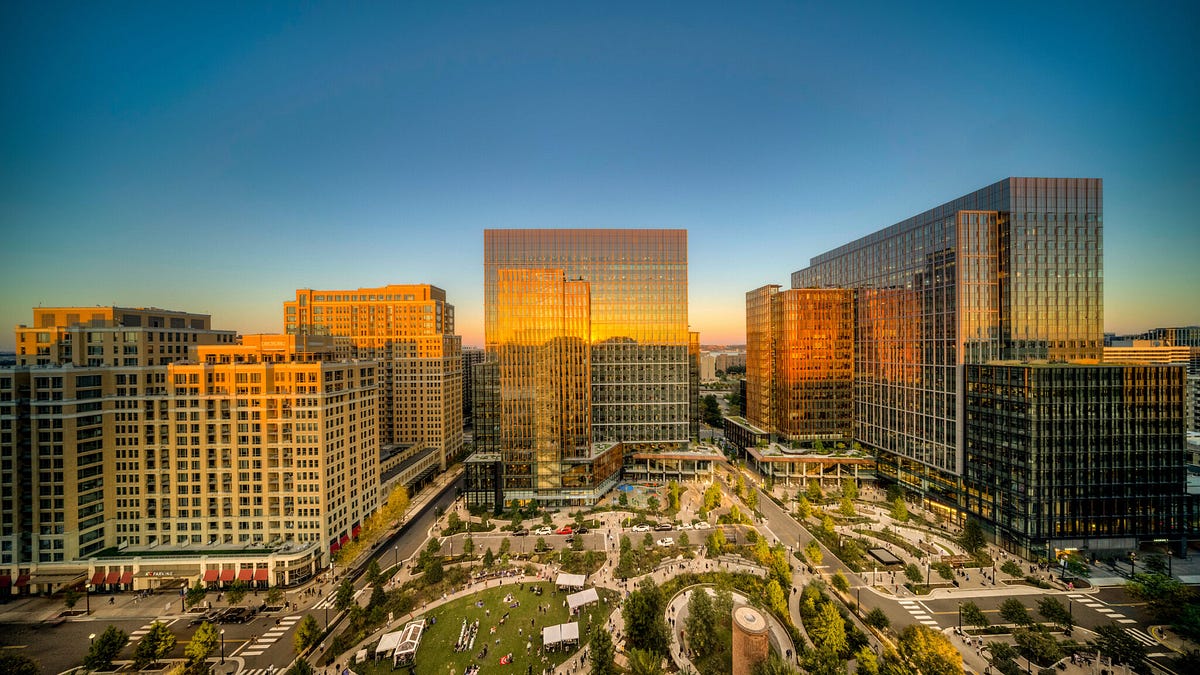
A bet on diversifying beyond HQ2
The district launched in February as Northern Virginia looks to build on — and move past — the momentum of Amazon's HQ2 decision. Amazon chose the region in 2018 with a pledge of 25,000 jobs but has since reported slower-than-expected growth and implemented layoffs. National IQ's backers have framed the district as the next phase of National Landing's evolution, pointing to a track record that includes HQ2, Boeing's headquarters relocation, and the arrival of defense-tech firms, as evidence the area can sustain innovation "across economic cycles."
The grant also lands as the broader region absorbs significant federal workforce reductions — a dynamic that has rippled through Alexandria's economy over the past year and that the city and state have repeatedly cited in pushing economic diversification. State officials framed Friday's GO Virginia awards around building "a more resilient and diversified economy."
The state's framing
GO Virginia, created in 2017, funds regional economic-development projects through a state board and regional councils, with grants requiring local matching contributions. Across Friday's seven awards, the state said local governments, employers, universities, and nonprofits committed more than $2.9 million in matching funds and more than $1.6 million in additional leverage.
"These projects reflect my commitment to building a more resilient and diversified economy that's prepared for the challenges of today and the opportunities of the decades ahead," Spanberger said in a statement, framing the awards around expanding career pathways and high-growth industries.
The state said the program has supported the creation of 27,000 jobs since 2017 and helped firms access more than $700 million in capital.
A second Alexandria connection
Alexandria also appears in a smaller award in the same round: a $250,000 grant for a Multi-Region Commercial Real Estate Market Analysis covering Alexandria, Arlington, Fairfax, Henrico, Richmond, Norfolk, and Virginia Beach. That study will examine office- and innovation-oriented real estate needs across the three metropolitan regions to support industries including IT, cybersecurity, life sciences, shipbuilding, and advanced manufacturing.