Table of Contents
ALEXANDRIA, Va. — The Alexandria City Council moved through a dense docket Tuesday night, adopting a five-year transportation strategy, reviewing a revised agreement governing police in city schools, advancing two consent items and taking up a pair of requests from the School Board, before closing a meeting that ran past 10 p.m.
The council took formal action on only a handful of items — most of the night was oral reports and discussion — but the agenda touched transportation, housing, public safety, school governance, and the long-running Duke Street planning effort. All seven members were present.
GO Alex strategic plan adopted
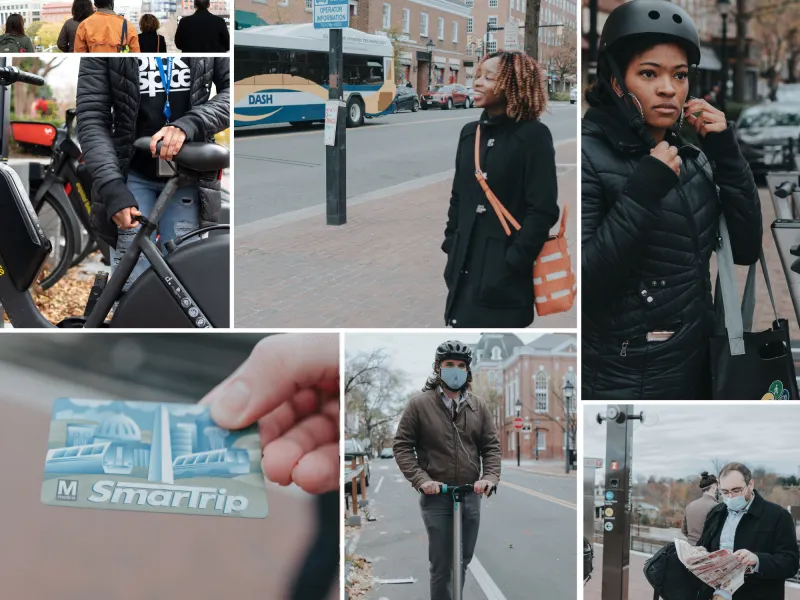
The council's main vote of the night was the unanimous adoption of the GO Alex Strategic Plan for fiscal years 2027 through 2031, the five-year plan for the city's Commuter Assistance Program, which works to reduce single-occupancy-vehicle trips. The Virginia Department of Rail and Public Transportation requires such a plan as a condition of the grant funding that supports the program, and the council approved it in its role as the program's governing board. Staff said the plan would take effect in July.
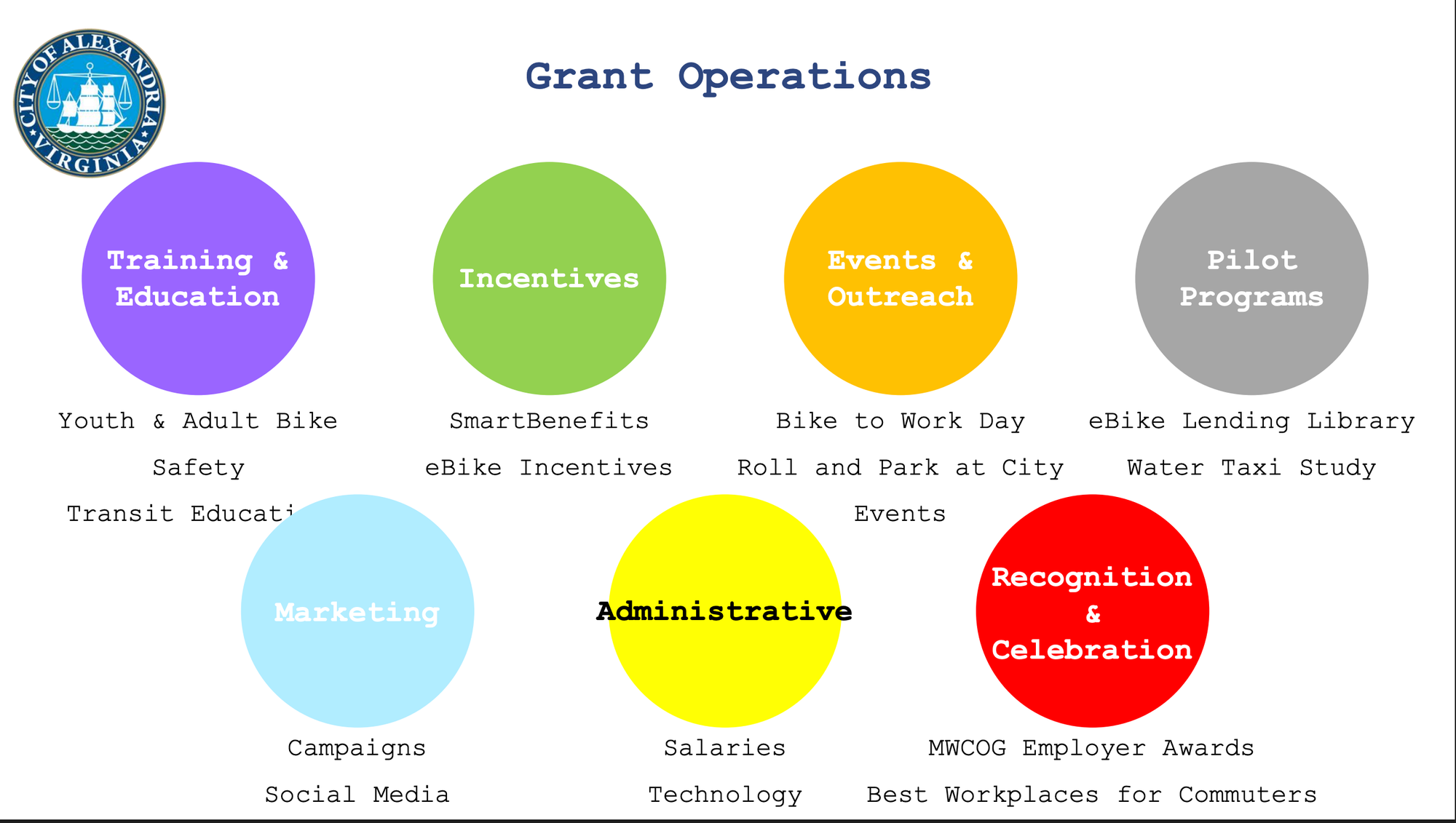
GO Alex program manager Josh Etim told the council the plan identifies target markets, programs and funding sources, organized around three goals: inform and educate, enhance and invest, and prove and celebrate. It maintains existing efforts — bike safety education, transit education, SmartBenefits and events such as Bike to Work Day — while adding new initiatives, including an e-bike incentive program the city expects to align with grant funding in fiscal 2028, and two pilot programs: an e-bike lending library that would let residents try an e-bike for up to a month, and a water taxi feasibility study. The plan also emphasizes what staff called storytelling, including a proposed series of "GO Alex" yard signs at completed projects, each with a QR code linking to information about the improvement.
Vice Mayor Sarah Bagley, who said she rides a pedal-assist e-bike most days, urged staff to include public education on what an e-bike actually is, noting the growing variety of devices on city streets and the distinction between pedal-assist bikes and throttle-powered ones. Councilman John Taylor Chapman asked about the water taxi study and the status of an earlier regional effort. The plan passed without dissent.
Schools-police agreement reviewed
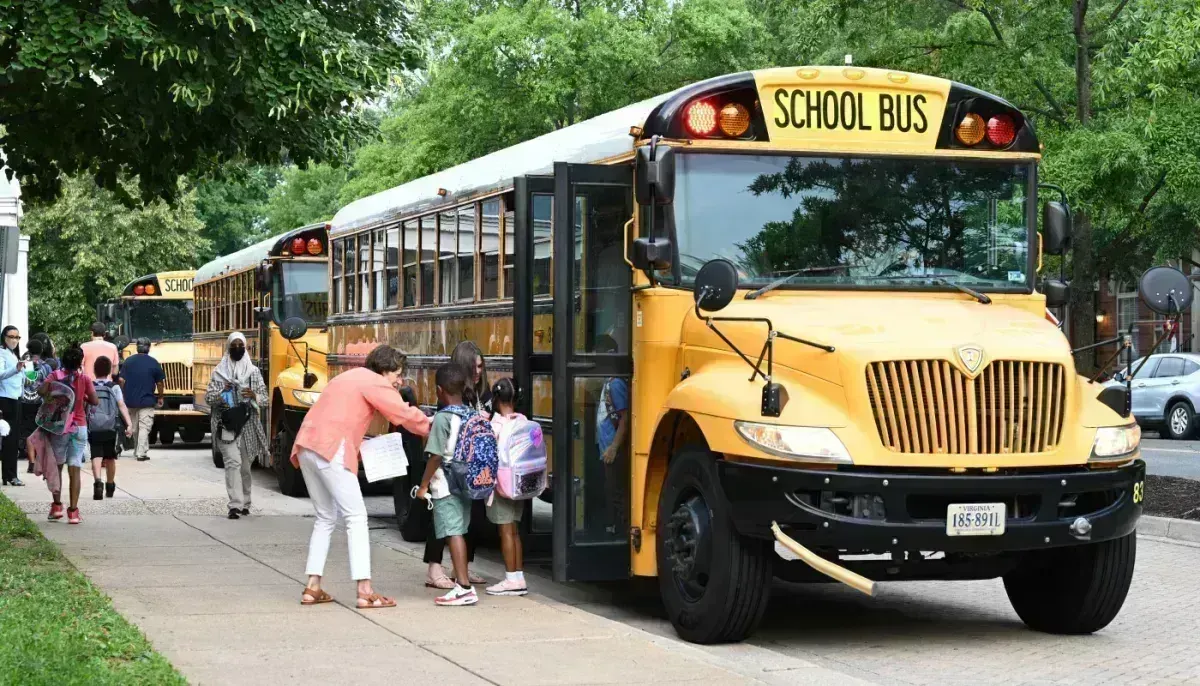
The council received an oral report on the updated School Law Enforcement Partnership memorandum of understanding between Alexandria City Public Schools and the Alexandria Police Department. No council action was requested or required; the School Board unanimously approved the revised agreement May 7, and it takes effect July 1, 2026, running through June 30, 2028.
State law requires any school division employing school resource officers to maintain such an agreement, based on a state model and reviewed at least every two years. Assistant Chief Tina Laguna, who oversees the bureau that includes the school resource unit, walked the council through nine sections of changes, most reflecting how a draft was refined into the final document. The central revision, in Section 6, removes a designation that had treated SROs as "school officials" — the sticking point that stalled the review. Without it, officers seeking student records need written consent from a parent, guardian or legal custodian, consistent with the federal Family Educational Rights and Privacy Act, and a new process lets a parent or guardian be present when a student is questioned in non-emergency situations. Section 7 adds language reminding principals that possession of alcohol and of less than a pound of marijuana are not felonies they must immediately report. A new Section 8 addresses immigration; according to the city's presentation, SROs will not take actions resulting in the denial of service based on the immigration or citizenship status of a child, parent or guardian, and Laguna said officers do not ask about immigration status.
The report drew some of the night's most detailed questions. Bagley asked how the city could be confident discipline is applied evenly — that particular student groups, teachers or departments are not disproportionately referring students to officers — noting the quarterly reports the city receives show numbers after the fact, not who is making referrals. Councilman Canek Aguirre said he had raised that concern for "six or seven years," describing an unresolved push to add an anonymous identifier to the referral form; ACPS has not agreed to it, he said. Officials responded that while the data is not tracked that way, an officer who noticed such a trend would be expected to flag it to the chief or school leadership. Council members also asked what an officer's role would be if federal immigration agents appeared near a school — a scenario officials said had drawn community concern — and Laguna said the department had reinforced its policies, trained staff and shared the guidance with ACPS. Councilwoman Marks, reviewing the agreement as a parent of two teenagers, asked about officers' authority to question students off campus in limited circumstances; Laguna said department directives grounded in state code govern interactions with minors regardless of location.
Chief Tarrick McGuire and Travis MacRae of the City Attorney's Office attended, along with School Board member Ashley Simpson Baird and ACPS attorney Bob Falcone.
Two school board requests
During council updates, the council took up two requests from the School Board, taking no votes but giving direction to City Manager James Parajon.
The first was a request to form a joint ad hoc committee to study changes to how and when school board members are elected, carrying out the board's Nov. 7, 2024, resolution seeking a charter amendment for four-year, staggered terms — a request the board first transmitted to the council more than a year ago. Mayor Alyia Gaskins said she found support for a two-member committee from each body, with an appetite to look beyond staggered terms to board size, timing and representation. Councilman Abdel-Rahman Elnoubi, a former school board member, pushed to consider a smaller board, noting at least one district had gone uncontested every year since 2009 except 2018, while cautioning that both bodies should agree on the committee's scope first. Marks favored keeping the effort narrow. Gaskins said she hoped to bring a resolution to a vote before the summer recess.
 Ryan Belmore
The second concerned funding for Communities in Schools of NoVA, a student-support program. Gaskins said the board had asked the city to use contingent reserve funding generated by parking revenue, but the money is not yet in hand — new enforcement would not begin until Jan. 1, with the earliest read on collections in late September or October. The city could generate about $329,000 if fines match historical levels, she said, short of the $350,000 ACPS invests in the program. Rather than commit funds it does not have, Gaskins proposed directing Parajon to include funding recommendations when he brings the contingent reserve proposal back in the fall. Councilwoman Jacinta Greene asked how the program would run if money did not arrive until after school starts; Aguirre said he supported the program but voiced frustration that the division had not budgeted for the cost, and used the moment to advocate for two Pashto-speaking community liaison positions the board had sought, about $100,000, for a vulnerable population; and Chapman asked what would happen if the city could not cover the full amount and whether the board would make up the difference.
Duke Street framework plan
The council reviewed, for guidance only, the draft framework plan for the Duke Street Land Use Plan — the effort to update the comprehensive plan for the corridor for the first time since 1992. Deputy Planning Director Jeff Farner and Division Chief Carrie Beach presented. Staff said the year-long process has drawn more than 3,500 residents, over 50 pop-up events, 10 community meetings, about 250 businesses and more than 100 students, and that of 250-plus community ideas evaluated, roughly 75% were incorporated.
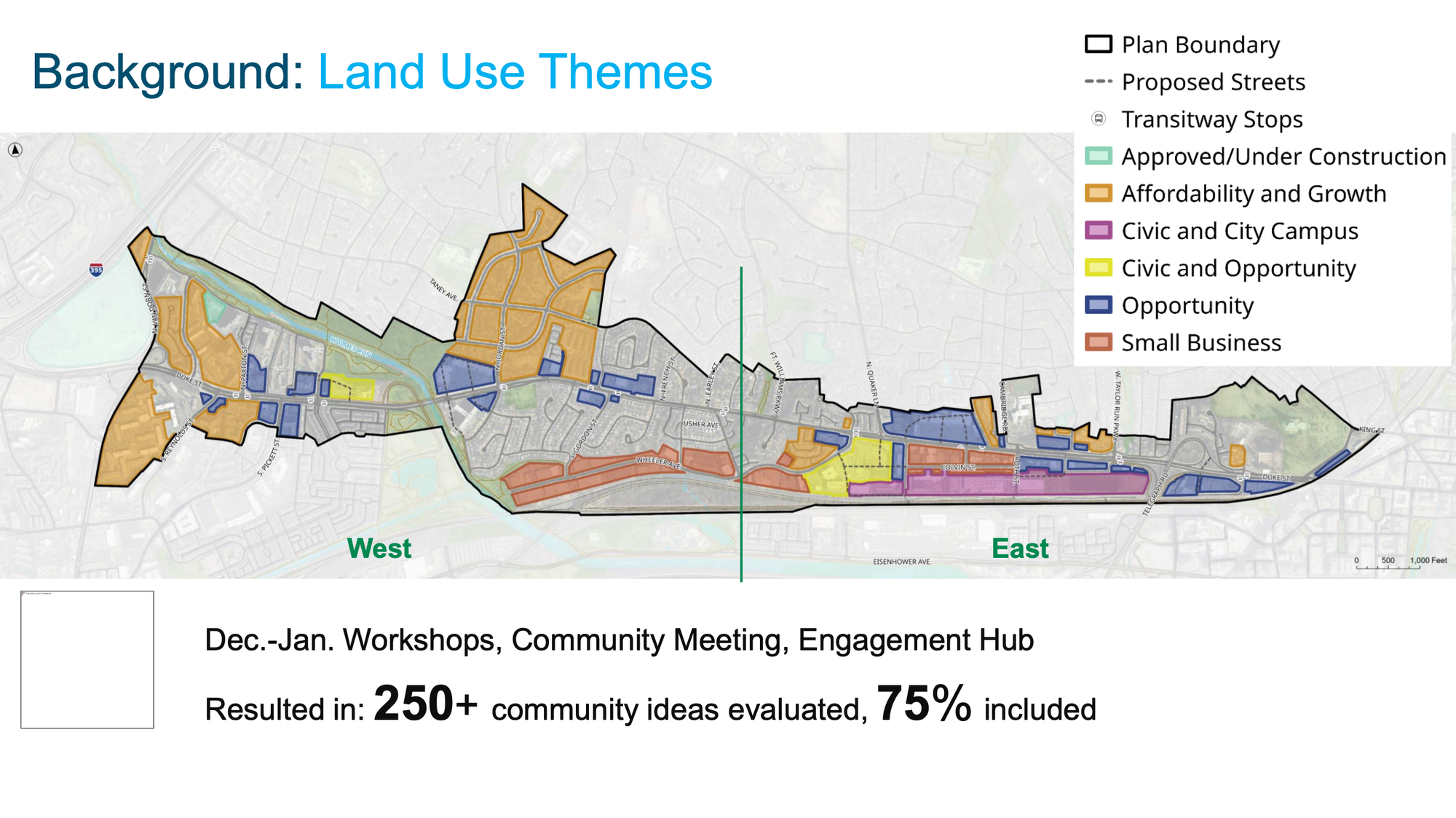
The framework organizes the corridor into themes. "Opportunity" areas — generally commercial sites such as Alexandria Commons and properties east of Telegraph Road — are targeted for incentivized redevelopment that staff said would add housing, including committed affordable units, without displacing existing residents, which the council has identified as a priority. A designated small-business area would largely preserve existing building stock and heights to keep space affordable for current tenants. The plan also envisions a civic and city-campus use on a 55-acre city-owned site, with capacity for operations such as bus and equipment storage. Proposed maximum building heights across the corridor range from 35 to 150 feet. For two large market-affordable properties, Foxchase and the Mason at Van Dorn, staff said the city is working with owners to advance Housing 2040 affordability strategies and limit displacement.
Asked about school capacity, staff said they had been coordinating with ACPS on anticipated development and that the division currently sees no need for a new school in the corridor. Staff also said a traffic study examining trip origins and destinations along the congested Quaker Lane-to-Telegraph Road segment would return to the community in June. Under the timeline presented, draft recommendations are tentatively set for release around July 15, a full draft plan in September, public comment in September and October, and City Council and Planning Commission public hearings in December.
Consent items, proclamations, and other business
On a unanimous roll-call vote, the council approved two consent items: a grant application of up to $270,000 to the Bloomberg Center for Public Innovation's Love Your Block program, which would fund the Health Department's Community Health Improvement Plan in the Arlandria and Landmark/Van Dorn neighborhoods, and an amendment providing up to $550,000 in additional city funding to renovate and preserve 1022 Pendleton Street as a rooming house.
The meeting opened with three proclamations: recognizing June as the 82nd anniversary of D-Day commemoration month, read by Councilwoman Marks and tied to the city's sister-city relationship with Caen, France, with a flagship event May 31 in John Carlyle Square; May as Sex Ed for All Month, read by Bagley; and May as Asian American, Native Hawaiian and Pacific Islander Heritage Month, read by Elnoubi.
In oral reports, Gaskins shared data from the regional point-in-time homelessness count, including 104 households without children identified in 2026, a 3% increase over 2025, and 19 individuals experiencing unsheltered homelessness, up from the prior year, while households reporting homelessness tied to fleeing domestic violence fell from 23 to 17. Chapman reported on the City/School subcommittee, which heard from the Summer Youth Employment Program and the nonprofit ALIVE and reviewed ACPS enrollment and capacity projections. The council also approved its meeting schedule before adjourning.
City Council's next Legislative Meeting is scheduled for 7 p.m. on Tuesday, June 9, followed by a Public Hearing Meeting on Saturday, June 13 at 9:30 a.m.
The Alexandria Brief
Alexandria, Va., news and information you won't find anywhere else.
The Alexandria Brief has no ads, no paywall, and no corporate owner. Support this work with a monthly or annual subscription, or a one-time contribution.
Publisher: Ryan Belmore, an Alexandria resident and journalist. Send feedback, story ideas, news, and tips to ryan@alexandriabrief.com.
© 2026 Alexandria News, LLC / The Alexandria Brief. All rights reserved. This material may not be published, broadcast, rewritten, or redistributed without express written permission.