Table of Contents
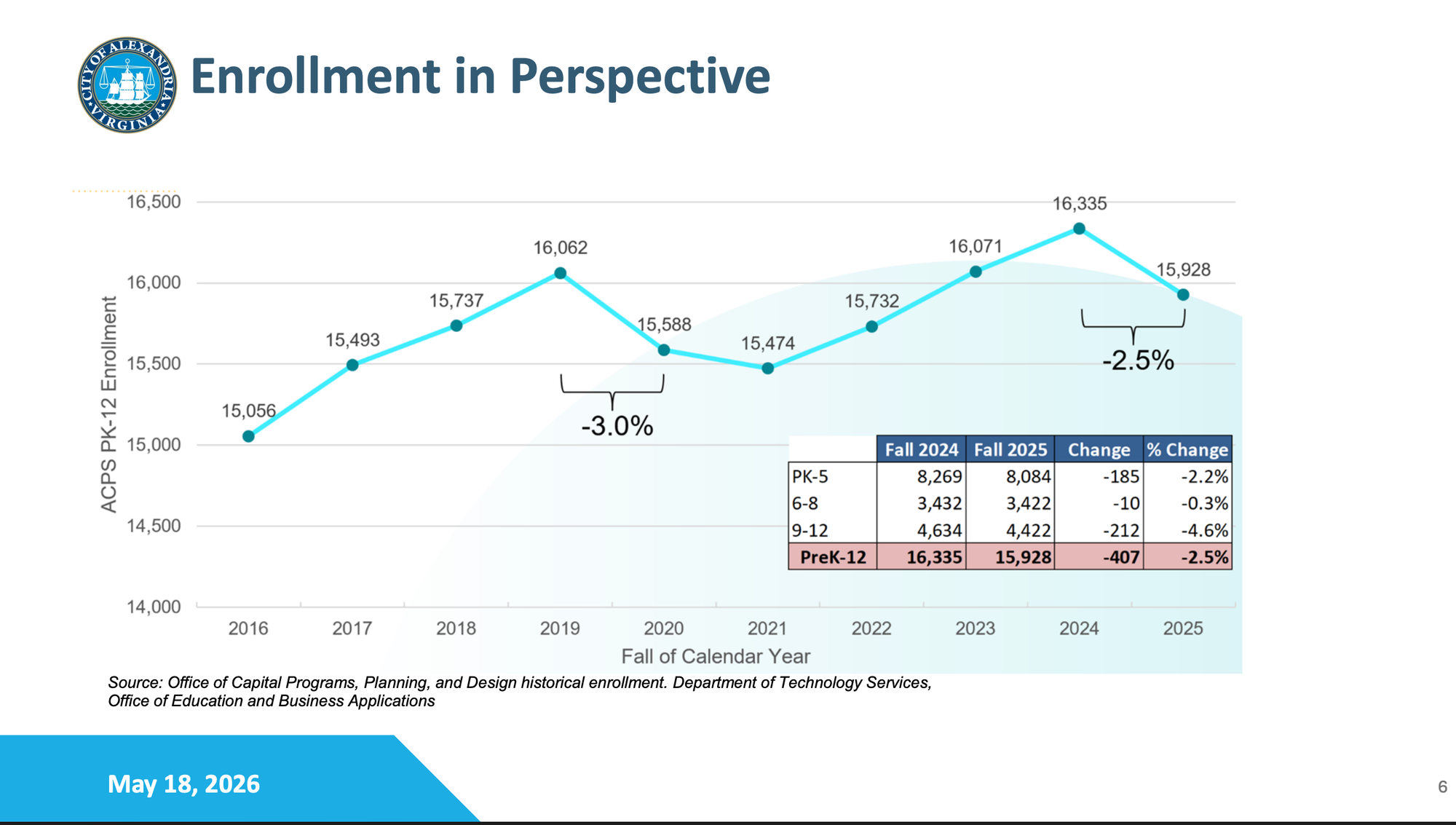
ALEXANDRIA, Va. — Alexandria City Public Schools enrolled 15,928 students in fall 2025, a drop of 407 students or 2.5% from the prior year — but the staff who briefed a joint City Council/School Board subcommittee Monday night urged officials not to read it as the start of a steep, sustained decline.
"There's no real enrollment cliff," Sophie Huemer, ACPS director of capital programs, planning and design, told the subcommittee. "There's a large narrative out there that enrollment's declining, births are declining, and so we're going to see this massive drop in enrollment. That's not true. We are seeing some slow declines over the next five years."
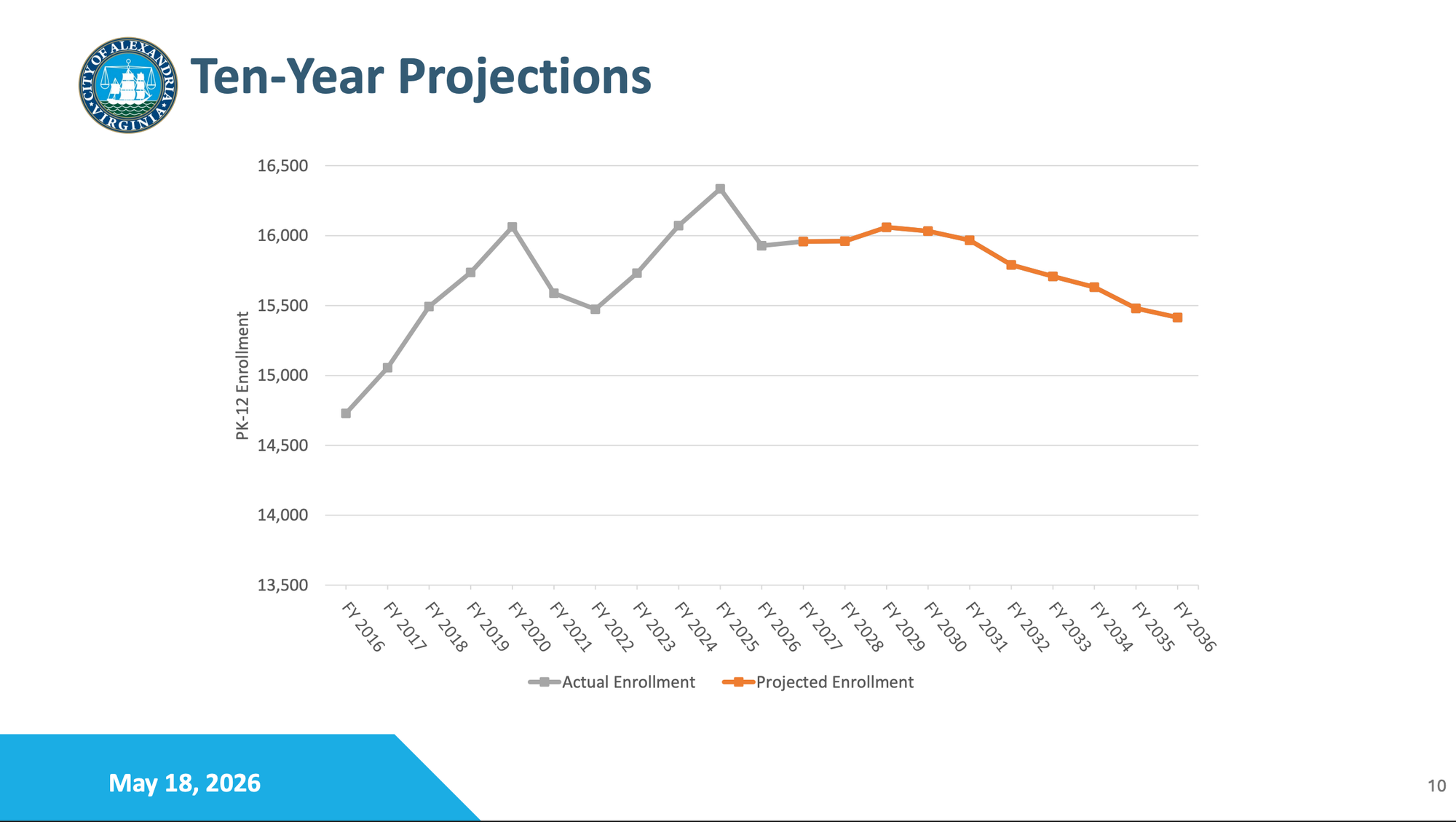
The 10-year projection presented Monday shows enrollment dipping slightly next year to 15,908, then hovering near 16,000 through the end of the decade before declining to 15,415 by FY 2036 — a net loss of about 500 students from current levels. Huemer said the five-year accuracy of the projection model runs 95% to 99%, and the 10-year accuracy 90% to 93%.
The path is uneven by grade. Elementary enrollment is projected to fall from 8,084 this year to 7,763 by FY 2036, a 4% decline. Middle school enrollment drops more sharply, from 3,422 to 3,105, down 9.3%. High school enrollment is projected to grow before declining, peaking at 4,899 in FY 2030 before settling at 4,547 — still above current levels.
The 10-year forecast diverges from this year's pattern, in which high school grades drove most of the drop. Grade 9-12 enrollment fell 4.6% in fall 2025, a loss of 212 students, while PK-5 fell 2.2% (185 students), and middle school was nearly flat, down 10 students.
The decline aligns with steeper losses across the region. Fairfax County reported a preliminary decrease of roughly 3,000 students, Montgomery County 2,600, Loudoun 1,000, and Arlington 300.
Births down, but still among the highest in Virginia
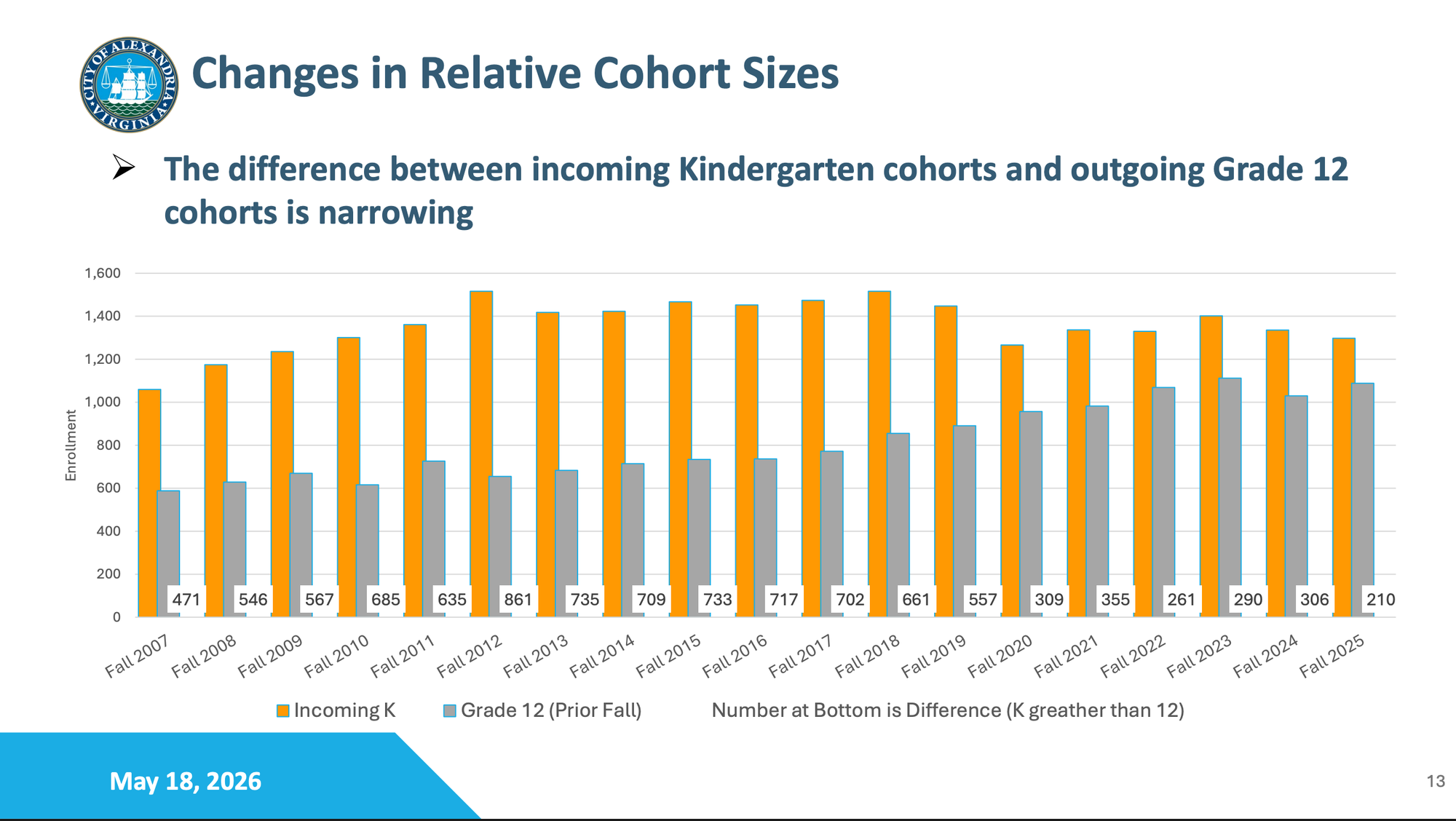
Two indicators point to leaner classes ahead. Births in Alexandria peaked at 2,816 in 2016 and have fallen to 2,278 in 2024 — the cohorts now reaching elementary and middle school. The gap between incoming kindergarten classes and outgoing 12th-graders, historically a source of net growth for the district, has narrowed sharply, from 861 students in fall 2018 to 210 in fall 2025.
Even at the lower count, Alexandria's birth rate remains among the highest in Virginia. The city recorded 14.7 births per 1,000 residents in 2023 — the most recent year for which data is available — tied for ninth-highest among the state's localities and well above its Northern Virginia peers, including Prince William (12.7), Falls Church (11.8), Loudoun (11.3), Arlington (11.1) and Fairfax County (10.9), according to the Virginia Public Access Project, citing U.S. Census Bureau estimates.
Why the headline number doesn't tell the budget story
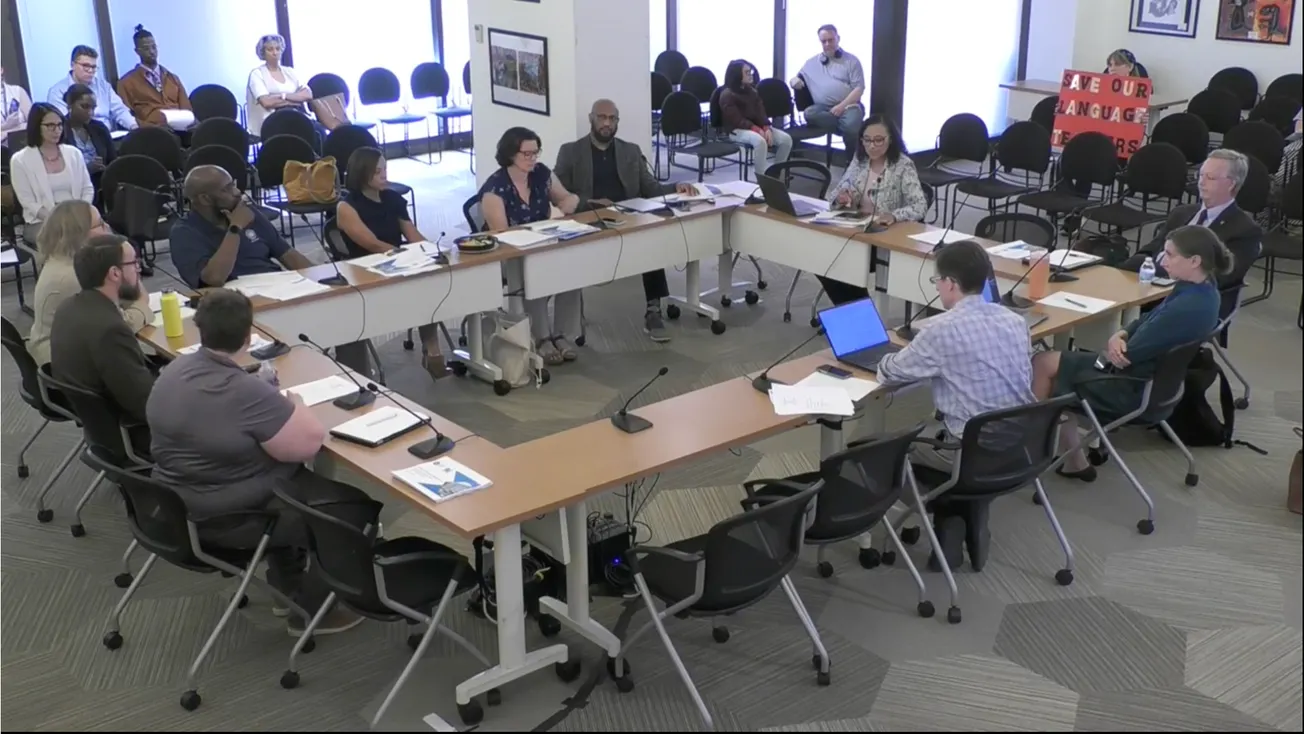
School Board Chair Michelle Rief chaired the session, joined by fellow subcommittee members Mayor Alyia Gaskins, Councilman John Chapman and School Board Vice Chair Christopher Harris. City Manager James Parajon was also in the room.
The conversation turned quickly to the demographic shifts inside the topline number.
Superintendent Melanie Kay-Wyatt said the falling student count masks growth in the populations that require the most services per student. "While we see a decrease in enrollment, we are seeing a growth in certain populations that we serve — our English language learner population and especially our students with disabilities or those students who receive specialized instruction," Kay-Wyatt said. Those students require "specialized classrooms" and smaller class sizes, she said, which carry their own facility and staffing costs.
Asked by Chapman what a resident should take away, Kay-Wyatt was direct: "Specialized instruction does come with an additional cost than educating a general student. … I hear it often, why are we all asking for additional funding," even as enrollment is flat or declining.
Rief said the conversation often misses that flat enrollment doesn't translate to flat budgets. "There is a tendency, I see, when people talk about public education to tie budgets strictly to enrollment," Rief said. Even with flat enrollment, "the costs continue to go up" because of staff raises, health insurance, and energy costs.
Rief also flagged a longer-term risk. "What we don't want is multiple schools to go below utilization, because that's when people start talking about the need to close schools," she said. "I don't think we're anywhere close to that right now, but … that's something that can happen when enrollment goes down."
Chapman drew a different conclusion from the data. "As the numbers say to me, the more development we're doing, it's not having as much of an impact as we grow," he said.
Generation rates show new development continues to add few students
Chapman's observation lined up with the second half of the presentation: Alexandria's annual update to its student generation rates, the per-unit ratios the city uses to estimate how many students a given housing project will produce.
The headline finding held from last year: 88% of ACPS students live in housing more than 30 years old; just 12% live in housing built in the last 30 years.
The rates vary substantially by housing age, with newer construction generating far fewer students per unit than older stock:
- Low-rise apartments and condominiums (one to three stories): 0.33 students per unit in older buildings, compared with 0.07 in newer ones
- Mid-rise apartments and condominiums (four to six stories): 0.19 versus 0.04
- High-rise apartments and condominiums (seven or more stories): 0.15 versus 0.03
- Single-family detached homes: 0.27 versus 0.17
- ARHA housing: 0.85 versus 0.74
- Other income-restricted housing: 0.55 versus 0.62
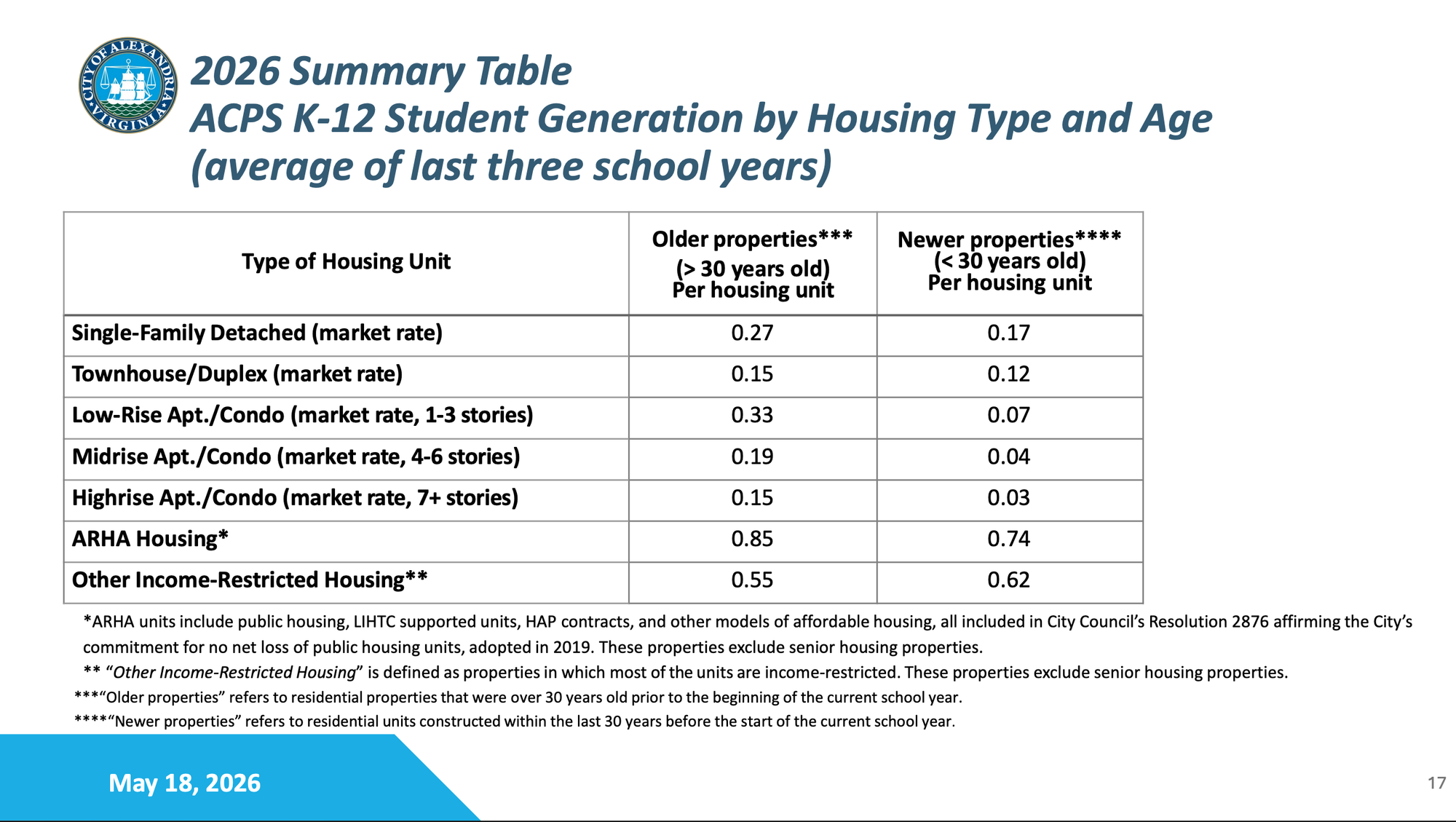
"New development generally has a lot fewer students," said Michael D'Orazio, a planner with the city's Department of Planning and Zoning. "For a high-rise apartment, 0.03 students per unit is what's generated."
Huemer cautioned against reading that as a story about building type alone. "Older housing generates more students [because] that's where people live," she said. "We're not generating '70s housing." The city's existing housing stock is concentrated in mid-20th-century construction, and that's where most families with school-age children currently live.
Year over year, the 2026 rates were largely consistent with 2025 figures, with the most notable shifts in ARHA housing, where the older-property rate fell from 0.92 to 0.85 and the newer-property rate from 0.76 to 0.74. Staff said they are also exploring whether to combine the two affordable housing categories — ARHA and other income-restricted — into a single category in future updates, because the two now produce similar generation rates in newer projects.
What's next
The 2026 generation rates take effect immediately in development review and will be refreshed each spring. ACPS will update enrollment projections in fall 2026 once the Virginia Department of Education delivers official Sept. 30 counts.
The data will also feed the district's long-range educational facilities planning process, for which ACPS has a request for proposals out for consultant services.