
Table of Contents
ALEXANDRIA, Va. - Alexandria's office vacancy rate fell to 18.8% in the first half of 2026 from 21.6% a year earlier, according to a mid-year market report the Alexandria Economic Development Partnership released Tuesday, though the improvement was uneven across the city and tenants continued to give back space.
The rate is better than Northern Virginia's 20.1%. On the other main measure, the comparison runs the other way: Alexandria posted negative net absorption of 160,400 square feet across an 18-million-square-foot inventory, while the region absorbed a positive 302,274 square feet. Net absorption tracks how much occupied space grew or shrank.
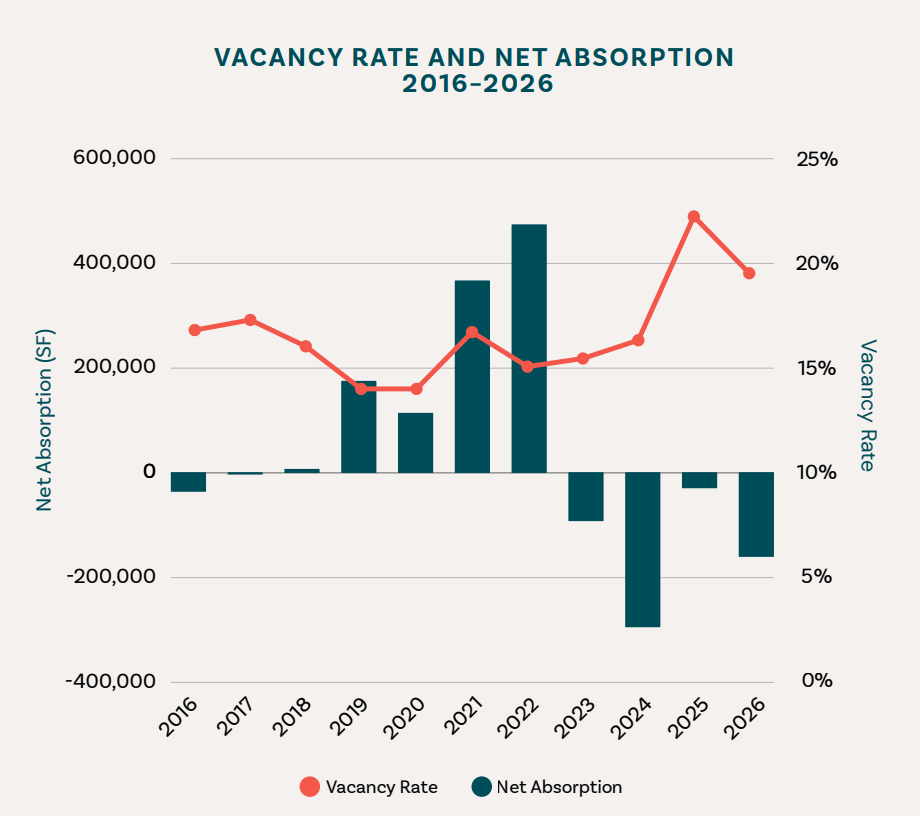
AEDP attributes the vacancy decline to retaining the National Science Foundation, which moved in May into a 386,600-square-foot building the U.S. Patent and Trademark Office had occupied, and to office conversions, including the start of construction at 5001 Eisenhower Ave., a long-vacant building becoming affordable housing. The report says tenants are resizing as the market adjusts, and that across the region companies are shedding square footage to move into newer, better-amenitized buildings.
Most of the year-over-year improvement had already arrived by January. AEDP reported an 18.9% vacancy rate for year-end 2025 in the report it presented to City Council in February, meaning the rate has moved a tenth of a point in six months.
Old Town is the outlier
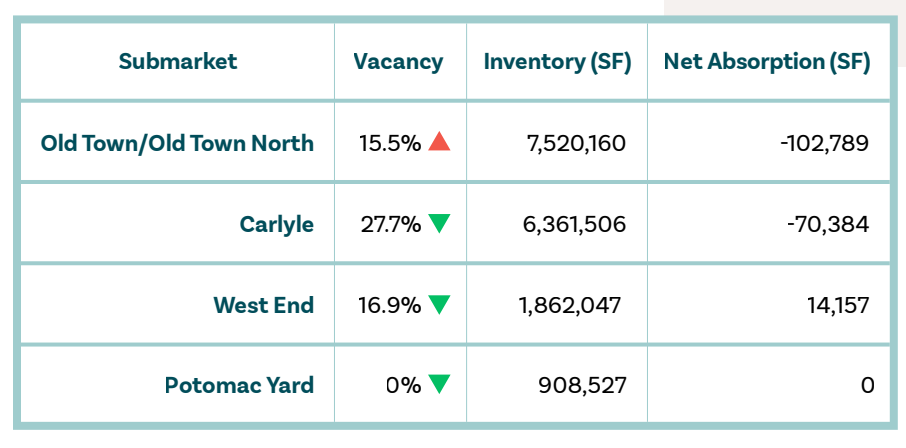
Of the city's four office submarkets, only Old Town and Old Town North saw vacancy rise. It reached 15.5%, and the submarket gave back 102,789 square feet, the worst net absorption in the city. It is also the largest, at 7.5 million square feet.
Carlyle remains the weakest by rate at 27.7%, down from 29.1% a year ago, with negative net absorption of 70,384 square feet. The West End improved to 16.9% and was the only submarket to add occupied space, 14,157 square feet. Potomac Yard again registered 0% vacancy across 908,527 square feet, which AEDP says signals demand outstripping a small inventory.
The largest leases signed were a 40,472-square-foot renewal by HumRRO at 66 Canal Center Plaza and 15,585 square feet taken by the Academy of Managed Care Pharmacy at 675 N. Washington St., both in Old Town North. Charles Schwab took 10,761 square feet at 1920 Ballenger Ave., and the Water Environment Federation 10,131 square feet at 1940 Duke St., AEDP's own address.
Four notable sales closed. The largest was the Alexandria Professional Center at 4660 Kenmore Ave., which Chicago Pacific Founders bought for $16.5 million, or $140.72 per square foot. AEDP notes the building is primarily medical office, a sector drawing stronger regional demand. NNN REIT paid $15 million for 3800 Richmond Highway in Potomac Yard, or $353.59 per square foot — more than twice the West End rate. Washington University of Science and Technology bought 2900 Eisenhower Ave. for $7.2 million, and the Cohen Clinic for Plastic Surgery paid $4.9 million for 1505 Prince St.
A first look at industrial
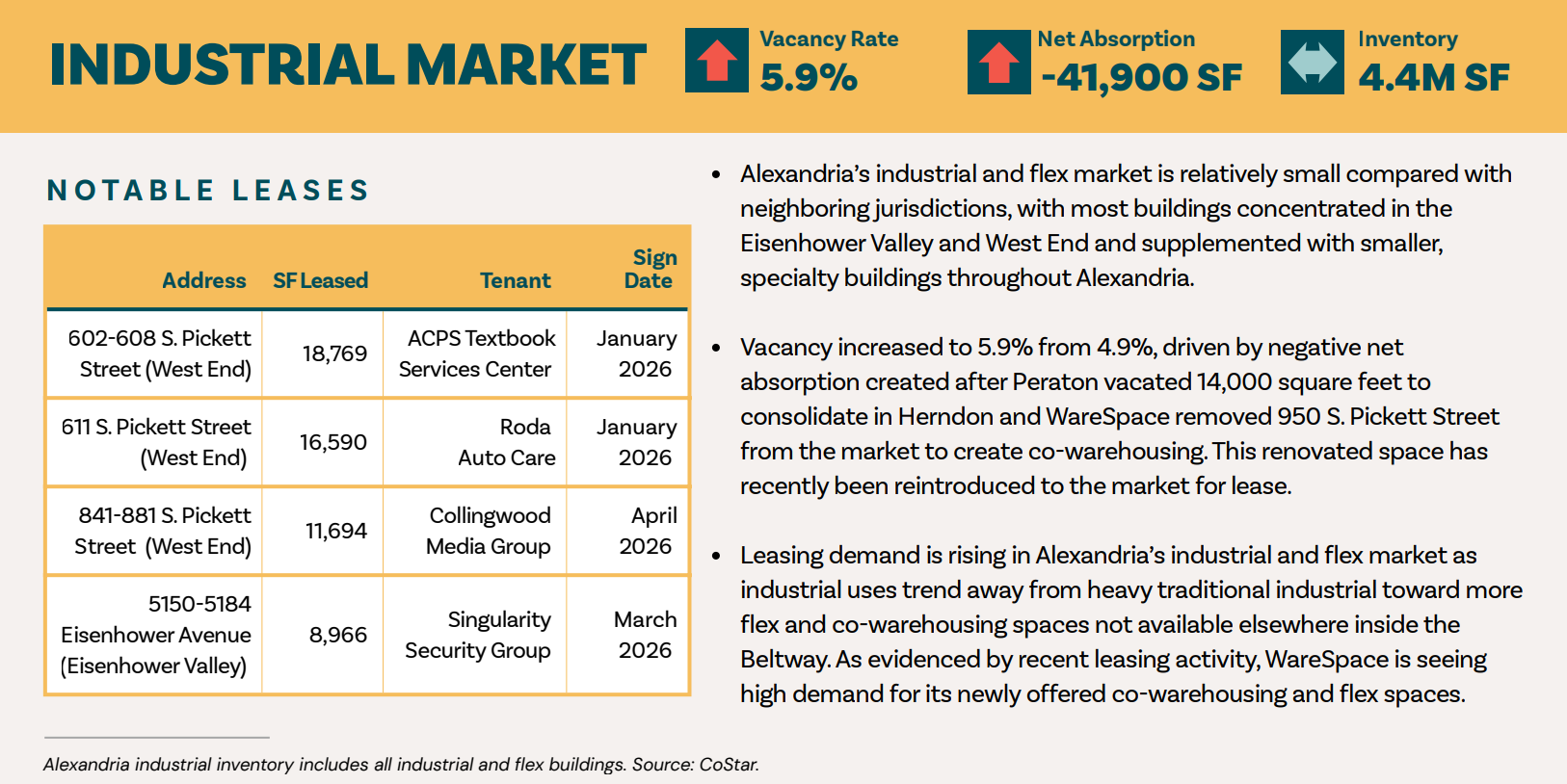
For the first time, the semiannual report examines the industrial and flex market, where AEDP says demand is rising because such space is scarce inside the Beltway. Vacancy there rose to 5.9% from 4.9%, with negative net absorption of 41,900 square feet across a 4.4 million-square-foot inventory concentrated in the Eisenhower Valley and West End.
The increase came after Peraton vacated 14,000 square feet to consolidate in Herndon and WareSpace pulled 950 S. Pickett St. off the market to convert it to co-warehousing. That renovated space has since returned for lease, and AEDP says WareSpace is seeing high demand for it.
Alexandria City Public Schools signed the largest industrial lease of the period, 18,769 square feet at 602-608 S. Pickett St. for a textbook services center. Roda Auto Care took 16,590 square feet at 611 S. Pickett St., Collingwood Media Group 11,694 square feet at 841-881 S. Pickett St., and Singularity Security Group 8,966 square feet on Eisenhower Avenue.
AEDP said its figures come from CoStar data, analyzed against the city's boundaries. Office inventory counts buildings larger than 5,000 square feet, and the submarket figures do not cover the entire city.
The report landed the same day City Manager James Parajon is scheduled to give a State of the Economy presentation to City Council, at the body's first meeting since summer recess. The meeting begins at 7 p.m. at the Del Pepper Community Resource Center.
Ryan Belmore is an Alexandria resident and the founder and publisher of The Alexandria Brief. Send tips, feedback, and story ideas to ryan@alexandriabrief.com.