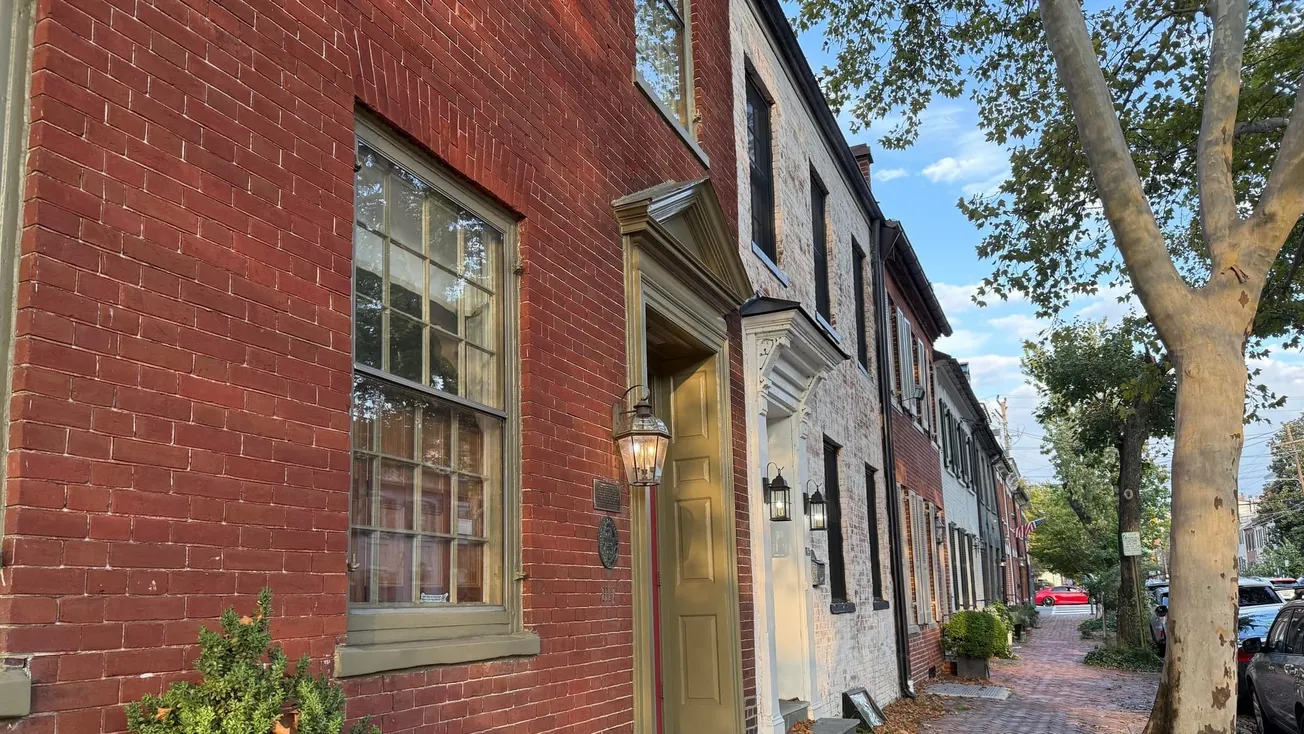
ALEXANDRIA, VA — Hotel AKA Alexandria served as the backdrop this week for the country's top gathering of state broadband officials, as the National Governors Association convened its 2026 Broadband Leaders Workshop Tuesday and Wednesday at the Old Town property.
The two-day workshop drew broadband directors, federal regulators, internet service providers and technology executives from 34 states and territories to the First Street hotel, putting a corner of Old Town at the center of a national conversation over how to get high-speed internet to the last stretch of unconnected American homes and businesses.
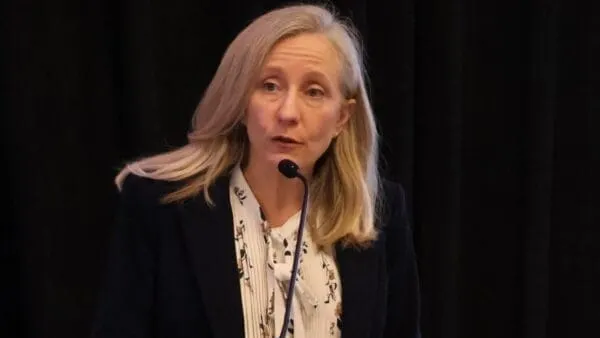
Virginia Gov. Abigail Spanberger welcomed attendees and framed the stakes in personal terms.
"Connecting the unconnected across America is an essential mission that will change the trajectory of the communities that you all serve," Spanberger told the group, according to the NGA.
In her keynote, the governor drew on her years representing a largely rural Central Virginia district in Congress.
"Throughout my time in Congress, I constantly heard from families, from farmers, from small business owners about what connectivity, or the lack thereof, meant for them," Spanberger said. "Addressing the digital divide is about so much more than simply being connected. It's about whether a family can afford internet connectivity at home. It is an issue of economic competitiveness."
Nearly 300,000 homes and businesses across Virginia have gained internet access since 2017, Spanberger said, and projects funded through the federal Broadband Equity, Access and Deployment program are set to break ground soon in the state's remaining unserved areas.
Virginia's own deployment story drew a hometown spotlight on the agenda, with Chandler Vaughan of the Virginia Department of Housing and Community Development walking peers through lessons learned alongside panelists from Comcast, Point Broadband and Searchlight Capital Partners.
The choice of Hotel AKA placed the national summit within a short Metro or cab ride of the federal agencies driving broadband policy. Officials from the Federal Communications Commission, the U.S. Department of Agriculture and the National Telecommunications and Information Administration all crossed the Potomac to brief attendees.
NGA CEO Brandon Tatum said governors are leading the national push.
"Your economic opportunities shouldn't depend on your zip code, and governors are working hard to make sure everyone in their states and territories has access to high-speed internet," Tatum said. "From broadband infrastructure investments to workforce training, governors are taking the lead in expanding access to the digital skills workers need to succeed."
Over the two days, attendees traded strategies on working with internet service providers and utilities to deploy broadband, streamlining state and local permitting, managing new federal reporting requirements and using data to reach rural areas. Federal officials briefed the group on programs including BEAD, the Rural Digital Opportunity Fund, the Middle Mile program, the Capital Projects Fund and ReConnect.
This week, NGA is hosting Governors' broadband leaders, key federal officials, partners and industry experts in Alexandria, Virginia for the 2026 Broadband Leaders Workshop. #BroadbandLeaders2026 pic.twitter.com/iHf2swrp2S
— NGA (@NatlGovsAssoc) April 21, 2026
Permitting — long a sore spot for broadband builders — drew its own session, with state broadband leaders from Arizona and Indiana joining industry representatives from USTelecom and Google Fiber to compare notes on state and local approval hurdles. In a separate fireside chat, NTIA's Amanda Pereira and NGA's Will Carraco discussed the role of state broadband offices in navigating federal permitting.
Other state officials took turns at the lectern. Maryland's Eric Bathras, of the state Department of Information Technology, highlighted his state's push toward next-generation statewide connectivity. Ohio broadband chief Peter Voderberg moderated a panel featuring Michael Baldino of the Massachusetts Broadband Institute, Meghan Sandfoss of the Kentucky Office of Broadband and the FCC's Ed Bartholme.
Private-sector participants included Comcast, AT&T, NCTA, Point Broadband, USTelecom, Google Fiber, McKinsey, BCG and Tarana Wireless.
The Alexandria gathering follows earlier NGA broadband workshops in Columbus, Ohio, and Overland Park, Kansas. In Ohio, Gov. Mike DeWine's Broadband and 5G Sector Partnership brings together 26 industry, education and government partners in collaboration with Ohio State University and the Wireless Infrastructure Association. In Kansas, Gov. Laura Kelly launched the Kansas Infrastructure Hub to coordinate state agencies and local entities on federal funding, alongside the Digital Opportunities to Connect Kansans program for digital skills training.
NGA also supports states through its Workforce Innovation Network, which has provided six states with technical assistance and grant funding to develop digital skills training plans.