Table of Contents
ALEXANDRIA, Va. — City staff showed City Council on Tuesday how it would work to fund Alexandria City Public Schools by budget category instead of in a lump sum, six months after council voted to make the change.
The plan has three moving parts. ACPS would send the city more detail earlier, with some working figures arriving around December rather than shortly before the city manager's proposed budget in February. Council's add-delete process, where it makes final changes to that budget, would have to account for changes within ACPS categories. And once council appropriates by category, moving money between categories during the year would require council's approval above a proposed $500,000 threshold.
It all applies to the fiscal 2028 budget. City Manager James Parajon framed the change as one of transparency, noting that ACPS accounts for roughly a third of the city's budget.
"Dollars that go to ACPS are the same dollars that are used to provide programs and services for the entire community," Parajon said.
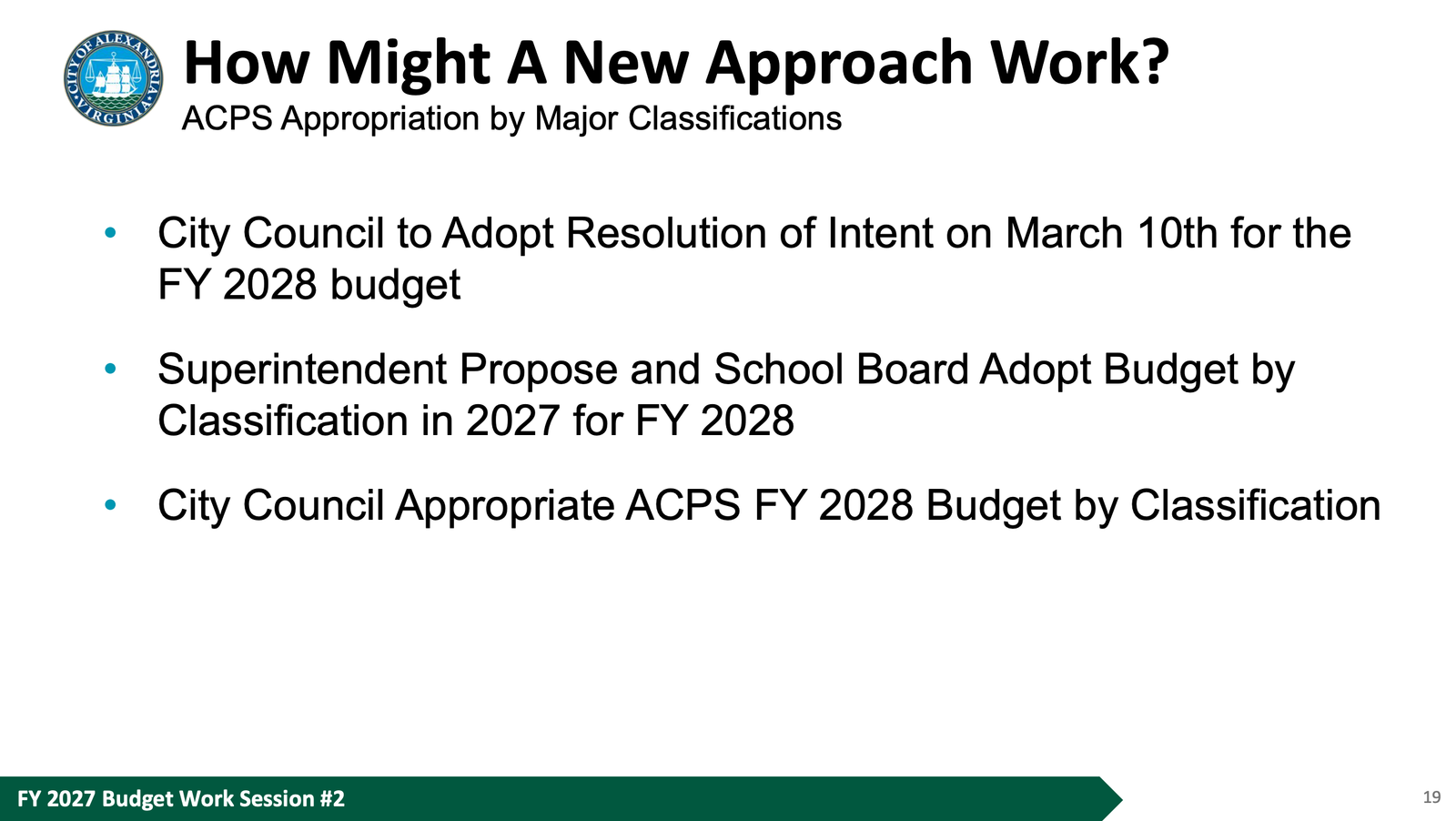
Council adopted Resolution 3368 in March, stating its intent to appropriate by the nine classifications set out in state code, which ACPS already uses to build its budget. The resolution says council "wishes to increase transparency and greater detail" in how it budgets and appropriates money to the schools.
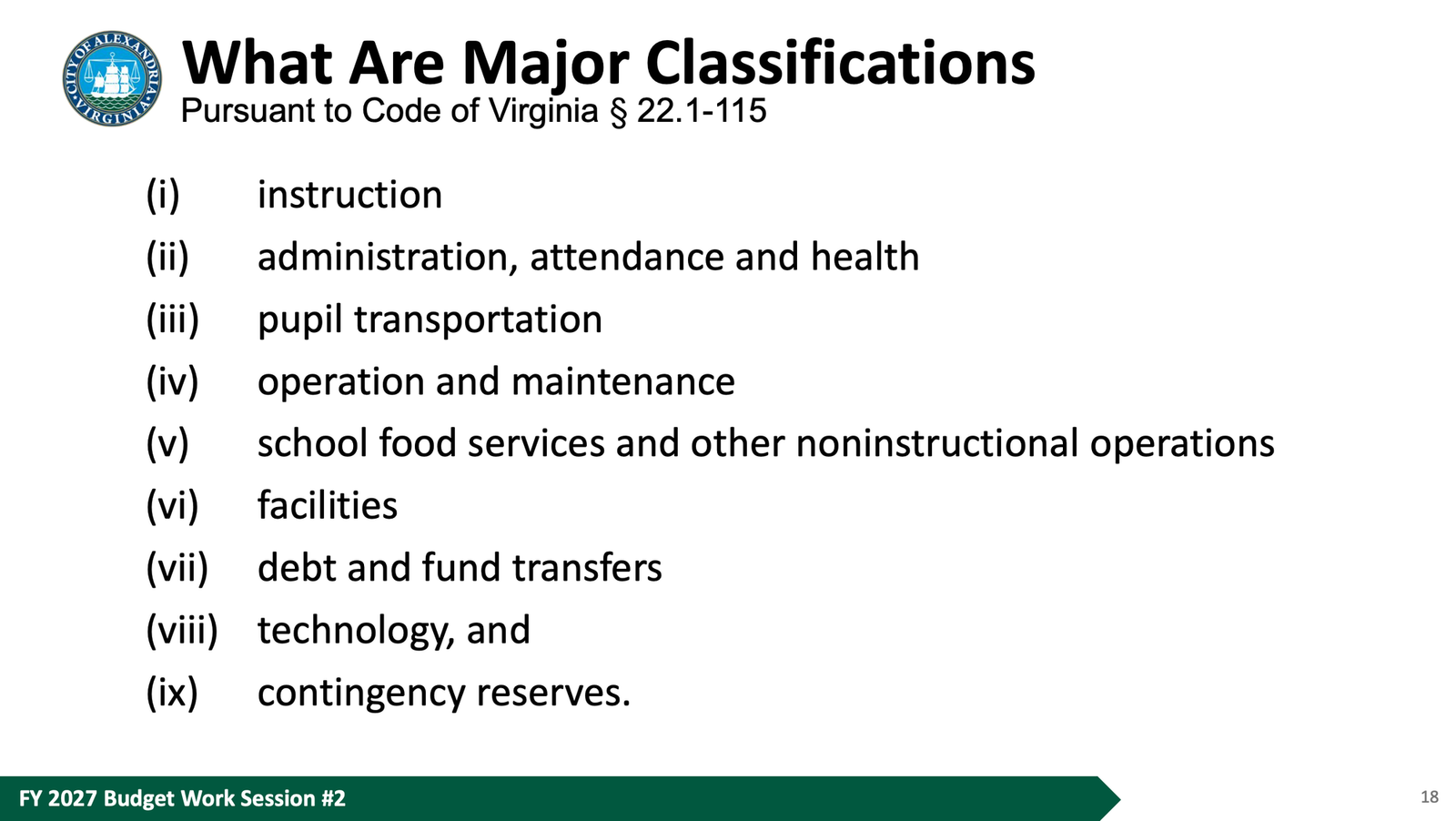
It set no mechanics. Its three resolved clauses direct ACPS to submit an estimate by classification and a report of expenditures, and state council's intent to appropriate that way for FY 2028. The plan staff outlined in March had three steps, all about budget adoption. What happens after adoption, when money needs to move between categories mid-year, was not part of that public outline. Tuesday was the first time staff put that piece in front of council.
Moving money between categories
Under Virginia Code § 22.1-89, once funds are appropriated by classification, a school board cannot spend outside those classifications without the governing body's consent. That is what makes a transfer process necessary.
Staff proposed that council delegate that authority to the city manager below $500,000, with those transfers reviewed and documented administratively and reported to council monthly.
Budget Director Morgan Routt said the threshold came from reviewing other jurisdictions, where practice ranged from no threshold at all to $100,000. Chesterfield County uses $500,000.
Applied to last year, the effect is narrow. Routt said ACPS made about 29 transfers between classifications in fiscal 2026. Roughly eight were over $100,000. Two were over $500,000.
Parajon said council could set a different number, and that staff had also considered $250,000 to $300,000.
What the advisory committees found
Much of the groundwork came from a joint memorandum by the city's Budget and Fiscal Affairs Advisory Committee and the School Board's Budget Advisory Committee, sent to every council member, School Board member and senior staffer on July 16. Parajon credited the two committees Tuesday, saying their review and analysis of past ACPS budgets and transfers played a critical role over the summer.
The memo describes Chesterfield's structure differently than Tuesday's presentation suggested. There, the county's appropriations resolution delegates authority for transfers up to $500,000 to the school division itself, with the superintendent approving under $50,000 and the school board approving between $50,000 and $499,000. Alexandria's proposal would give the same dollar authority to the city manager. In Lynchburg, the school board approves transfers under $100,000; in Spotsylvania, every transfer goes to the Board of Supervisors. Chesterfield staff told the committees that transfers requiring county approval can take two to three months.
The committees also counted transfers differently. Their memo put the number at roughly 264 transfers between classification categories in the then-current fiscal year, about a third of all ACPS transfers, with 90% under $25,000. Both counts agree that eight exceeded $100,000, which suggests the two define a transfer differently rather than describing different activity. The city has not publicly reconciled them.
The memo, written by Nancy Drane and Randall Williams of BFAAC and Christina Hildebidle and Benjamin Bryant of the School Board committee, made four recommendations, all adopted by both bodies: tiered transfer thresholds rather than a single one, a fast-track process for time-sensitive transfers, consideration of a funded contingency reserve, and a legal analysis of how classification appropriation interacts with collective bargaining. Staff set the tiered approach aside to keep the process simple. Tuesday's presentation focused on the transfer process and the budget calendar.
The committees found that in the three jurisdictions they studied, appropriating bodies rarely changed anything beyond the total transferred to schools, relying on school staff to calculate the categories, and that none reported improved public engagement. One jurisdiction's staff told them the approach "really is a lot of work and changes nothing." The memo also warned the change could reduce transparency in one respect, if it displaces the roughly six-week public process the School Board runs after the city sets its final appropriation. Council did not ask the committees to recommend for or against the change, and the memo does not.
What council asked about
Vice Mayor Sarah Bagley asked whether the threshold accounted for the scale of Alexandria's obligation to its schools, noting the city funds about 80% of the school system's budget while many jurisdictions using this method fund 30% to 40% and run smaller systems. Parajon said the figure is scaled to that difference. Bagley also asked for monthly reporting with analysis rather than a straight list; Routt said ACPS already produces a monthly transfer report for the School Board and the city could share it and flag transfers approaching the threshold.
Councilwoman Sandy Marks asked whether a lower threshold could be set at the discretion of ACPS staff. Parajon said appropriations require council action under state law and cannot be delegated to a non-city entity.
Marks also raised the coming collective bargaining agreement, noting support staff are funded across multiple categories. Parajon said that level of detail would need to be worked out with the ACPS chief financial officer, particularly if council wanted to move money between categories during add-delete. The July memo had flagged the same issue, noting Alexandria is the only one of the four jurisdictions studied with a collective bargaining agreement and raising the possibility of a conflict between council's appropriation authority and the School Board's obligation to honor a negotiated contract.
"I'm just hoping, inasmuch as we are trying to provoke transparency in budgeting from our school system, that we are equally as transparent during this process to make sure nobody such as support staff falls through the cracks," Marks said.
Councilwoman Jacinta Greene asked staff to be clear with the public that ACPS can still move money within a category on its own, and that only transfers between categories above the threshold would reach council. Parajon confirmed that.
Councilman John Taylor Chapman asked how the process would catch a shift from operating spending to the capital improvement program, citing a past conversation about textbooks. Routt said transfers between classifications would be visible regardless of size, and that any change to a capital appropriation runs through the CIP process separately. Chapman also asked whether an incoming superintendent would have a chance to weigh in; Parajon said the staff team, including Routt, Finance Director Kevin Greenlief and David Lanier of the City Attorney's Office, would brief new ACPS staff.
How Alexandria got here
Council adopted the resolution unanimously on March 10, during a budget season shaped by a $5.6 million gap between what ACPS said it needed to honor its first collective bargaining agreement and what the city manager had proposed.
Mayor Alyia Gaskins previewed the change at a joint work session six days earlier, framing it in terms of that dispute. If the public told council to fund collective bargaining, she said, "there's a way that the category can say collective bargaining," and residents would be able to see whether it was funded.
All nine School Board members signed a letter the day before the vote asking council to postpone and hold a joint work session first, saying the resolution was introduced at a March 4 work session focused on the FY27 budget, appeared on a revised council docket two days later and was never formally shared with the board. The letter asked how classification caps would interact with collective bargaining obligations, how transfers would work, and why council was diverging from the Virginia Appropriation Act's recurring language urging localities to appropriate school funds as a lump sum.
Gaskins told council the resolution was non-binding and applied only to the operating budget. "This is not about changing our operational role or changing the operational role of the school board," she said. The advisory committees wrote in July that the shift is more than a change in presentation and "fundamentally restructures the working relationship" between the appropriating body and the school system.
Councilman Abdel-Rahman Elnoubi was more pointed in March, saying that by many metrics the system was not working and citing the School Board's handling of the Jefferson-Houston conversion. Chapman said the transparency goal had been on his mind since 2013. Councilman Canek Aguirre dismissed the legal objections, noting the authority is in state code.
Greene asked staff in March to research why Alexandria discontinued the classification model, which the city apparently used in the 1990s. The advisory committees took the question up in July, citing a column by former School Board member Mark Eaton, who wrote that council weighed the approach in the 1990s amid pressure on ACPS to adopt all-day kindergarten, and quoted a former council member saying it did not work for changing a specific program because "categories don't get you there."
What happens next
Gaskins asked for a draft of how add-delete will work under the new system, either by the Nov. 10 budget guidance meeting or before council's first work session with the School Board, and asked for the side-by-side city and ACPS budget calendar in time for the Nov. 7 retreat.
"It's going to be new for all of us," Gaskins said.
The committees had recommended a joint work session with the School Board in early fall to build the implementation plan, and suggested at least three joint sessions may be needed during the budget year. Tuesday's presentation was made to council alone; Parajon said the work had involved ACPS staff over the summer.
Council would take up the delegation itself as a separate docket item, through a resolution.
Ryan Belmore is an Alexandria resident and the founder and publisher of The Alexandria Brief. Send tips, feedback, and story ideas to ryan@alexandriabrief.com.