ALEXANDRIA, Va. — The metropolitan division that includes Alexandria lost more jobs over the past year than any other metro area in Virginia, according to data released last week by Virginia Works — and a separate analysis released Monday by the Metropolitan Washington Council of Governments shows the broader Washington region is bearing a disproportionate share of the nation's federal-workforce contraction. The numbers land just two days before the City Council adopts its fiscal 2027 budget.
Total nonfarm employment in the Arlington-Alexandria-Reston Metropolitan Division fell to 1,617,500 in January, down 22,700 jobs, or 1.4%, from a year earlier and down 4,700 from December alone, the state's Department of Workforce Development and Advancement reported April 22. Both figures led all 10 Virginia metro areas tracked. The Virginia Beach-Chesapeake-Norfolk region was a distant second, losing 2,300 jobs over the year.
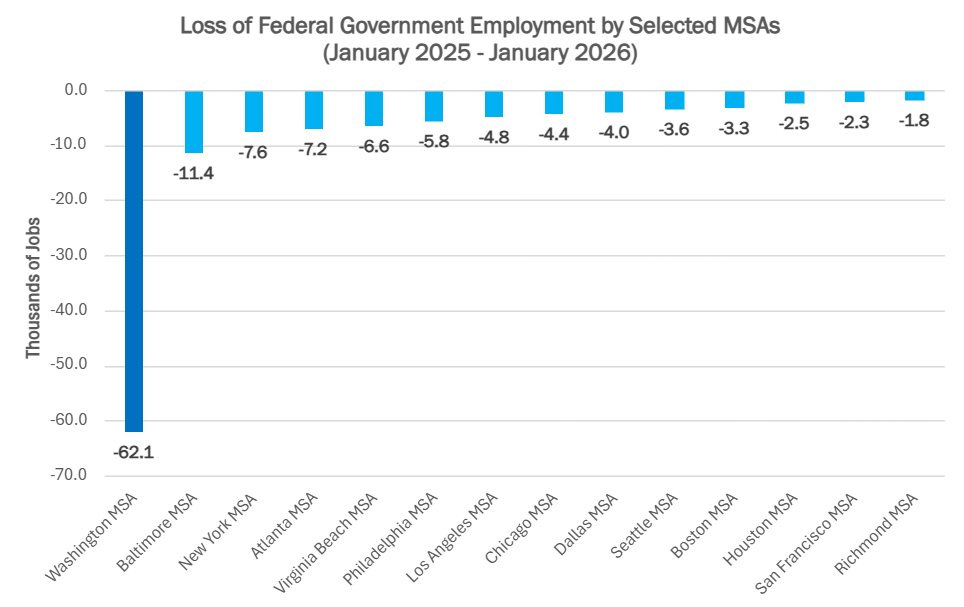
The Washington Metropolitan Statistical Area shed 62,100 federal jobs over the same year-long period, COG reported Monday, dropping the region's federal workforce to 313,700 — its lowest level since 1990, when the Bureau of Labor Statistics began publishing the series. Federal cuts accounted for the majority of an overall 103,900 jobs lost in the region.
The 16.5% drop in Washington-area federal jobs outpaced peer metros nationally. New York lost 7.4% of its federal workforce over the year, Philadelphia 10.1% and Boston 9.3%, according to COG's analysis of BLS data. Only Baltimore, at 20.5%, lost a higher share.
"The numbers are stark. We cannot achieve long-term economic resilience without coordinated action," COG Executive Director Clark Mercer said in a statement. He noted that D.C. Mayor Muriel Bowser, Virginia Gov. Abigail Spanberger and Maryland Gov. Wes Moore have met twice to discuss workforce development and other regional priorities.
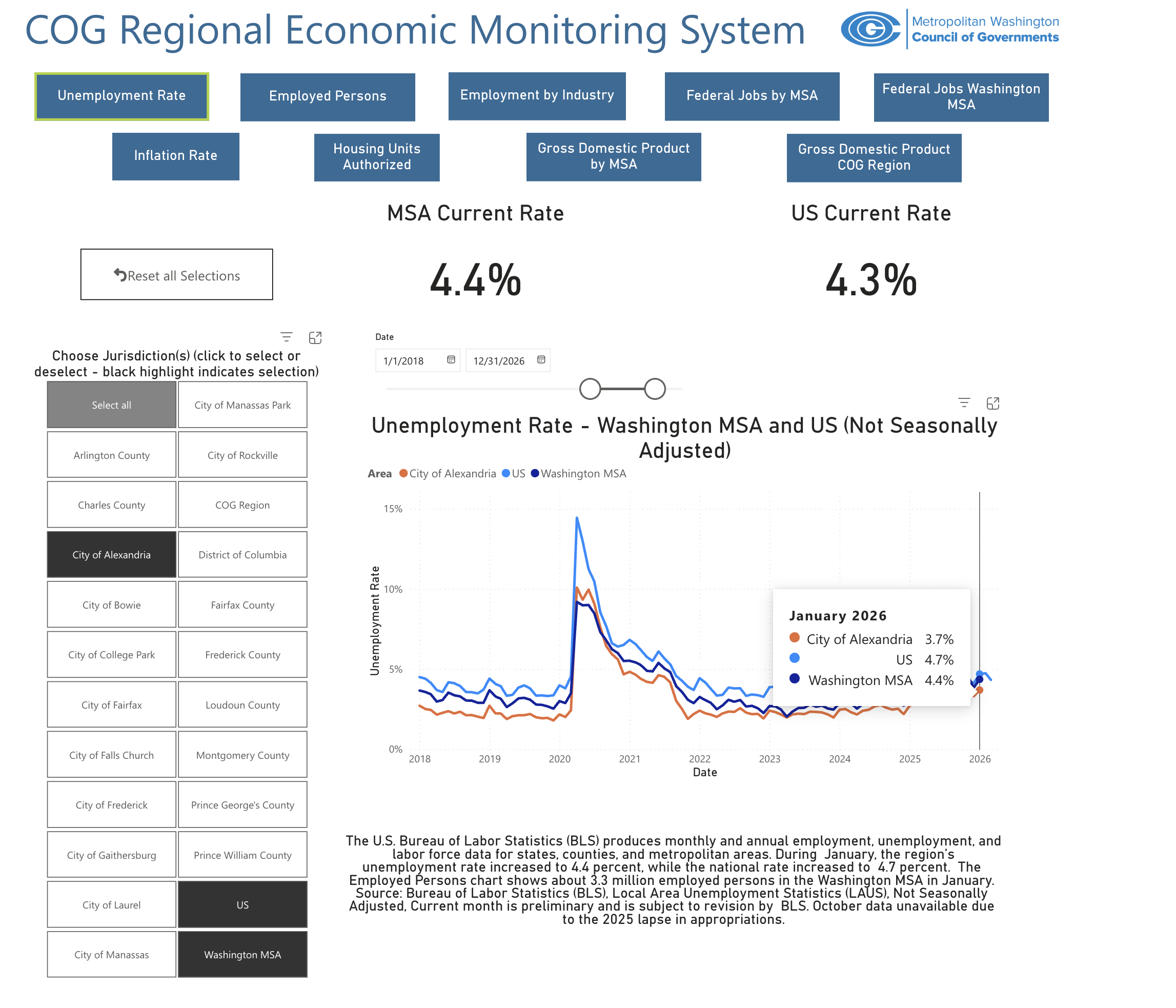
Regional unemployment rose to 4.4% in January from 3.8% the previous month, while the national rate was 4.7%. October data is unavailable because of last fall's lapse in federal appropriations, COG noted.
Statewide, federal government employment in Virginia fell by 26,000, or 13.3%, to 169,700 — by far the largest year-over-year sectoral decline in the commonwealth. Professional and business services, the sector most closely tied to federal contracting, lost 16,100 jobs over the same period. Virginia's seasonally adjusted unemployment rate ticked up to 3.7% in January, still 0.6 percentage points below the 4.3% national rate.
Alexandria's January unemployment rate was 3.7% on the COG dashboard — below both the regional and national figures, and consistent with what Brookings Institution fellow Tracy Hadden Loh told the City Council on March 10. Loh said Alexandria's federal employment had fallen about 4.8% from January 2025, compared with the 13.7% drop across the broader Washington metro that her team measured at the time. The U.S. Department of Housing and Urban Development selected Alexandria for its planned headquarters relocation in 2025, and the National Science Foundation remained in the city.
But the second-order effects are already showing up in city revenues, City Manager James Parajon told the council in his April 14 State of the Economy report. National unemployment remained elevated at 4.3% and inflation rose to 3.3% in March, driven in part by global conflict, Parajon said. Gas prices hit $4.17 on April 9.
Locally, the city manager said, Alexandria's real estate market is cooling — average days on market have risen from 28 to 44, and the sale-to-list price ratio has slipped from 99% to about 97%. More concerning, Parajon said, meals tax and transient lodging tax revenues are running negative year-to-date in fiscal 2026, reflecting reduced business travel and tighter household spending.
"We're hopeful that that trend will change," Parajon told the council.
The softening tax base lands at a sensitive moment. Parajon's proposed $977.3 million general fund budget — set for adoption at 6 p.m. Wednesday at the Del Pepper Community Resource Center — closes a $22.9 million gap without raising the real estate tax rate, in part by eliminating 45 vacant positions and identifying $9 million in efficiency savings. The plan also sets aside $1 million in fund balance for lost grant funding, which Parajon described in February as "the protection against some of the poor decisions that the federal government could make," and another $1 million for economic incentives.
The pain in the broader regional private sector is well documented. Brookings found that private employment in Alexandria fell 1.1% over the course of 2025, even as the broader metro posted a 0.4% gain. Federal contract obligations in the city dropped 16% from November 2024 to November 2025. Resident spending at brick-and-mortar retailers fell 7.77% over a comparable period, and non-business bankruptcy filings rose 28.4% between the fourth quarter of 2024 and the same period in 2025. More than 20% of Alexandria's workforce holds federal jobs, well above the Northern Virginia average of 12.5%.
Local and regional officials have leaned on workforce-development tools as a near-term lever. COG's Talent Capital platform — an AI-powered job-matching tool developed with local firm BuildWithin and launched last fall with Bowser and other regional leaders — now connects more than 83,000 active users to 65,000 full-time jobs, the council said Monday. Other regional efforts include Montgomery County's Mobilize Montgomery career center and the Pivot with Purpose Career Expo, sponsored by Virginia Works, the Maryland Department of Labor and the D.C. Workforce Investment Council. COG also partners with Brookings Metro on the DMV Monitor, which tracks indicators across real estate, venture capital and tourism.
In Alexandria, Rep. Don Beyer, D-Va., has helped organize regional job fairs for displaced federal workers. In February, Alexandria and Arlington jointly launched the National Innovation Quarter, a nonprofit backed by Amazon, Northrop Grumman and Virginia Tech aimed at strengthening the region's defense-tech and startup ecosystem.
Council will adopt the FY 2027 budget and set the calendar year 2026 tax rate Wednesday with six members rather than seven; the winner of last week's special election to fill former Councilmember Kirk McPike's seat will not be seated until May 12.
Sources: Metropolitan Washington Council of Governments Regional Economic Monitoring System and statement, April 27, 2026; Virginia Works, Local Area Unemployment Statistics and Current Employment Statistics, released April 22, 2026; Brookings Institution DMV Monitor; City of Alexandria FY 2027 budget materials and prior State of the Economy reports; prior Alexandria Brief reporting.