Table of Contents
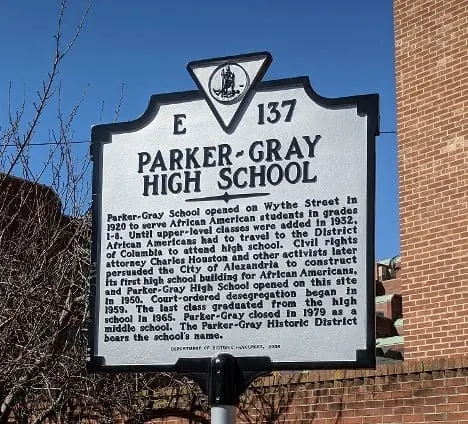
ALEXANDRIA, Va - On May 31, 1950, Parker-Gray High School was dedicated at 1207 Madison Street as Alexandria's first dedicated high school building for Black students, marking a milestone in the city's long fight for equal access to public education.
The dedication followed a years-long campaign by Alexandria's Black community and civil rights attorney Charles Houston, who served as lead NAACP counsel and pressed city, state, and federal officials to fund a separate high school building. Until then, Black students in Alexandria who wished to continue beyond the eighth grade had to travel to Washington, D.C., or to Manassas, Virginia, to attend a segregated high school, despite a 1920s Virginia law requiring public education through high school.
A name rooted in the city's earliest Black schools
The school's name traces back to two of Alexandria's earliest African American schools, both opened after the Civil War under the Freedmen's Bureau: the Snowden School for Boys, in the 600 block of South Pitt Street, and the Hallowell School for Girls, in the 400 block of North Alfred Street. As both buildings became overcrowded and dilapidated, the community pressed for better facilities — a campaign led by the Rev. S.B. Ross of Third Baptist Church, Samuel Tucker, Samuel Madden, Henry T. Taylor, Mrs. Blanche Taylor, the Teachers' Association and alumni of both schools.
When the new combined school opened in 1920, it was named Parker-Gray in honor of Snowden's principal John F. Parker and Hallowell's Sarah A. Gray.
A New School, separately and unequally funded
In September 1920, Parker-Gray opened at 901 Wythe Street, teaching grades one through eight under teacher-principal Henry T. White and nine other teachers. The City of Alexandria provided only the barest necessities; community members and alumni raised about $4,000 themselves to outfit the building — chairs for the auditorium, a stage curtain, equipment for the home economics room, reference books, a typewriter, a Victrola and records, even half the cost of window shades.
In 1932, under Principal Wesley Elam, another community campaign succeeded in adding high school grades, making Parker-Gray the first high school for African Americans in Alexandria. The first 11th-grade class graduated in 1936.
A new building, a "Golden Age," and a name in honor of Houston
By the late 1940s, growing enrollment again forced the issue. The community pressed for a new high school, and in 1950 the city built one at 1207 Madison Street. The original Wythe Street building was renamed Charles Houston Elementary School in honor of the NAACP attorney who had championed the project. Houston, who mentored Thurgood Marshall and helped architect the legal strategy that would lead to Brown v. Board of Education in 1954, died in April 1950 — weeks before Parker-Gray's new building was dedicated on May 31.
The 15 years that followed are often called Parker-Gray's "Golden Age." The school added 12th grade in 1953 and dedicated an addition in 1963. Its alumni went on to become doctors, lawyers, judges, teachers, military officers, government workers and the first African American chairperson of the Alexandria School Board. Class of 1947 graduate Earl Lloyd became the first African American to play in the NBA.
Desegregation and a long afterlife
Court-ordered desegregation began in Alexandria in 1959, and in the fall of 1964 the school system fully integrated. Parker-Gray High School closed in 1965, the same year T.C. Williams High School opened. The building reopened that fall as Parker-Gray Middle School under new principal E.L. Patterson, and operated until 1979.
The original Wythe Street school later burned down. In 1976, the Charles Houston Recreation Center opened on the site, and today it houses the Alexandria African American Hall of Fame, where many Parker-Gray alumni are honored. A statue of Earl Lloyd is planned for the center. The Madison Street high school building is also gone; the site is now Braddock Place, home to the Alexandria City Public Schools central office. In 1983, the stadium at T.C. Williams High School was dedicated as Parker-Gray Memorial Stadium. In 2015, ACPS marked the 50th anniversary of desegregation with a plaque, and in 2020, the city commemorated the school's 100th anniversary with the unveiling of a Parker-Gray School Memorial Walkway.
A Parker-Gray alumni association, formed in 1975, ensures the legacy continues to be remembered.
The Parker-Gray archives
The Parker-Gray Archives, maintained by the Alexandria Black History Museum, contains more than 300 photographs along with documents, yearbooks and other memorabilia from the school's 1920 to 1979 history. Photographs from the Parker-Gray School Collection can now be viewed at Historic Alexandria Collections Online, where the museum is also asking the public to help identify individuals in the photos.
Information via the City of Alexandria's Historic Alexandria, the Alexandria Black History Museum and Alexandria City Public Schools.