ALEXANDRIA, Va. — Three anniversaries link this date to Alexandria's political, wartime and preservation history.
A former mayor's death at the Lee-Fendall House (1843)
On May 30, 1843, Edmund Jennings Lee I — a former mayor of Alexandria, a prominent lawyer and a founder of Virginia Theological Seminary — died at the Lee-Fendall House in Old Town at age 71.
Lee served as mayor from 1815 to 1818 after rising through the Alexandria Common Council, which he led as president beginning in 1810. A member of the Lee family of Virginia, he was an uncle of Confederate Gen. Robert E. Lee and a brother of Henry "Light-Horse Harry" Lee, of U.S. Attorney General Charles Lee, and of Richard Bland Lee, Northern Virginia's first congressman. He was best known as a lawyer who successfully defended Christ Church's Glebe lands from confiscation after the Revolutionary War, and he served the church as vestryman and warden.
Financial reverses cost Lee his home in 1833, when he was forced to sell the Lee-Fendall House at auction. His son Cassius bought the house back several years later, and Lee returned to it before his death there. He was buried beside his wife, Sarah, at the Christ Church Episcopal Cemetery on Wilkes Street.
A presidential rivet at Jones Point (1918)
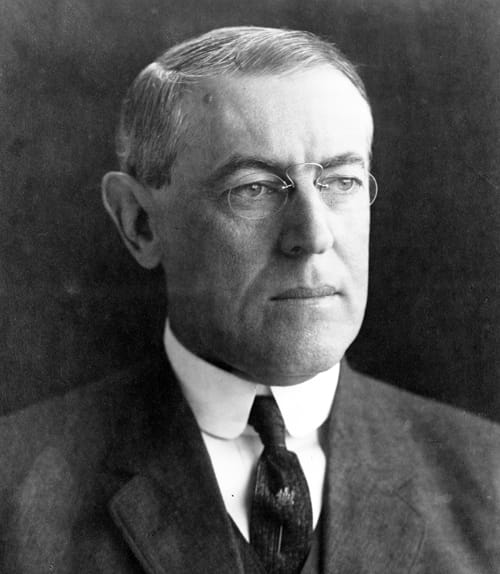
On May 30, 1918, President Woodrow Wilson drove the first rivet into the keel of the Gunston Hall, the first ship under construction at the new Virginia Shipbuilding Corporation yard at Jones Point. The yard had been organized in response to the U.S. Shipping Board's emergency call for cargo vessels during World War I, part of a national push to expand merchant shipping capacity as the country entered the war.
The Gunston Hall was launched the following February, along with a second ship, the Betsy Bell. The shipyard sat near the southernmost point of the original District of Columbia diamond, anchored at Jones Point Lighthouse — a tract that had been returned to Virginia in the 1846 retrocession.
Decades later, the Potomac River bridge connecting Alexandria to Maryland would be named for the same president who set the yard's first rivet. The original Woodrow Wilson Memorial Bridge opened in 1961; the twin-span replacement was completed in 2008.
A Civil War fort restored (1964)
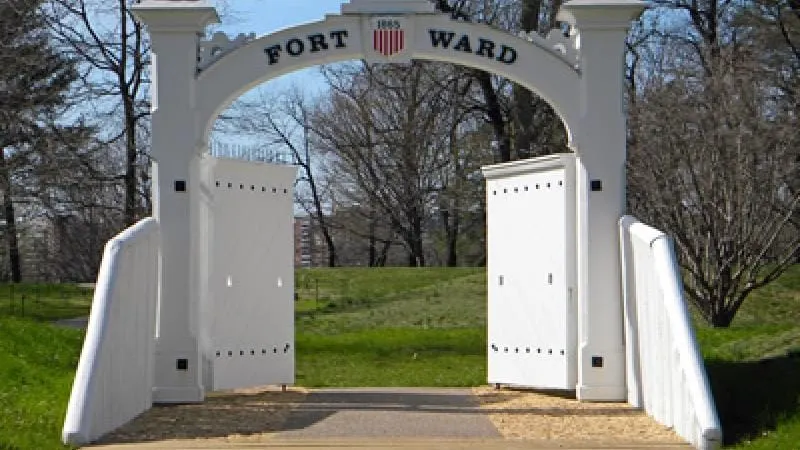
On May 30, 1964, the city dedicated Fort Ward Park at 4301 W. Braddock Road, completing Alexandria's first major historic preservation project. The reconstructed Northwest Bastion of Fort Ward — a Civil War-era earthwork — was unveiled in time for the American Civil War Centennial.
The fort was one of dozens built to defend Washington during the Civil War and is named for James Harmon Ward, the first U.S. naval officer killed in the conflict. Today it remains the best-preserved of the Union forts and batteries that ringed the capital, a system known collectively as the Civil War Defenses of Washington.
What opened as a small visitors' center evolved into a museum after Civil War collector Dr. Francis A. Lord made a long-term loan of his private collection. The city purchased nearly 600 objects from that collection in 1972, and Fort Ward Museum's holdings have grown to more than 4,000 items from the Civil War period, including military arms and equipment that interpret soldier life at the fort and objects documenting local history during the war.
Information via the Office of Historic Alexandria, with additional historical reporting.