ALEXANDRIA, Va. — Police Chief Tarrick McGuire will ask the City Council for feedback Tuesday on a new Public Safety Plan, a strategic framework that turns the data-driven approach he has championed since taking office into a formal set of department priorities.
The presentation, on the council's June 9 legislative docket as a city manager report, seeks guidance only — no vote. It builds directly on McGuire's March 24 public safety update, when he told the council Alexandria had posted the sharpest crime drop in the Washington region and signaled technology as the department's next frontier. At that meeting, McGuire was expected to return to the council with a deeper look at technology opportunities and updated performance metrics; this plan appears to be that follow-through.
The strategy this builds on
The March update centered on a Brookings Institution DMV Monitor analysis, released March 10, that put Alexandria's per-capita crime reduction at 57% between November 2024 and November 2025 — the largest of any jurisdiction the report tracked, against a Virginia average of 10 to 14%. That figure sat atop the 2025 year-end numbers the Brief first reported in January: overall crime down 30% from 2024, with violent crime down 29% and property crime down 30%, including a 47% drop in auto theft.
Those figures are preliminary, and APD has cautioned that its counts may differ from what it submits to the FBI's National Incident-Based Reporting System, which makes direct comparisons with other jurisdictions unreliable.
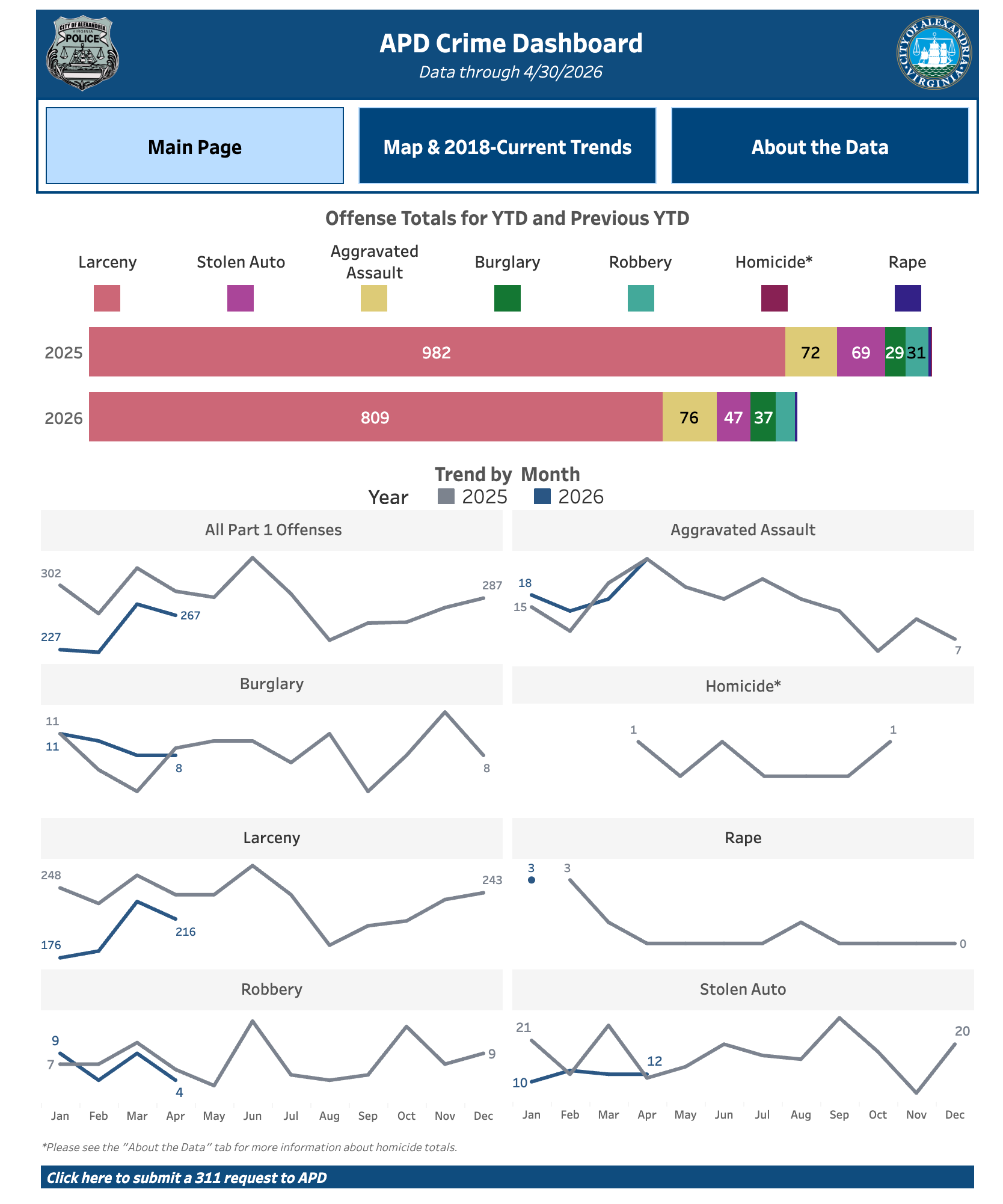
The most recent numbers extend the downward trend. APD's public crime dashboard, current through April 30, shows total Part 1 offenses through the first four months of 2026 running below the same period a year earlier, and tracking lower month-by-month across the major categories. Larceny, the highest-volume offense, fell about 18% year-to-date (809 offenses, from 982), and stolen-auto cases dropped roughly a third (47, from 69). Two categories ran modestly higher than the same point last year — aggravated assaults (76, from 72) and burglaries (37, from 29) — but the overall total remained down.
The five pillars
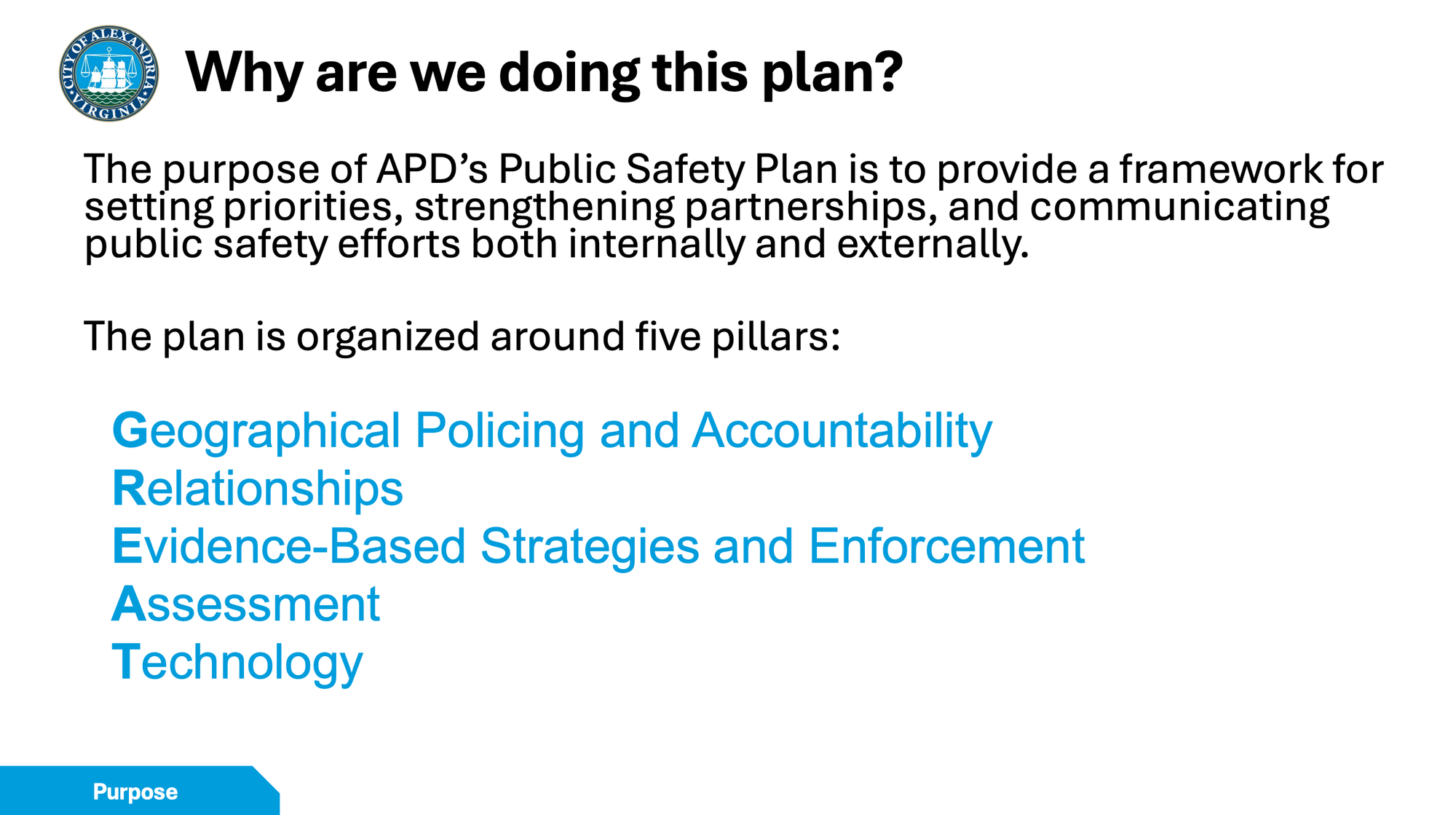
The new plan organizes the department's priorities around five pillars, spelling the acronym GREAT: Geographical Policing and Accountability, Relationships, Evidence-Based Strategies and Enforcement, Assessment, and Technology.
Geographical Policing and Accountability centers on matching police resources to demand and deepening neighborhood ownership — consistent officer assignments to neighborhoods, data-driven realignment of divisions, sectors and beats, and city coordination on the root causes of crime and disorder. The beat realignment echoes the geospatial redistricting McGuire described to the council during March budget deliberations.
Relationships focuses on building trust before a crisis through neighborhood, youth, business and clergy partnerships, including a youth police academy and police explorer programs.
Evidence-Based Strategies and Enforcement would use research and data to direct police action — identifying hot spots, repeat offenders and traffic risks, and strengthening crime analysis to guide deployment.
Assessment is the accountability piece: annual benchmarks, tracking of crime-reduction results, improved data collection on traffic stops, searches and use of force, transparent annual public reporting, and outside research partnerships.
Technology addresses tools and oversight — real-time emergency information, expanded crime-analysis tools, engagement platforms, planning for the costs and staffing new technology requires, and a commitment to community education and feedback before major technology decisions.
What to watch
Because the item is advisory, the news will be in how council members respond. The Technology pillar is the likeliest flashpoint: the plan promises community input "before major technology decisions," language that often precedes debates over surveillance tools, and it lands against real budget strain — the council's March review of the $221 million public safety budget surfaced an aging 911 system and staff losses to private tech firms. Council questions on the use-of-force and traffic-stop reporting commitments under the Assessment pillar are also worth tracking, given the data-sharing and enforcement concerns raised at the March meeting.
The presentation is item 26-1012 on the June 9 docket. The meeting begins at 7 p.m. at the Del Pepper Community Resource Center and is carried on government Channel 70, the city website, and Zoom.