Table of Contents
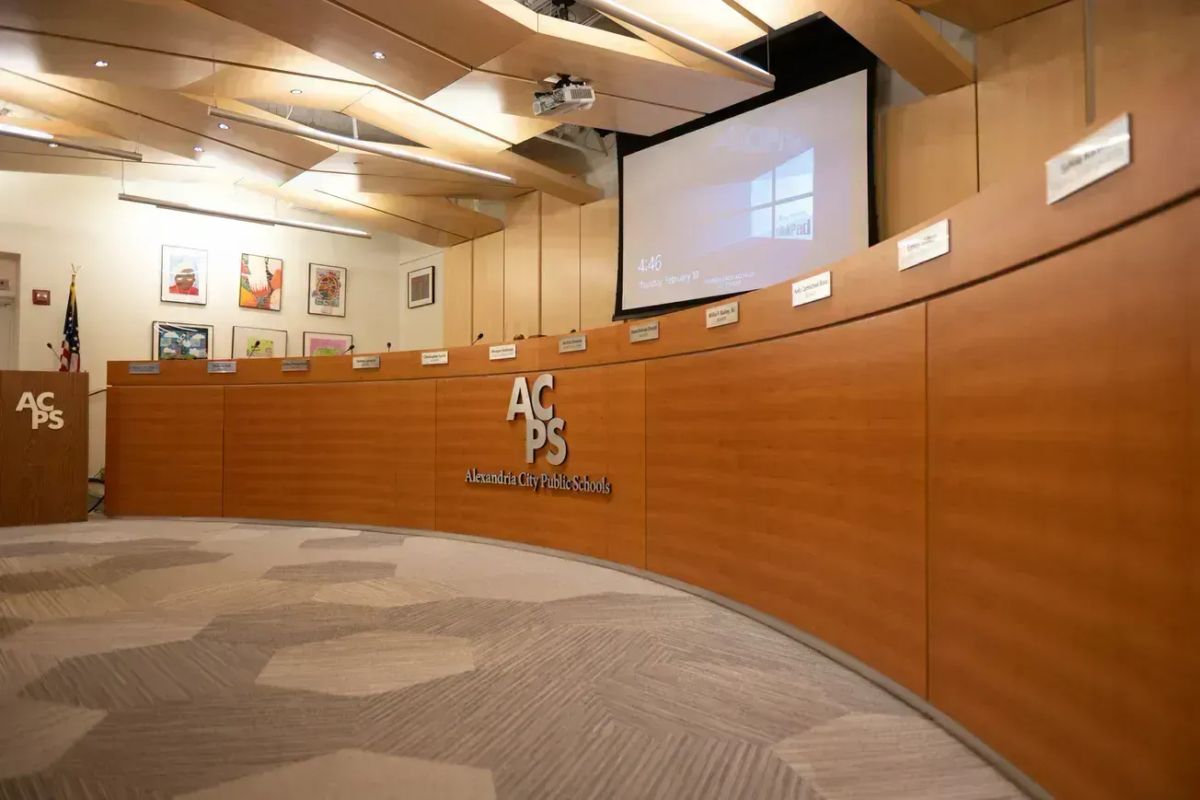
ALEXANDRIA, Va - The Alexandria City School Board is heading back to the drawing board on its FY27 budget after Alexandria City Council declined to close a $5.6 million funding gap in its add-delete process, with Superintendent Dr. Melanie Kay-Wyatt scheduled to present an adjusted spending plan May 7. The board heard sustained public comment on the process Thursday, wih community members urging the board to protect middle school sports, world language programs and educator compensation. The meeting also included a wide-ranging recap of the 2026 Virginia General Assembly session, a first-year update on the division's Social Emotional Learning plan, and confirmation that the long-awaited police partnership agreement has been sent back to division counsel for additional revisions.
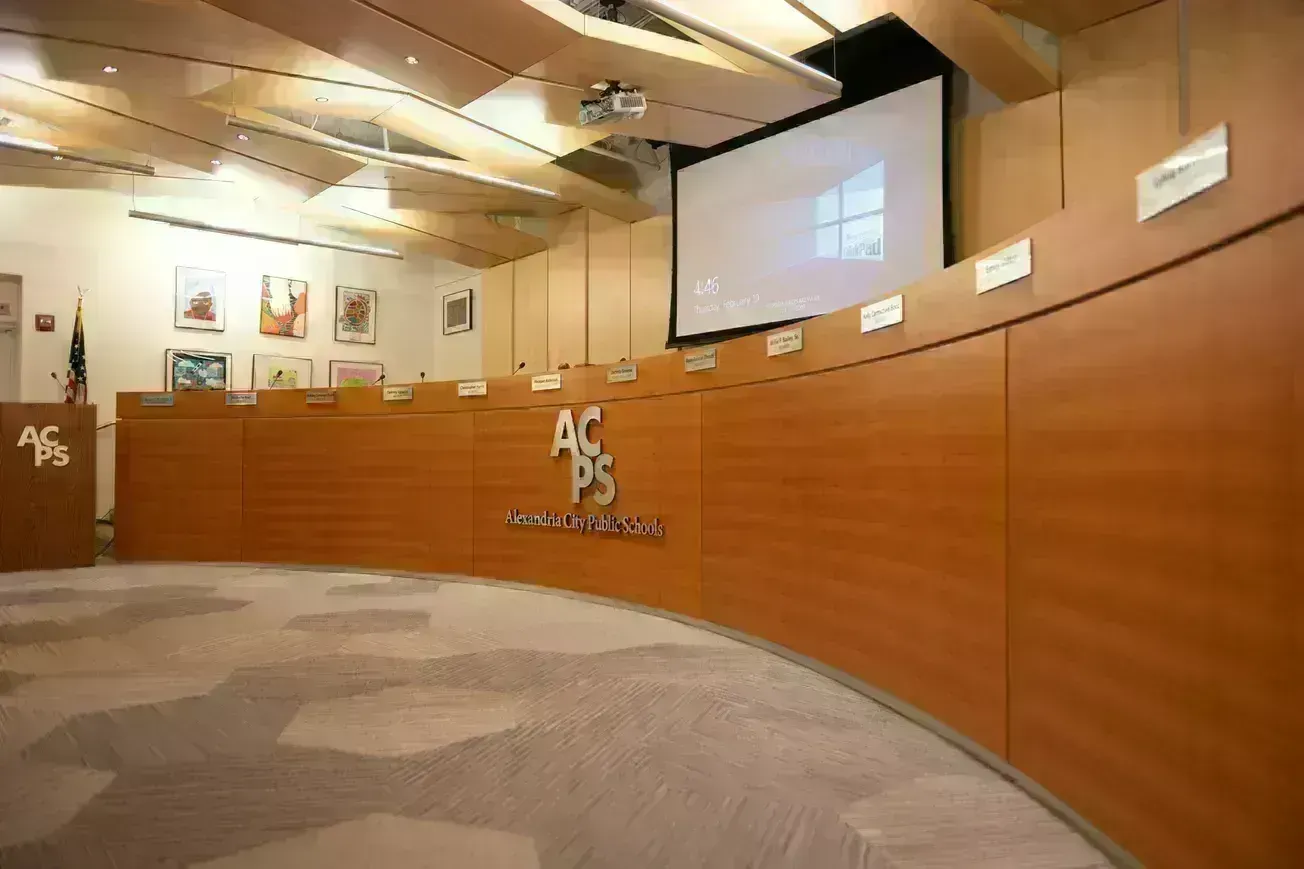
Vice Chair Chris Harris chaired the meeting in the absence of Chair Dr. Michelle Rief, the only board member absent Thursday. Superintendent Dr. Melanie Kay-Wyatt joined the meeting virtually due to illness; Dr. Grace Taylor delivered much of the Superintendent's Report.
Thursday's public comment period stood in contrast to Saturday's Council add-delete public hearing, where no members of the community spoke in favor of additional school funding. The two Saturday speakers addressing ACPS called for structural reforms to the school board rather than for additional funding, and no school board members testified at the hearing either — a choice Rief addressed in a statement to The Alexandria Brief on Tuesday.
"The Alexandria City School Board has consistently communicated the needs of our school division to the City Council through both public updates and direct engagement," Rief said. "We recognize the City's broader fiscal constraints. At the same time, we are disappointed that no additional funding was included for Alexandria City Public Schools, despite the clearly identified needs within our system."
 Ryan Belmore
 Ryan Belmore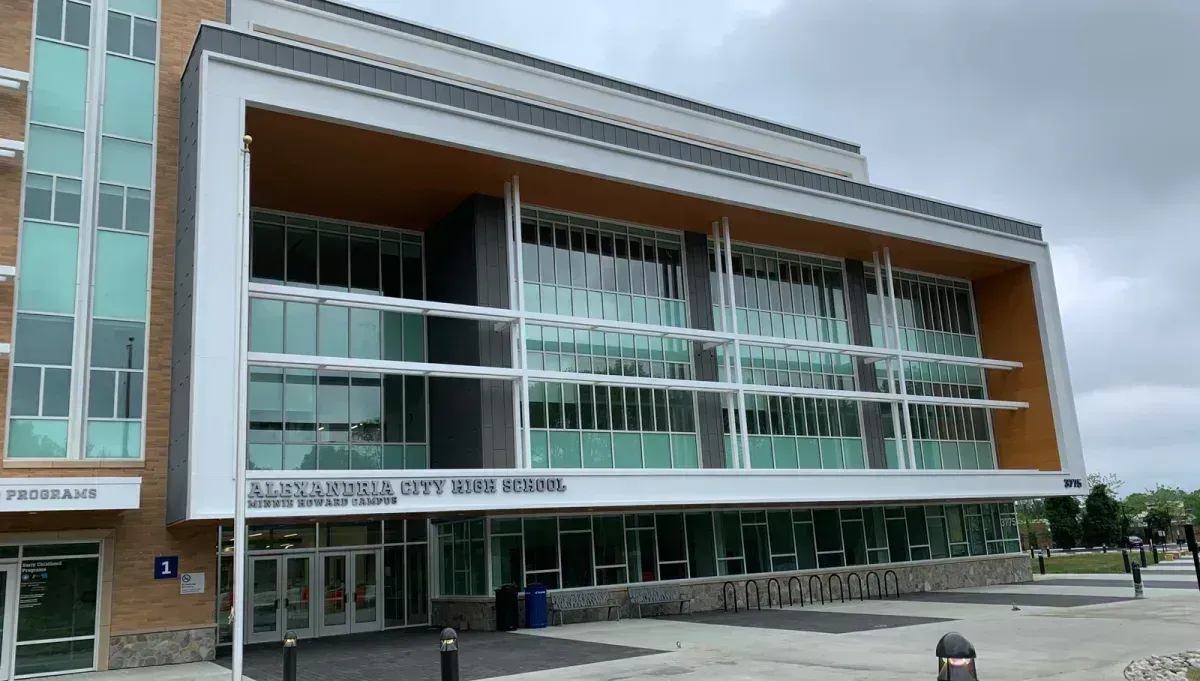
Public commenters urge board to look at central office before program cuts
The board's public comment period, which ran roughly 20 minutes, drew a concentrated focus on the FY27 budget process. The speakers referenced potential cuts to middle school sports and world languages — examples raised in earlier board discussions and joint work sessions as the kinds of choices the board might face if city funding fell short of the division's request. No specific reductions have been formally proposed; Kay-Wyatt is scheduled to present an adjusted FY27 budget reflecting the Council funding level at the board's May 7 meeting, with the board targeting a June 11 vote on the combined funds and Capital Improvement Program budgets. The school board adopted a $408.2 million combined funds budget in February that requested a $9.8 million increase from the city; City Manager James Parajon's proposed budget included $4.2 million of that, leaving a $5.6 million gap that Council's add-delete process did not close.
Crisa Young, who has spoken at multiple recent meetings, argued that the division has not fully examined alternatives that would spare student programs. The same amount of money that would be saved by cutting middle school sports, she said, could be found by closing vacant central office and instructional support positions currently posted on the ACPS website. She urged the board to examine a list of more than 30 potential budget reductions she has previously submitted.
Alan Bodiford, who identified himself as a recent transplant to Alexandria, said he had moved to the city in part because of the reputation of its schools and was alarmed to hear middle school sports and language programs had been discussed as possible reductions. "Why are students being affected at all if it can be avoided?" he asked.
Genevieve Conty, also a recent transplant, delivered the most pointed critique. She said she had read the 400-page budget book and compared ACPS staffing to Arlington, describing an HR department she said "hires 10 less employees for $3 million more" while payroll remains frequently inaccurate. She identified six vacant central office and instructional support positions whose combined cost, she said, is roughly equal to the middle school sports program. Conty also contrasted the board's posture at recent City Council meetings with that of Spanish-speaking immigrant residents who had testified in favor of rental assistance funding.
Allison Smith, the evening's only Zoom speaker, anchored her remarks in the cost of health care access. Smith, who described herself as deaf and reliant on specialized medical care scheduled six months in advance, said the board was "gambling with our lives" by not negotiating more effectively with providers. Smith cited the same $500,000 figure for middle school sports and six vacant administrative positions she said cost a similar amount. "If I am forced to choose between hearing my husband's laughter and this district, let me be so clear with you. I will not be picking you," Smith said.
David Paladin Fernandez addressed the tentative collective bargaining agreement between the Education Association of Alexandria and ACPS. Paladin Fernandez, who identified himself as a silent observer to negotiations and a member of the collective bargaining committee, said educators are considering voting no on the CBA because the agreement was "drafted, proposed and negotiated about us, without us." He said educators need bereavement and parental leave that does not deplete sick days first, a pay increase not offset by health care costs, and "restorative status steps" reversing wage stagnation.
Deborah McKeeman compared resource allocations between Lyles-Crouch Traditional Academy — the division's only distinguished elementary school, with 382 students — and William Ramsey Elementary, a needs-intensive support school with 712 students. She said Ramsey had 252 students fail their Virginia Literacy Assessment in the current year compared to 43 at Lyles-Crouch, and that FY22-through-FY26 budget data show relatively unchanged resource allocation at both schools over that period.
Two speakers addressed matters unrelated to the budget.
Leslie DeJesus Brooks, the mother of a rising seventh-grader at Francis C. Hammond Middle School, asked the board to review a redistricting decision that would send her daughter — who has a 504 plan and participates in the Symphonic program — to George Washington Middle School for the 2026-27 school year.
Brian Godfrey, carpentry teacher at Alexandria City High School, raised an ongoing dispute over instructional space in his program, which he said has left students without tools or usable workspace since second quarter and out of compliance with Virginia Department of Education guidelines. Godfrey thanked Kay-Wyatt, Taylor and board member Abdulahi Abdalla for visiting the space.
Carmichael Booz defends central office staffing, confirms timeline
During board announcements, board member Kelly Carmichael Booz — the board's liaison to the Budget and Fiscal Affairs Advisory Committee — responded to the themes raised in public comment while pushing back on the characterization that central office staffing can be substantially reduced without affecting students.
"Even if you reduce all of central office, we're still not going to meet the gap that we have to cut," Carmichael Booz said. "And a lot of those positions in central office are student-facing. Some are required by state." She said she would submit a formal question seeking clarity on which central office positions meet those criteria.
Carmichael Booz confirmed that Kay-Wyatt will present an adjusted budget and Capital Improvement Program reflecting the Council funding level on May 7, followed by work sessions May 12 and 14. The board has targeted a June 11 vote on the combined funds and CIP budgets at an add-delete work session. She acknowledged the collective bargaining agreement remains "on the table" and said funding it will come with additional trade-offs.
"Our priorities are our staff, because we don't have incredible students without the staff that we have," Carmichael Booz said.
Carmichael Booz acknowledged that the program examples raised in public comment remained among the possibilities the board would weigh as Kay-Wyatt finalizes the adjusted budget. She said some of the potential reductions discussed at joint meetings "could still be on the table of things that we have to cut to get to that gap, to close the gap."
Board member Alexander Crider Scioscia followed up by pointing the community to board members' written explainers on budget topics published at acpsschoolboard.com, including Reyna's piece on central office structure titled "Topic Deep Dive: Where Your School Dollars Are Actually Going."
Board member Alexander Crider Scioscia followed up by pointing the community to board members' written explainers on budget topics published at acpsschoolboard.com, including Reyna's piece on central office structure titled "Topic Deep Dive: Where Your School Dollars Are Actually Going."
General Assembly recap: immigrant protection bill signed, budget still unresolved
Legislative Consultant Emily Webb of Advantus Strategies delivered a roughly 40-minute update on the 2026 General Assembly session, which formally adjourned March 14 and held a reconvene session the day before Thursday's board meeting. The legislature passed 1,208 of the approximately 2,400 bills introduced, with 716 failing, 438 carried over and 86 consolidated. Governor Abigail Spanberger issued eight first-term vetoes — fewer than her three most recent predecessors in their opening years — and recommended amendments to 176 bills.
Two pieces of ACPS-initiated legislation saw significant movement. Senate Bill 491 from Sen. Stella Pekarsky, and House Bill 836 from Dels. Sam Rasoul and Alfonso Lopez prohibit the denial of public education access based on actual or perceived immigration status and place restrictions on immigration enforcement in schools. The legislation was signed by Spanberger on April 13. Board member Ashley Simpson Baird, who was closely involved in drafting the legislation, contrasted the Virginia law with recent moves in Oklahoma to collect student immigration status.
The second ACPS-initiated bill, House Bill 382 from Del. Elizabeth Bennett-Parker, would have raised the compensation supplement for school board chairs to 30% of base annual salary or $3,500, whichever is greater. The bill passed the House 71-27 but failed in the Senate Finance and Appropriations Committee over concerns about downstream fiscal impact on the state.
Among ACPS legislative priorities, Webb reported that the Solar Interconnection Grant Program — House Bill 683 and Senate Bill 659 — was signed April 13, with both the House and Senate budgets proposing $2 million for the program. Board member Tim Beaty asked whether ACPS could benefit in the coming year; Webb said the program would be competitive and that ACPS would likely be a strong applicant given its net-zero construction at Minnie Howard and the under-construction Douglas MacArthur replacement. Simpson Baird said grid connection fees at those two schools have totaled approximately $1.5 million.
House Bill 334, which would authorize localities to levy an additional local sales and use tax of up to 1% for school construction and modernization, was continued to the 2027 session, but the Senate included the language in its proposed budget. Webb said she was not aware of any significant opposition and that the Virginia Association of Counties and Virginia Municipal League have both supported the measure. Board member Ryan Reyna, who had joined the meeting by this point, said the division and City Council have signaled alignment on the issue.
A state budget remained elusive as Webb presented. The General Assembly convened in special session the same day but adjourned without an agreement. Webb reported that an informal revenue agreement between House Appropriations Chair Luke Torian and Senate Finance and Appropriations Chair Louise Lucas had been reached roughly 15 minutes before her presentation began, though formal conferees had not yet met. The core dispute is the sales and use tax exemption for data centers: the Senate wants to eliminate it immediately and capture over $1 billion in new revenue, while the House budget conditions the tax credit on environmental requirements. The biennial budget must be enacted before July 1 to avoid a state government shutdown, a near-unprecedented occurrence in Virginia.
On the question of a statewide teacher compensation adjustment, Webb said the House budget proposed 2% and the Senate 3%, both applying only to Standards of Quality-funded positions.
Collective bargaining legislation — House Bill 1263 and Senate Bill 378 — passed the General Assembly but received structural amendments from Spanberger that the legislature rejected at reconvene. The bill now returns to the governor for signature or veto. Simpson Baird asked Webb how the legislation would affect ACPS, given the division's active collective bargaining process. Webb said the governor's original amendments included a mechanism for existing agreements to be grandfathered in, but that provision is not in the enrolled bill. Public Employee Relations Board regulations would take 18 to 24 months to develop, Webb said.
SEL update: student voice strong in some areas, alignment with academics an area of growth
Dr. Marcia Jackson, Chief of Student Services and Equity, presented the board's annual update on Social Emotional Learning implementation along with Executive Director of Equity Kanitra Wood and Mental Health Specialist Ursula Rocha. The presentation was the first full update since the division received recommendations from its SEL evaluation in December 2024.
The team conducted student voice surveys at two pilot schools. At Patrick Henry K-8, 148 middle schoolers — roughly 60% of the population — responded, with 80% to 90% reporting they feel connected to school but 10% to 20% reporting they do not consistently feel they have voice in their learning experience. At Alexandria City High School, over 1,400 students across all four campuses responded; 60% said they want to be more involved in decision-making, 78% said staff model respectful and inclusive environments, and 67% said school feels safe and supportive. Rocha said students identified cell phone policy and advisory period as the top two topics where they wanted more voice.
The team also conducted over 200 classroom observations, finding that approximately 78% of classrooms demonstrated strong learning environments. Rocha said SEL is consistently visible through routines, PBIS expectations and classroom culture, but intentional alignment between SEL practices and academic objectives remains an area of growth. "The next step is to intentionally embed CASEL standards into academic learning," she said.
Beaty asked whether a chart showing 26.7% "not observed" and 14% "no evidence" for equitable instruction meant 41% of classrooms lacked equitable instruction. Wood clarified that "not observed" meant the walkthrough team did not see an opportunity for the practice during their observation window, while "no evidence" meant there was opportunity but the practice was not demonstrated. Harris pressed on whether students understand that their input will result in structural change; Wood said administrators have been coached on ensuring a feedback loop so students see outcomes from their participation.
Year two of the SEL plan will launch a year-long professional learning cohort with at least one Student Support Team member and ideally two teachers from each school in the division.
Governance Committee update: MOU heads back to counsel
During the Governance Committee report, Simpson Baird confirmed that the revised Memorandum of Understanding with the Alexandria Police Department has been sent back to division counsel for additional changes.
"The Governance Committee discussed the MOU at our meeting last Friday and directed the attorney to make some additional changes which we will be reviewing at our next meeting on Friday, May 1," Simpson Baird said. The board is now scheduled to vote on the revised agreement at its May 7 meeting, according to ACPS.
The decision comes a week after the April 16 public hearing on the MOU adjourned after one minute with no speakers signed up to participate.
Ryan Belmore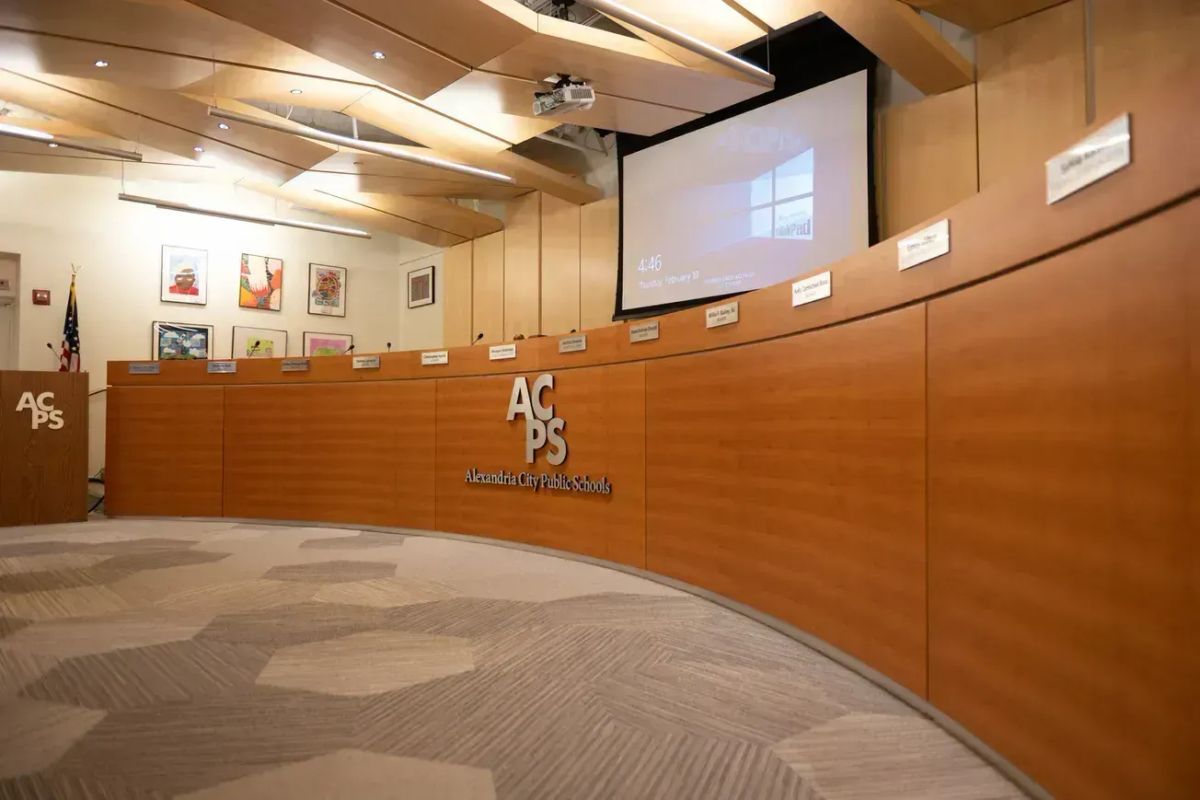
Other business
The board adopted the consent calendar as published, which included the 2026-27 IDEA grant application — $3.9 million in Part B Section 611 flow-through funds and $103,117 in Part B Section 619 preschool funds. Per the application memo, ACPS has been identified by VDOE as having significant disproportionality for Black students classified with an Emotional Disability, triggering a required 15% set-aside for Comprehensive Coordinated Early Intervening Services.
The consent calendar also approved the hiring of a new CTE director — a Virginia Tech graduate, Beaty noted — following a several-month gap after the departure of the previous director. Beaty also highlighted the 2026-27 Local Perkins V Plan for Career and Technical Education federal funds. Several policies reviewed at the April 9 meeting were adopted, including KNAJ (Relations with Law Enforcement Authorities), JM (Managing Student Behaviors in Emergency Situations) and associated regulations, IGBC (Parent-Guardian and Family Engagement) and Title I regulations, and student placement regulations effective July 1, 2026.
Charles Barrett Elementary was recognized in the "Heart of ACPS" segment for its arts integration work, highlighted in a video introduced by Principal Lauren Brody and Assistant Principal Marcel Ahern. Taylor delivered the Superintendent's Report, citing recognitions including a $40,000 Amazon Future Engineers Scholarship awarded to Alexandria City High School seniors Zhi McMillan and Mohammed Elyas Noorzai, and the Alexandria City High School Advanced Choir and Colore Dolce tying for the Grand Champion Award at Orlando Fest 2026.
Ryan Belmore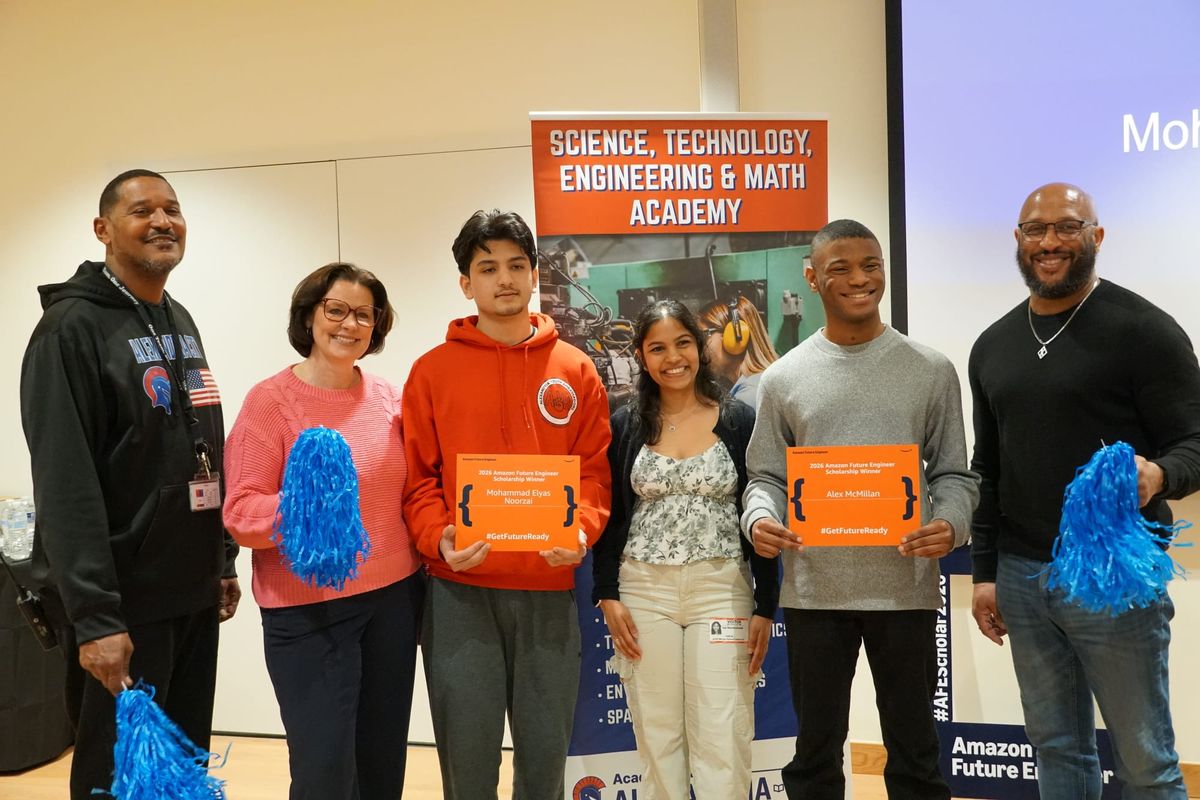
Student Representative Madison Lynch, who is in her final year of service, was congratulated on her acceptance to Virginia Tech. The board will select two new student representatives on May 7.
What's next
The Operational Excellence Committee meets on May 5 at 6:30 p.m. The Governance Committee meets on May 1 in person at Central Office, with the MOU, school board election reform, and VSBA legislative positions on the agenda. The Strategy and Accountability Committee meets on May 12 at 5 p.m., immediately before the board's budget work session at 6 p.m.
The board's next regular meeting is May 7, when Kay-Wyatt is expected to present her adjusted FY27 budget, the MOU is scheduled for a vote, and the board will select two new student representatives. The Owens Place renaming ceremony will be held on June 2 at 3:30 p.m. at the Early Childhood Center.
The board entered a closed session at approximately 8:30 p.m. to discuss pending litigation — identified in the motion as case 1:26cv133PTG LRV — and a contract matter related to textbook adoption.