Table of Contents
ALEXANDRIA, Va. - With less than four months until Alexandria's gas-powered leaf blower ban takes effect, city staff held an informational meeting Tuesday evening to answer questions from residents, landscapers, and property owners about what to expect come Nov. 17.
Earlier in the day, Mayor Alyia Gaskins promoted the meeting in her daily social media video, framing the ordinance as a response to community demand. Residents had submitted letters, attended public meetings, and taken polls expressing concern about the health and climate impacts of gas-powered equipment, she said. Neighboring jurisdictions passing similar bans also factored in.
"We want to make sure that our policies are consistent across the region," Gaskins said.
She credited the 18-month phase-out period to feedback from businesses that said they couldn't switch overnight, and said the transition time also allowed the city to review contractor agreements and build out enforcement infrastructure. "We don't want to pass policies if we don't have a way of implementing them and holding ourselves accountable," she said.
About a dozen people attended, either in person at Charles Houston Recreation Center or on Zoom. Melissa Atwood, the city's acting environmental manager, led most of the question-and-answer session alongside intern Abigail Ernst, who gave the presentation. The ban was adopted by city council in May 2025 with an 18-month phase-out period. The city itself transitioned to all-electric leaf blowers on May 17, 2026.
What's banned — and what isn't
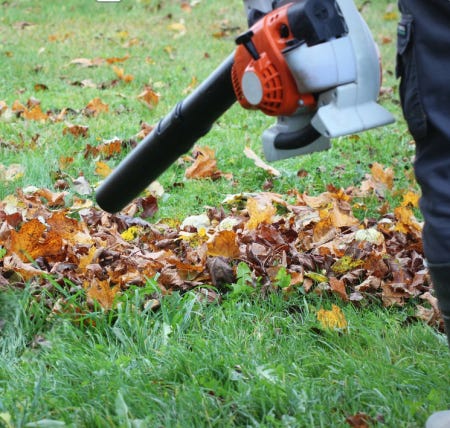
The ban covers any gas-powered leaf blower or leaf vacuum, including handheld, backpack, and walk-behind equipment powered by gasoline, diesel, alcohol, or other liquid or gaseous fuels.
One question that came up more than once: what about the large vacuum trucks the city uses to collect leaves from streets? Atwood said those are not covered by the ban, which is limited to the smaller equipment defined in the noise code. She acknowledged the question was fair and directed those who want more clarification to submit a request through Alex311.
The ban also does not extend to other gas-powered lawn equipment such as mowers. Atwood noted that while the city has a broader initiative to encourage a shift to electric lawn equipment, that effort is not a regulation.
Enforcement
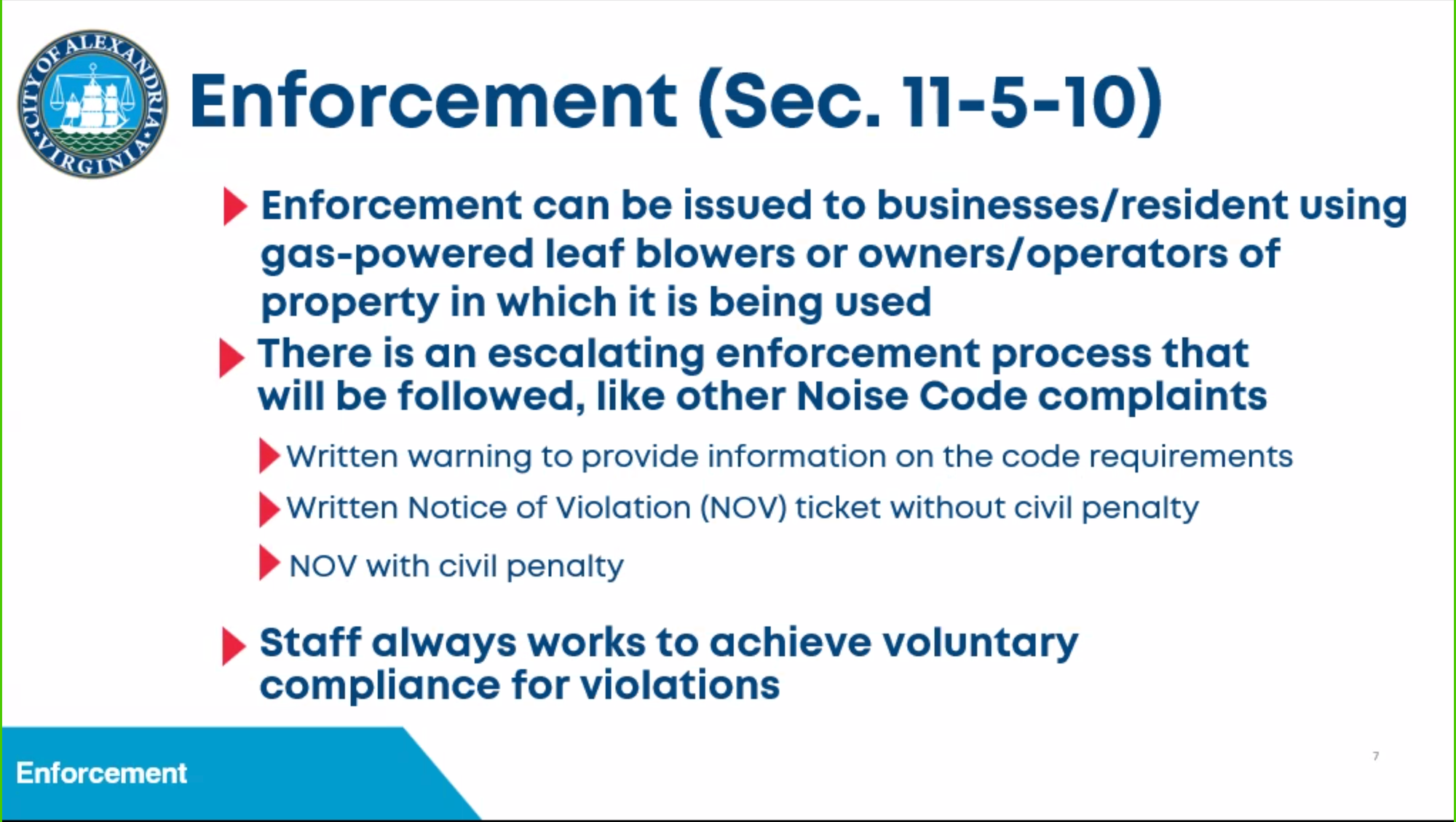
Enforcement will be handled by the city's Environmental Quality team, which now has two noise inspectors — one position predating the ban and a second added around the time the ordinance was adopted. The second position was added in part to ensure weekend coverage.
The process is graduated. A first offense draws a written warning intended to inform. If violations continue, inspectors issue a notice of violation without a financial penalty, followed by one with a civil penalty. Fines start at $100 for a first offense, $250 for a second offense committed within seven days of the first, and $500 for a third offense committed within 14 days of the first. Atwood also noted that violations are counted per hour, meaning a crew cited at 9 a.m. and still at it at 10 a.m. could face a second citation.
Both the person or company using the banned equipment and the property owner can be cited. Atwood said the city's preference is voluntary compliance and that staff would try to reach both parties before escalating. Homeowners who hire landscapers that show up with gas blowers were told they have options: work with the company to switch equipment, or find a different landscaper.
For civil penalty citations, Atwood said a violation must be directly observed by city staff — a neighbor's photo or complaint alone is enough only for the informational warning letter, not a fine.
Inspectors will work weekends. Atwood confirmed the seven-day coverage was part of the reason the city created the second inspector position.
One attendee asked what happens if a landscape company refuses to let an inspector look at their equipment. Atwood said at the meeting that the city will not be searching trucks — enforcement is based on observing equipment in use on a property. The city's noise code (Sec. 11-5-9), however, specifies that inspectors may only enter private property with permission from the owner or someone with authority to act for the owner. That means if a crew is operating on private property and denies access, the city's ability to inspect is limited to what inspectors can observe from public property.
Costs and alternatives
Several attendees pushed back on the financial burden of switching to electric equipment. One said a battery-powered backpack blower capable of clearing their property would require three batteries at $1,400 each, plus a $500 blower. While commercial-grade batteries can be expensive, consumer-grade battery-powered backpack blowers are widely available for $300 to $700, according to current retail listings. Atwood acknowledged the concern and directed the person to the city's leaf blower ordinance webpage, which lists lower-tech alternatives including rakes, leaf scoops, push-powered lawn sweepers, and leaf plows. She said the city doesn't have the authority to tell residents how to manage their leaves — only to enforce what equipment they can't use.
Some environmental advocates argue that residents overestimate how much leaf removal is actually necessary. The city's own ordinance webpage notes that leaves left in natural areas — under trees and shrubs, for example — decompose in place and enrich the soil, and that grass clippings and mulched leaves act as natural fertilizers. Raking and mowing over leaves, the city says, can be just as effective for most properties.
A resident raised the possibility of the city or Alexandria libraries offering electric leaf blower rentals, modeled on an existing library program that lends thermal cameras. City staff called it a good idea worth exploring with the Office of Climate Action.
The city partnered with Clean Air Partners last year on a leaf blower exchange program for residents. Atwood said discussions about whether to repeat it are ongoing but depend on whether city funds are available.
Disposal
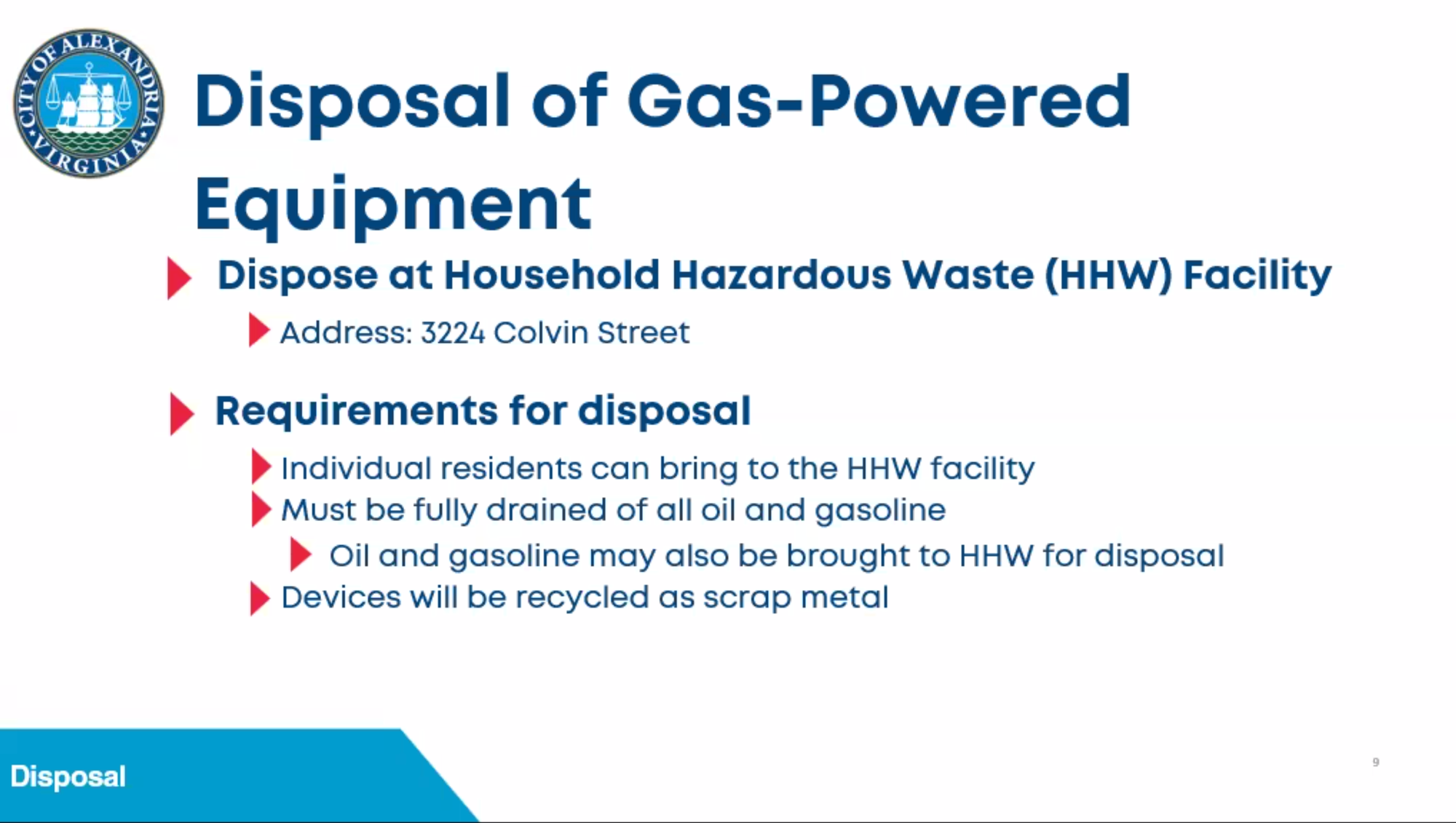
Residents can drop off gas-powered leaf blowers at the Household Hazardous Waste Facility at 3224 Colvin St. Equipment must be fully drained of oil and gasoline before drop-off; both can also be brought to the facility separately. The devices will be recycled as scrap metal. The disposal option is available to individual residents only, not commercial landscapers.
Reporting
Once the new ordinance takes effect, violations can be reported through Alex311 or by calling the city's Environmental Quality staff at 703.746.4065. Questions can be emailed to eco-cityalexandria@alexandriava.gov.
Update: This story was updated on Tuesday, July 21, to include additional context on retail prices for battery-powered leaf blowers and the environmental case for leaving leaves in place. This story was updated on Wednesday, July 22, to include additional context on enforcement.
 Ryan Belmore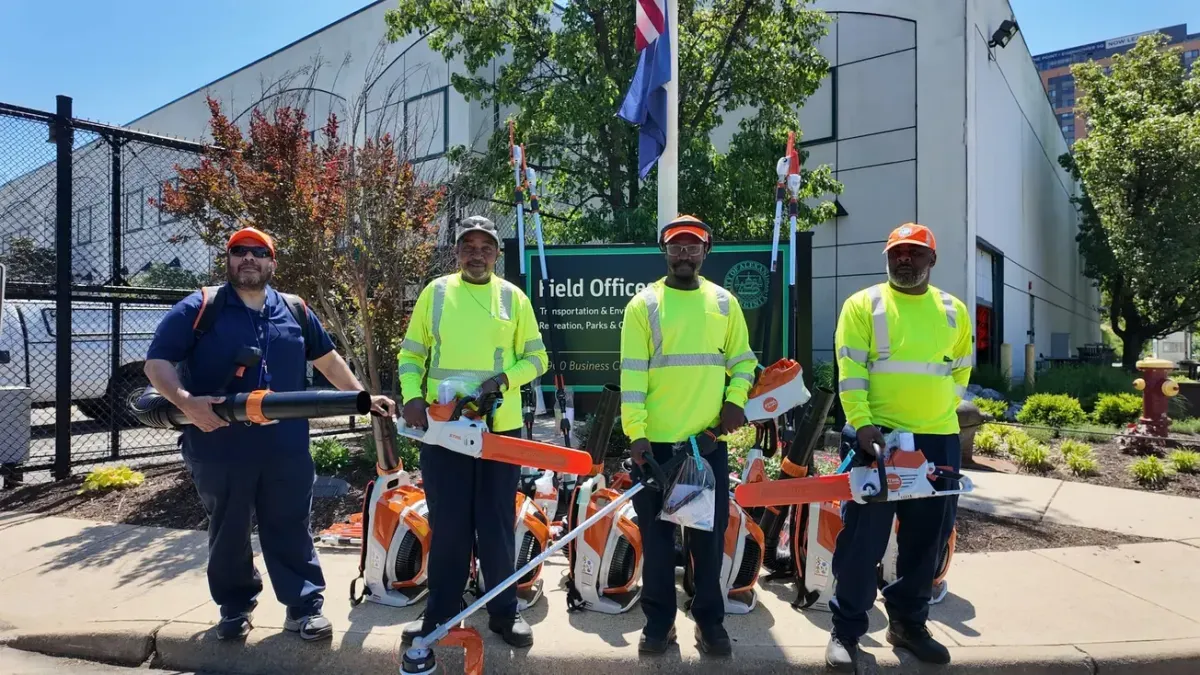
 Ryan Belmore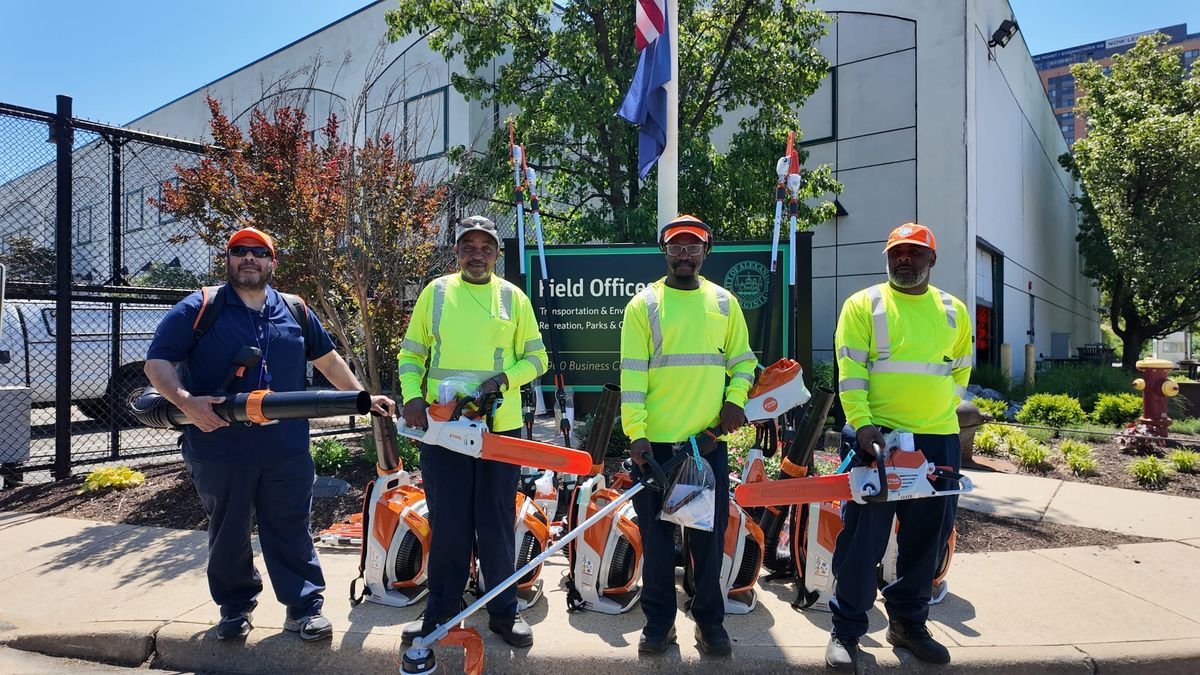
 Ryan Belmore