Table of Contents
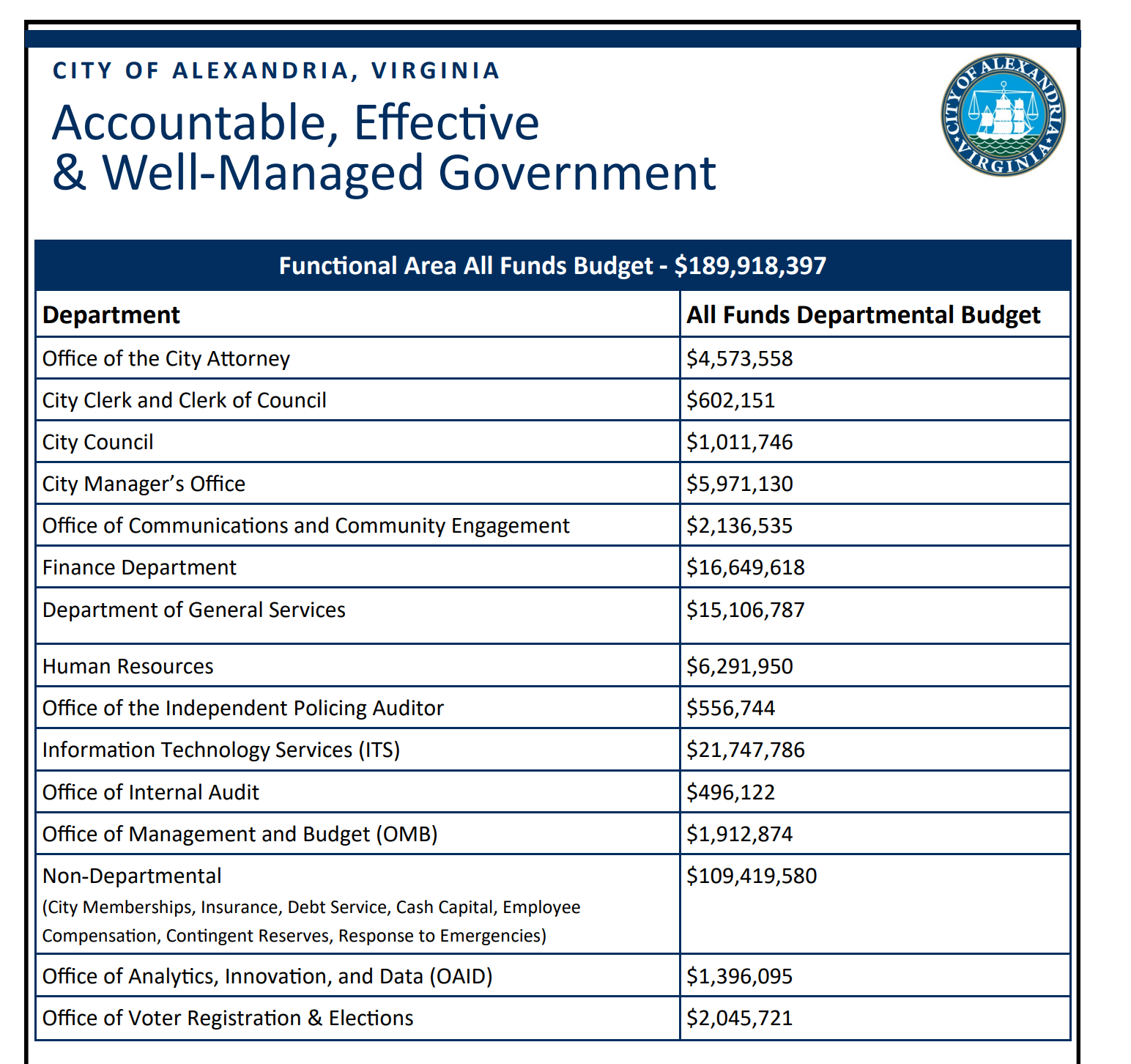
With Mayor Alyia Gaskins absent Wednesday night, Vice Mayor Sarah Bagley led the sixth and final FY 2027 budget work session, covering the departments that run city government itself — technology, finance, human resources, communications, and the city attorney — before closing with a presentation from the Budget and Fiscal Affairs Advisory Committee (BFAC) that put Alexandria's longer-term financial picture in sharp relief.
The session ran from 7 p.m. to approximately 9:24 p.m. at the Del Pepper Community Resource Center. Add-delete proposals are due April 9.
The add-delete rules
Proposals are due by midnight April 9. Items requiring an ordinance — typically tax adjustments beyond real estate and personal property — are due April 6. Each proposal requires three co-sponsors, including the original sponsor, must be balanced, and the sum of any individual council member's proposals must also balance.
With six members currently seated — the seat vacated by former Council Member R. Kirk McPike remains open until after the April 21 special election — four co-sponsors still constitute a majority and the threshold for the initial consensus column. Items arriving with fewer than four co-sponsors are not automatically dead; support can be added or removed during the work session. New proposals cannot be introduced at that stage. If consensus is reached on April 21, the April 27 final session will be canceled. Budget adoption is April 29.
Information Technology: AI pilot, two new positions, and a court transfer
Chief Information Officer and Director of Information Technology Services Vanetta Pledger, serving as acting deputy city manager Wednesday night, and the Acting Chief Information Officer presented an ITS budget of $21,747,786 — up 8.1% — with total FTEs growing from 79 to 86.
Five of those seven new positions are not new to city government: Circuit Court judges transferred five existing FTEs and their associated costs into ITS mid-year, accounting for $779,537 of the department's growth. Two positions are genuinely new supplementals: a cloud architect engineer ($150,308) in network operations and a cybersecurity engineer ($150,308) in security. Both replace existing temporary services spending, limiting their net budget impact.
The cloud architect will manage security, identity management, and data integrity as five major city software systems migrate to the cloud. The position will also handle the growing volume of FOIA requests flowing from the city attorney's office — ITS received more than 40 such requests in the past three months. The cybersecurity engineer expands a four-person team that fielded more than 600 phishing attempt reports in the past 30 days. The security budget rises 9.4% to $1,651,096.
Offsetting reductions include $75,000 from renegotiated internet service provider terms, $217,000 in server maintenance savings, and a reduction in research and advisory subscriptions from two contracts to one.
The ITS department is requesting $300,000 in one-time funding for an AI pilot focused on land use development review — a portal that would pre-check permit submittals and provide applicants a pass-fail score before staff review begins, reducing revision cycles and accelerating the path to occupancy. Staff noted the city already piloted AI against building code data with a 90% accuracy rate. A separate $300,000 in one-time AI funding sits in the Non-Departmental section for broader citywide initiatives. The city is also piloting Microsoft Copilot internally, evaluating return on investment before committing to a citywide rollout estimated at approximately $700,000.
Council Member John Chapman pressed staff on whether the pilot would become a recurring line. Staff said other jurisdictions have explored technology fees — charging the development community for efficiency gains — as a potential funding mechanism. Council members also asked about using AI to offset vacancy-driven staffing costs; staff said the approach is to focus first on low-risk, publicly available data sets before applying AI to sensitive data.
Chapman raised ARHA's troubled software transition — which affected hundreds of residents — and asked whether the city's IT team could offer paid consulting to partner agencies in similar situations. City Manager James Parajon confirmed the model is viable. "We have some of the most talented staff in that area," Parajon said. "If we were to enter into longer-term agreements, we would have to grow our team a little bit, but the efficiency can be pretty substantial."
Human Resources: turnover down, internships a focus
Chief Human Resources Officer Alyssa Williamson reported citywide turnover has dropped from 14.5 percent to 10.5 percent, crediting retention and hiring bonuses the Council funded two years ago. The HR budget is essentially flat — down just $8,616 to $6,291,950 — with staffing holding at 30 FTEs. The department is eliminating its annual employee field day, digital benefits technology, and a compensation strategy software tool, while requesting $100,000 in one-time funding to support employee relations work as collective bargaining expands. An additional $75,000 supports the city's WMATA transit benefits program.
The summer internship program drew nearly 200 applicants this year and has produced direct hires. Chapman asked about expanding to year-round opportunities as part of a regional strategy to retain young talent in local government. Williamson said expansion is feasible, with personnel costs as the primary driver.
Communications: positions transfer to APD, bilingual program cuts translation costs
The Office of Communications and Community Engagement sees the steepest percentage budget reduction in the functional area — down 18.8% from $2,631,656 to $2,136,535 — losing 3.0 FTEs and dropping from 17 to 14. The largest driver is the transfer of two positions back to the Alexandria Police Department: a Public Safety Information Officer and a Communications Manager, totaling $307,700. An additional Community Engagement Specialist position is eliminated, and partial-year freezes apply to a vacant Communications Manager and a second vacant Community Engagement Specialist.
Director Ebony Fleming said the office is focused on sustaining service delivery despite the reductions. A $26,317 reduction in third-party translation services reflects savings from the bilingual pay program — spending that reached $61,000 in FY 2024 and has fallen significantly since. Updated enrollment figures are forthcoming.
Fleming confirmed the office uses AI selectively — for voiceovers and certain editing tasks — while avoiding AI-generated photos or writing in public-facing content. "We've used AI, but maybe you haven't noticed. That's the goal," Fleming said.
City Attorney, Finance, Clerk, and OMB
The Office of the City Attorney proposed no supplementals, reductions, or fee adjustments. The budget rises 1.4% to $4,573,558 with 21 FTEs unchanged. City Attorney Cheran Ivery confirmed required continuing legal education credits are budgeted and additional professional development requests have been approved when made. FOIA requests have grown from 1,640 in FY 2023 to 2,110 in FY 2025 even as average response time improved to under six days. The office is preparing to support the city's fourth collective bargaining unit.
Collective bargaining: locked-in budgets
Wednesday's session surfaced a frustration that has run through the budget season: the city still doesn't know how many ACPS employees will fall under the school division's first collective bargaining agreement. Parajon confirmed on the record that more than a year ago, Council directed him to formally request the city be included in ACPS's bargaining process — not to manage negotiations, but to be informed. He sent a written request. ACPS denied it.
"It's probably over a year ago Council first directed me to request the opportunity to be part of the bargaining," Parajon said. "We followed that up with a written formal request that was denied by ACPS."
He said he still cannot confirm which staff positions fall under the agreement without a definitive review, and planned to meet with the superintendent this week. Teachers clearly qualify — but whether custodial staff, support staff, and social workers are included remains unknown. Council members noted they learned about the agreement through a press release, halfway through the budget process.
The contrast with DASH was drawn explicitly. Parajon described pre- and post-negotiation conversations with DASH General Manager Josh Baker throughout that process — keeping the city aware of every choice being considered so fiscal impacts could be analyzed in real time. "That process didn't hinder the negotiations," Parajon said. "What it did was allow the city to be part of that entire process from the very beginning so there were no surprises."
The question of what ACPS's CBA means for future budgets also prompted a broader discussion about whether Alexandria should move toward a biannual budget. Vice Mayor Bagley raised it directly: as CBAs lock in increasing portions of the budget, the annual process may produce diminishing returns on discretionary spending. Budget Director Morgan Routt said OMB could address it in a memo. Chapman noted former Mayor Justin Wilson raised the same idea repeatedly. Council Member Canek Aguirre joked that Wilson "was accused of communism" for it — but said the question becomes more pressing now that the last CBA is being finalized.
Finance, Clerk, and OMB
Finance Director Kevin Greenlief eliminated one Fiscal Officer III position vacated by retirement and highlighted a shared Management Analyst I position between Finance and the Office of Housing — split 80/20 following their co-location after City Hall's closure. The Finance Department budget rises 3.0% to $16,649,618, with FTEs dropping from 109 to 107.80. The Purchasing program sees the largest program-level increase — up 28.5% to $796,675 — driven by a new procurement software system going live next month. Council Member Aguirre flagged rising codification costs and requested two budget memos: one on future codification costs and one on bringing City Clerk Gloria Sitton's office from 3.5 to 4.0 FTEs. The City Clerk's budget is $602,151, down slightly.
Chapman and Vice Mayor Bagley requested a budget memo on technology fees and how other jurisdictions build dedicated funds to address aging IT infrastructure.
The Office of Management and Budget holds at $1,912,874, up 2.0%, with 12 FTEs unchanged. The office has earned the Government Finance Officers Association's Distinguished Budget Presentation Award with an outstanding rating for three consecutive years.
Greg Useem, Director of the Office of Analytics, Innovation and Data, described ongoing partnerships with George Mason University, Virginia Tech, and the Bloomberg What Works Cities initiative on AI and analytics projects. The OAID budget rises 22.5% to $1,396,095, adding one FTE — a Strategic Initiatives Officer transferred from the City Manager's Office to better integrate analytics with citywide strategic planning. Parajon highlighted the office's less-visible daily work. "It's so embedded in our organization," Parajon said. "I use this data every week to help make decisions."
The City Council's own budget rises 10.9% to $1,011,746, driven by adding a council member salary previously not budgeted — reflecting the forthcoming special election winner who will join the body after April 21.
Office of Voter Registration and Elections: four elections, small staff
The Office of Voter Registration and Elections presented no supplementals, reductions, or fee adjustments but described a significantly expanded workload. The office budgeted for two elections this fiscal year — a June primary and November general. It is now running four: the February 10 special election, the April 21 special election, a June primary moved to August, and the November general. A $70,000 supplemental appropriation is coming to Council in April to cover the shortfall. FY 2027 covers the August primary and November general; a subsequent June primary will require another supplemental. Parajon praised the registrar and her staff publicly, noting a major equipment and technology overhaul had been completed simultaneously. "The problem solving is really top notch and it's really made for very smooth elections," Parajon said.
Non-Departmental: debt, reserves, and the Clean Team
The Non-Departmental line — $109,419,580, more than half of the functional area's $189.9 million total — was not directly discussed on Wednesday but warrants context. Total debt service excluding ACPS rises to $69,409,964, driven by city capital projects; staff anticipate a new bond issuance during FY 2027 and plan to bring a bond authorization ordinance to Council in June. ACPS debt service of $50,296,916 is now budgeted separately in the ACPS section. CIP cash capital decreases $1,417,528 to $26,531,996, with the city drawing on $15 million in fund balance to maintain adequate pay-as-you-go capital.
Contingent reserves of $1,107,752 include the $513,055 DOT Paratransit reallocation set aside last year pending an efficiency review, a $250,000 City Council contingency fund, and a $300,000 Clean Team pilot — a litter mitigation program funded by plastic bag tax revenue, partnering Recreation, Parks and Cultural Activities with Transportation and Environmental Services. Snow and ice emergency funding rises to $1,000,000.
Chapman: "I don't mind talking about a tax increase for this budget"
The session's most consequential exchange came during the BFAC presentation, when Council Member Chapman addressed the revenue question directly.
"I don't mind talking about a tax increase for this budget," Chapman said. "Is that realistic? Is that something the community is ready for? Is that something our partners are ready for?"
He framed what he described as a structural challenge ahead — stagnant federal and state revenues, the implications for taxation and fees in coming years, and the need to prepare the community for what multiple years of constrained budgets will look like. The 1.5 percent increase in city appropriations to ACPS, he said, is not a one-year anomaly.
Chapman's remarks echo a budget season in which Council advertised a maximum real estate tax rate of $1.145 but signaled reluctance to use it. The proposed budget holds the rate flat at $1.135. No other council members publicly endorsed or opposed a tax increase during Wednesday's session.
BFAC: manage expectations, prepare community for tighter times
The Budget and Fiscal Affairs Advisory Committee — whose members are community volunteers — presented its annual recommendations. BFAC Chair John Ruthinoski joined remotely partway through.
BFAC's central message: Alexandria needs to proactively communicate with residents about what years of flat tax rates and efficiency-driven cuts mean for future service levels. The committee specifically named free DASH service as an example of something residents have come to expect but that may require reexamination. It also urged Council to better communicate how capital project debt works, suggesting analogies like paying off a car loan to help residents understand that completed projects still carry years of repayment obligations.
The committee proposed two future memos. The first would analyze the shift from lump-sum to classification-based ACPS funding that Council has voted to pursue, research how other jurisdictions have handled the transition, and recommend a collaborative process for city council and school board to implement it. Council broadly supported the memo and encouraged BFAC to seek input from the school board's equivalent advisory committee. A June delivery date was discussed as feasible.
The second proposed memo would explore structured community engagement around specific budget priorities — including participatory dot-voting exercises Council found useful in a fall CIP session. That memo drew broad support.
Vice Mayor Bagley asked whether the community expectations memo could address Alexandria's consistent property value growth since 2010 — framing rising assessments as a positive indicator of community investment rather than only a tax burden. BFAC suggested the Office of Community Engagement and explainer video formats might be better vehicles for that message than a formal committee document.
What's next
Add-delete proposals are due by midnight April 9. A public hearing on the add-delete list is on April 18. The preliminary add-delete work session is April 21 — the same day as the special Council election to fill the seat vacated by McPike. Budget adoption is April 29.
FY 2027 Budget Calendar
- April 6 — Deadline for Council to notify staff of planned tax rate changes
- April 9 — Council add-delete deadline, midnight
- April 18 — FY 2027 Add/Delete and Tax Rate public hearings
- April 21 — Work Session #7: Preliminary Add/Delete; special Council election
- April 27 — Work Session #8: Final Add/Delete (if needed)
- April 29 — FY 2027 Budget and Tax Rate Adoption, 6 p.m.
- July 1 — Fiscal Year 2027 begins