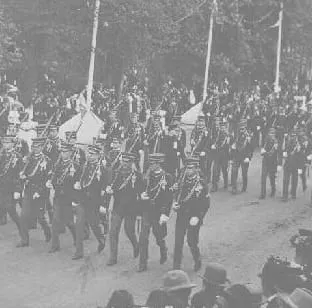
ALEXANDRIA, Va. — One hundred and seven years ago today, Alexandria's streets filled with cheering crowds as nearly a hundred returning veterans of World War I marched from King and Patrick streets to Washington and Prince streets in the city's official homecoming parade.
The procession formed at the corner of King and Patrick streets and proceeded through Old Town, ending at the intersection of Washington and Prince. The band from nearby Fort Myer marched in the parade, alongside former members of the Alexandria Light Infantry — the city's historic militia unit — who turned out to honor the men who had served. Several hundred Alexandrians had served in the war; the men who marched that day represented just under a third of them.
The parade fell about seven months after the Armistice of Nov. 11, 1918, which had ended the fighting on the Western Front but left American troops to wait through a long demobilization process. Many of the soldiers marching that day in Alexandria had returned from France only in the spring of 1919.
The Alexandria Light Infantry
Many of the men who served — and many who turned out to escort them home — came through the Alexandria Light Infantry, the city's historic militia unit. Founded in 1878 as a private local militia, the Alexandria Light Infantry operated from an armory at 200 South Royal Street. Under the Dick Act of 1903, the unit and other private militias across the country were incorporated into the National Guard. By 1916, the Alexandria Light Infantry had become Company G of the 1st Virginia Infantry Regiment.
The unit's first 20th-century mobilization came on June 28, 1916, when the city turned out for a procession to escort the troops to the train waiting on the siding at Fayette and Cameron streets. Last-minute enlistments brought the unit to 90 men, deployed to the Mexican border during the U.S. response to Pancho Villa's incursions. Two veterans of the 1846 Mexican-American War — then in their 80s or 90s — marched alongside the city's officials and dignitaries to see the unit off.
The 116th Infantry Regiment in the Great War
When the United States entered World War I in April 1917, the Virginia National Guard reorganized. The 1st, 2nd, and 4th Virginia Infantry Regiments were combined to form the 116th Infantry Regiment, assigned to the 29th Division — the "Blue and Gray Division" that drew from Virginia, Maryland, and the District of Columbia. Alexandria's men served in that regiment, applying skills they had learned on the Mexican border to combat in France.
The 29th Division's defining engagement was the Meuse-Argonne Offensive, fought from late September through November 1918 along a 24-mile front in the Argonne Forest of northeastern France. It was the largest American military operation in the war — more than 1.2 million American soldiers participated — and the costliest, with more than 26,000 American killed and 95,000 wounded. The 29th Division was thrown into the fighting near Verdun in mid-October, and the offensive's final phase continued through the morning of Nov. 11, 1918, when the armistice ended the war.
When the parade's veterans marched through Old Town that June afternoon, many were carrying that experience with them.
Alexandria's Great War losses
Several hundred Alexandrians had served in World War I. The exact number who died has been a subject of local research; the Office of Historic Alexandria maintains records and registrations through the Alexandria Library's Local History and Special Collections division, which houses World War I draft registrations for Alexandria, Arlington and Fairfax counties on microfilm from the National Archives.
The June 10, 1919, parade was one of dozens of homecoming ceremonies held across Virginia in 1919, as the state welcomed home soldiers from the 29th and 80th Divisions. Richmond held two large parades that summer, complete with three victory arches modeled on the Arc de Triomphe through which troops had marched in Paris. Charlottesville held its parade on July 4, 1919 — notable as one of the few homecoming events that summer where Black and white veterans marched the same streets together, though still separated by race. New York City held its great parade in September.
In Alexandria, the parade was smaller and more intimate — a city procession through the streets where these men had grown up, escorted by the Fort Myer band and the older Alexandria Light Infantry men who had once worn the uniform before them.
The route today
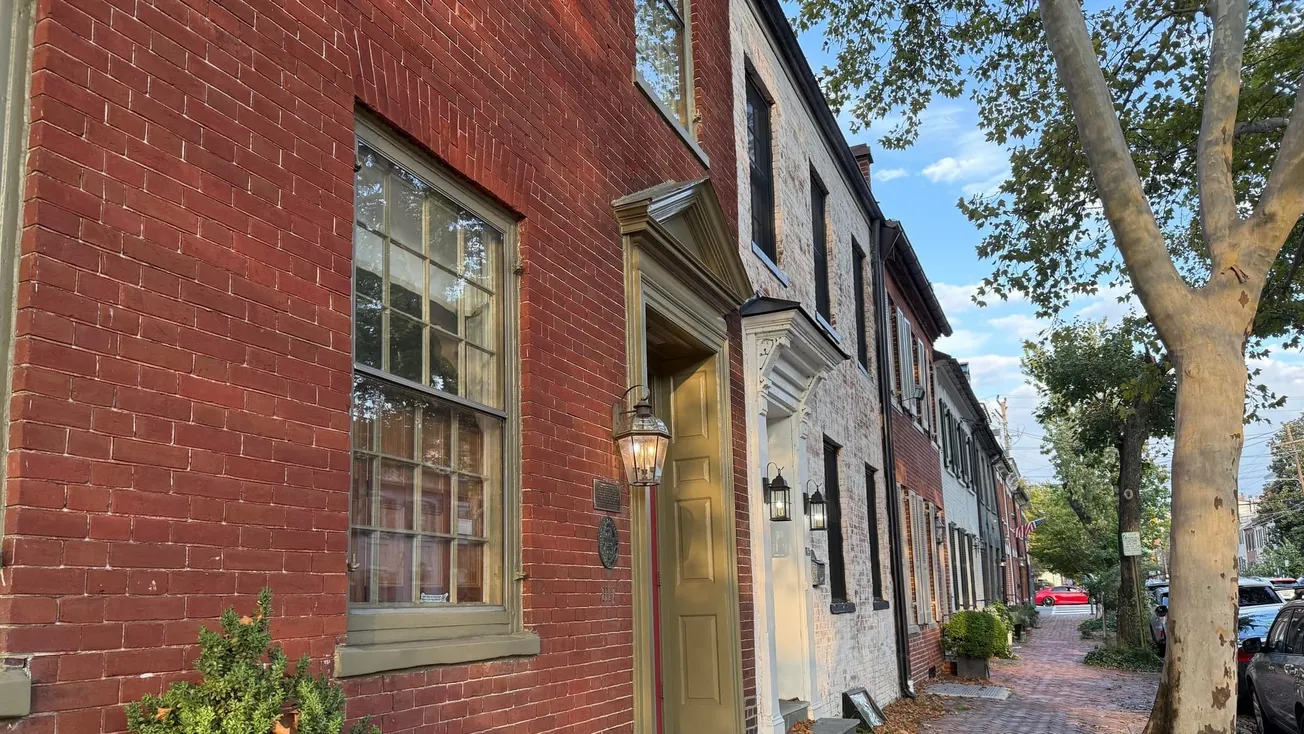
The route the veterans walked is still walkable today. King and Patrick streets remains a major intersection in Old Town, and Washington and Prince streets — the parade's endpoint — sits in the heart of the historic district. A walk between the two intersections covers roughly half a mile through what remains the same street grid the soldiers marched through in 1919.
The Alexandria Light Infantry's armory building no longer stands at 200 South Royal Street, but the unit's lineage continues today through the 116th Infantry Regiment of the Virginia Army National Guard, headquartered in Staunton.
Information via the Office of Historic Alexandria's "This Week in Historic Alexandria" newsletter, the Alexandria Library's Local History and Special Collections division, the Virginia Museum of History & Culture, and military histories of the 116th Infantry Regiment.