
Table of Contents
ALEXANDRIA, Va. — Two anniversaries fall on June 6, one global in scale and one local: the day Allied forces stormed the beaches of Normandy in 1944, and the day Alexandria's leaders confronted the limits of policing a city that had grown faster than its City Hall facilities.
The 82nd anniversary of D-Day
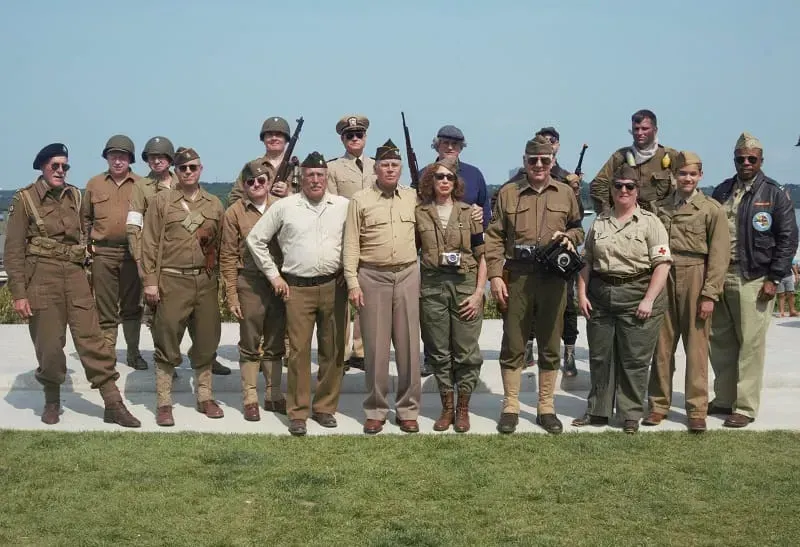
On June 6, 1944 — 82 years ago today — the largest amphibious invasion in history launched on the beaches of Normandy, France, marking the beginning of the liberation of Western Europe. The events of D-Day are commemorated each year in Alexandria through a sister city relationship that links the city directly to one of the places most devastated by the battle that followed.
Alexandria and Caen, France, have been sister cities since 1991. Caen, located 10 miles inland from the Normandy coast, sustained near-total destruction in the Battle of Normandy that followed D-Day — first from Allied bombing meant to disrupt German defenses, and then through ground combat that lasted into late July before the Allies captured the city. By the time the fighting ended, an estimated 75% of Caen lay in ruins.
The Sister Cities International program itself traces to the same era, founded in 1956 at the urging of President Dwight D. Eisenhower, who had commanded the D-Day invasion as Supreme Allied Commander a dozen years earlier. Alexandria's partnership with Caen was formalized 35 years later, in 1991.
In 2010, the Alexandria-Caen Sister City Committee held its first annual D-Day commemoration, and the Alexandria City Council has passed a resolution commemorating the Normandy invasion every year since. The 16th Annual D-Day Commemoration was held this past Sunday, May 31, at John Carlyle Square Park, with Thursday's companion lecture at The Lyceum delivered by Rear Adm. Samuel Cox, director of the U.S. Navy's Naval History and Heritage Command.
A growing city outgrows its police headquarters (1950)
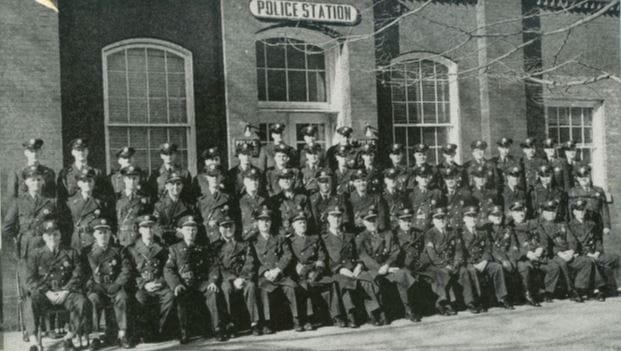
Six years after D-Day, on June 6, 1950, a city report flagged the urgent need for a new Alexandria police facility to replace the cramped quarters on the North Fairfax Street side of City Hall.
The pressure was demographic and operational. Between 1940 and 1950, Alexandria's population had nearly doubled, from about 33,500 to roughly 62,000 residents, propelled in part by the rapid expansion of federal government employment during and after World War II. The police force grew alongside the city, from 39 officers in 1940 to 85 in 1950. The case load had grown faster still — exceeding 12,000 charges a year — and the City Hall quarters could no longer handle it.
The new police headquarters opened nine years later, in 1959, at a cost of $350,000 — equivalent to roughly $3.8 million in today's dollars. The new building, on North Pitt Street, was constructed in the colonial-style architecture popular for Alexandria municipal buildings at the time, echoing the design of the Alexandria Health Department building on North Saint Asaph Street and the city's trash and incinerator facility at the southern end of South Payne Street.
While colonial on the outside, the headquarters was state-of-the-art on the inside, featuring modern holding cells, dedicated training and interview rooms, and a film processing darkroom — facilities largely unavailable at the old City Hall location.
The Alexandria Police Department, like the city it serves, has continued to grow and modernize since. Today's department, with hundreds of sworn officers, operates from its modern headquarters at 3600 Wheeler Ave.
Information via the Office of Historic Alexandria's "This Day in History," the Alexandria-Caen Sister City Committee, and Sister Cities International.