
Table of Contents
Update, May 21 at 1:15 p.m.: This story has been updated to include additional context from Chief Financial Officer Dominic Turner on cross-division staffing comparisons, and details from a second round of staff answers to board questions that were provided to The Alexandria Brief on Thursday.
ALEXANDRIA, Va. — The Alexandria City School Board spent Wednesday night working through the fine print of Superintendent Melanie Kay-Wyatt's adjusted fiscal 2027 budget, holding its second work session not to hear a new presentation but to press staff on follow-up questions before members file their proposed changes Friday at noon.
The meeting was the board's last scheduled discussion before the deadline to submit add/delete proposals — the formal mechanism members use to amend the superintendent's recommended budget. Whatever members file by noon Friday, May 22, will frame the final round of decisions on a spending plan shaped by some of the tightest constraints in years.
The session built on 97 written questions the board submitted ahead of its May 12 meeting, which the finance team answered within five days. Staff posted responses to a second round of follow-up questions during Tuesday's meeting and revised an earlier answer comparing central office staffing across Northern Virginia. The full set of questions and answers, a 114-page document, is available through BoardDocs.
Why this year is different
Chair Michelle Rief opened the meeting by reminding viewers why this budget cycle has been so difficult. The division is negotiating its first collective bargaining agreements, with two units — licensed staff and education support professionals. The state budget that supplies about 20% of ACPS funding has not been adopted, leaving the division without a firm number from Richmond. And the city's appropriation will rise just 1.5%, or about $4.2 million, which Rief said represents the lowest share of the general fund directed to schools in more than a decade and less than half the rate of inflation.
That increase, she said, does not keep pace with the division's rising costs for items such as supplies, security and custodial contracts, transportation for students with disabilities and health insurance premiums. As a result, she said, the raises ACPS can offer employees this year depend on cuts elsewhere in the budget.
To balance the plan, the division is weighing $13.3 million in total expenditure adjustments: $7.7 million the board approved in February and an additional $5.6 million Kay-Wyatt recommended May 7. The second round eliminates 45.6 positions and reduces the raises in the division's first bargained agreement, dropping the average increase for both units to 4.2% from the 5.35% for licensed staff and 6.42% for support staff negotiated in March.
 Ryan Belmore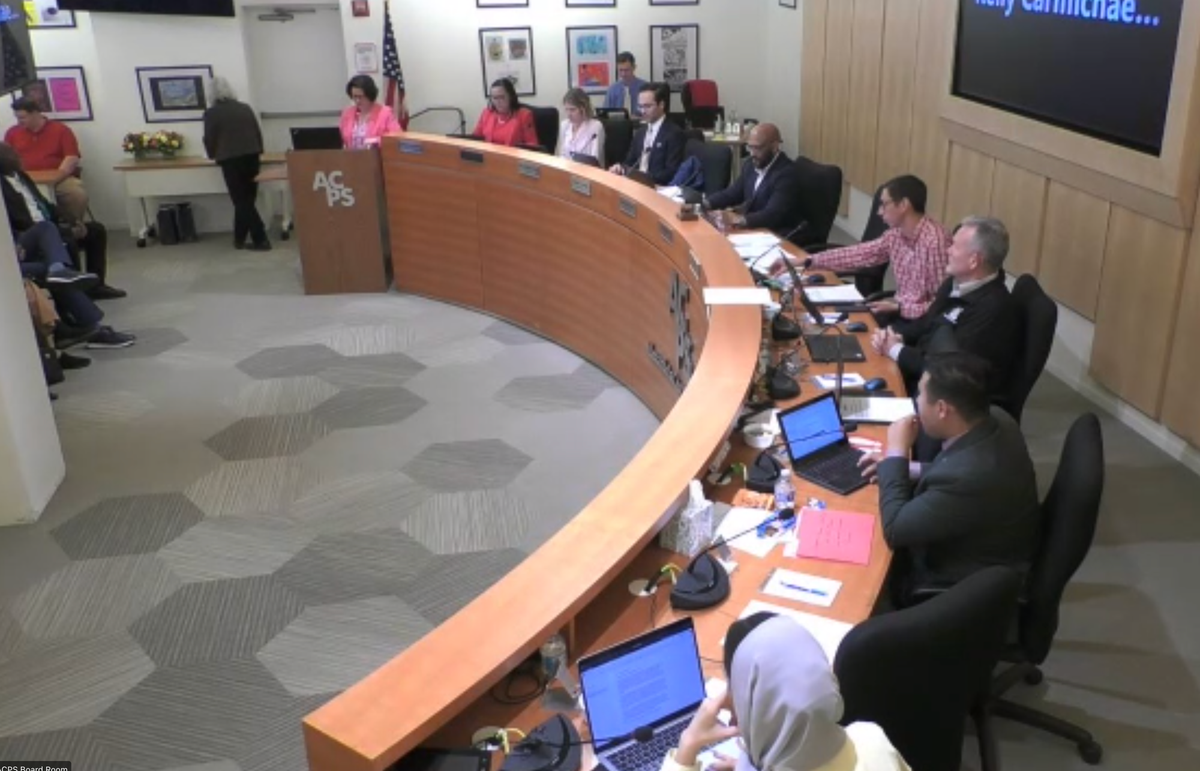
Central office under the microscope
Central office staffing drew the most sustained questioning. Chief Financial Officer Dominic Turner walked the board through a regional comparison showing that ACPS operates one of the leanest central offices in Northern Virginia, with 213 building-based positions, about 7.7% of total staff. He cautioned that the figures are not a clean comparison, because divisions group their departments differently — what ACPS splits into seven offices within financial services, for instance, another division might fold into four. "When compared across school divisions, the roles and responsibilities are not the same within departments of similar names," Turner said.
Even so, Turner said, every surrounding division except Manassas City runs a larger central office relative to enrollment. The adjusted budget cuts 12.5 central office positions, several of them filled, meaning some current employees will be affected. By contrast, most of the school-based reductions are vacant positions expected to be handled through retirements, resignations and transfers.
Board members, including Ryan Reyna, pressed for a clearer public breakdown distinguishing central office staff who work in the building from those budgeted centrally but assigned to schools — special education teachers, therapists, English learner teachers and others. Turner said ACPS plans to adopt that two-category presentation in next year's budget book, mirroring how Arlington and Fairfax report their figures.
Healthcare costs and a proposed shift
Members also questioned the proposed change to how employees and the division split healthcare premiums. Staff said maintaining the current cost-sharing structure would require cutting about 14.5 positions or eliminating the budgeted 1.25% cost-of-living adjustment, set against a healthcare budget of roughly $33 million absorbing steep premium increases — 16% for the UnitedHealthcare plans most employees use and 8% for Kaiser.
Turner explained that UnitedHealthcare's plan is self-insured, meaning the division must bring in enough money to cover claims, and that costs are rising both because healthcare prices are climbing nationally and because employees are using benefits more. He noted the division recently completed a competitive bidding process that lowered administrative and prescription drug costs. Data presented earlier in the cycle put the ACPS employee cost share at about 25%, in line with the regional average.
The healthcare shift, approved as part of the February budget, dominated public comment at the May 12 hearing, where teachers said their premiums had jumped far more than expected when the rate increase and the cost shift landed at once.
Devices, staffing levels and class size
Board member Donna Kenley asked whether eliminating digital devices in the lowest grades would save money. Staff said removing kindergarten tablets would yield little net savings, because the division has not budgeted to replace the aging devices and would face new costs to redesign curriculum and retrain teachers. They added that device use in kindergarten is already the lowest in the division and that the reduction would not change the number of state-mandated technology staff.
Members also asked why ACPS staffs well above the state's Standards of Quality minimums in many categories. Kay-Wyatt said those positions reflect priorities the board set over years to serve special education students, English learners and specific school communities, and that federal law requires additional staff when a student's individualized education program calls for it.
On class size, staff stressed that a change in the budgeting formula will not change what families see in classrooms. Elementary classrooms have operated at 24, 26 and 28 students — for kindergarten, grades one and two, and grades three through five — for two years. The adjusted budget resets the planning formula, previously 22, 24 and 26, to match the ratios already in place rather than imposing new ones.
What the latest answers revealed
The follow-up responses provided to school board members during the meeting on Wednesday sharpened several points the board has been weighing. Staff confirmed that if the still-unadopted state budget delivers new money, it could be used to honor the original collective bargaining terms — but only if the board forgoes a $507,929 state Standards of Quality bonus, which carries an "equivalent pay action" requirement the adjusted budget already largely meets. Staff also said the Virginia Department of Education has confirmed that federal Title I funds can be used to support Communities in Schools, a potential alternative route to preserving the program Rief is fighting to fund.
On staffing, the answers quantified how far ACPS exceeds state minimums: the division budgets about 2,441 positions in state-defined SOQ categories, compared with the roughly 1,665 the state funds — a difference of more than 770 positions. The largest gaps fall in special education aides, elementary resource teachers, kindergarten aides and secondary English teachers.
The responses also underscored how quickly healthcare costs are rising. Combined employer and employee costs are projected to climb from about $30.7 million in fiscal 2025 to an estimated $38.2 million in fiscal 2026 and $43.7 million in fiscal 2027, with the employee share nearly doubling over that span.
And on the proposed move to scale back student devices, staff said reducing to a 2-to-1 ratio would cost more than the $200,000 it would save once curriculum redesign, new purchases, and teacher training are factored in.
Positions members want to save
Several members advocated for specific reductions on the list. Kenley pressed the case for the two Afghan family liaison positions, arguing that families arriving from a region marked by trauma require more support, not less, and that she had heard broad community backing for the roles.
Rief said she has asked Mayor Alyia Gaskins and Councilman John Taylor Chapman to consider using leftover city contingent reserve funds to restore $350,000 for Communities in Schools of Northern Virginia, which provides wraparound support in six ACPS schools. If reversed, she said, the cut would also preserve more than $800,000 in matching funds from outside foundations. Rief said the request is under consideration and that she would keep the community informed.
What's next
Board members' add/delete proposals are due by noon on Friday, May 22. The board will take up those proposals at an add/delete work session on Tuesday, June 9, and is scheduled to adopt the FY 2027 budget on Thursday, June 11. It will be Kay-Wyatt's final budget as superintendent before her planned Oct. 1 retirement.
Members noted the division is still awaiting the state budget and any associated funding, which they expect within the next couple of weeks — money that could determine what, if anything, gets restored.
The board accepts written comment anytime at board@acps.k12.va.us, and public comment is open at its regular meetings.
Coverage like this takes time — watching the meeting, reading the 114-page document, and checking every figure. The Alexandria Brief has no ads, no paywall and no corporate owner. If this reporting is useful to you, support it with a monthly or annual subscription, or a one-time contribution.