ALEXANDRIA, Va - When Northern Virginia school leaders sat down with Virginia's top education officials at Alexandria City High School's Minnie Howard Campus three weeks ago, they had a metaphor ready for the state's new school rating system: it acts as a "hammer" for punishment rather than a "flashlight" for showing where help is needed.
That line, attributed to Region 4 school leaders in a Virginia Department of Education report released Thursday, is now central to a wave of state-level changes the Spanberger administration says it will bring to the Board of Education this fall — directly responsive to feedback gathered in Alexandria and across the state.
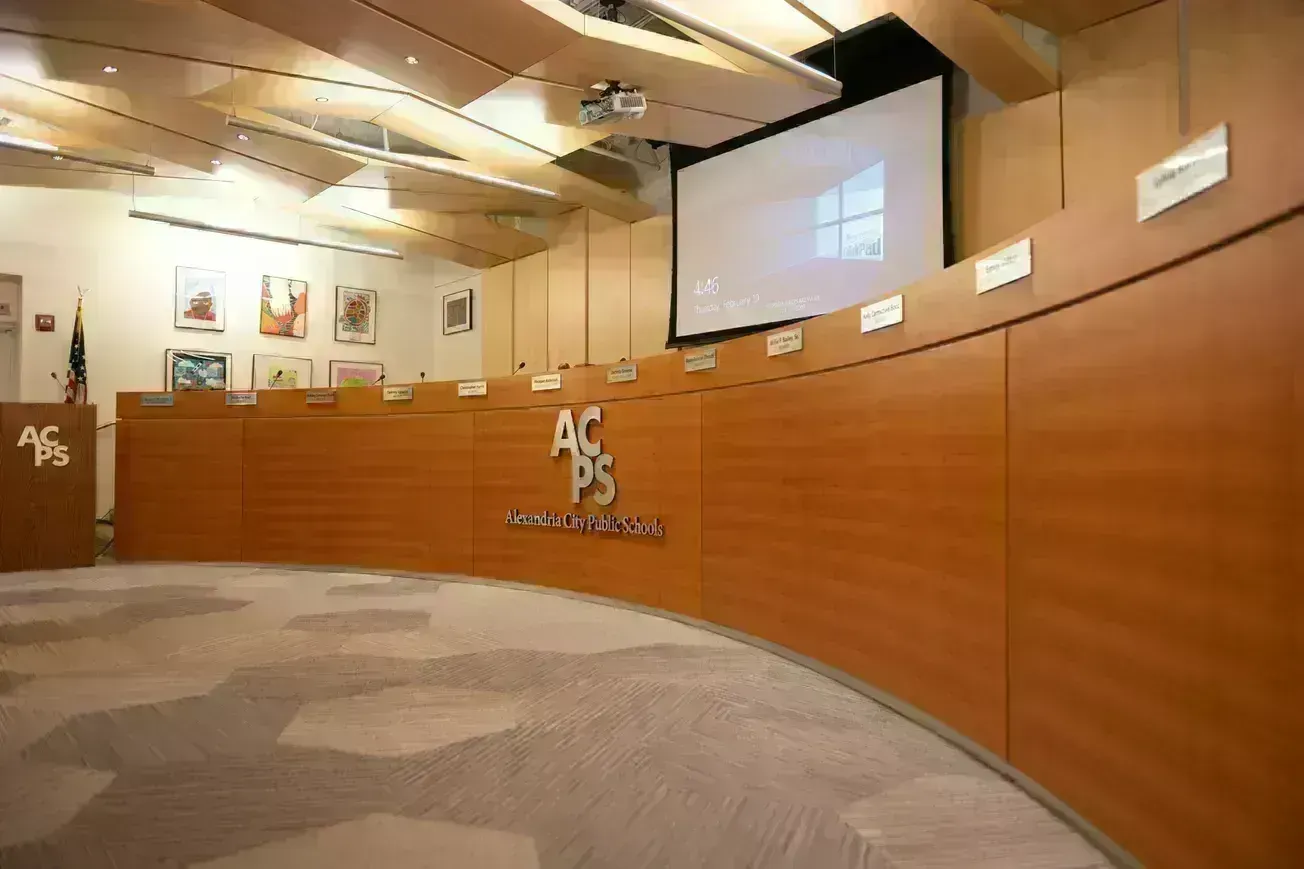
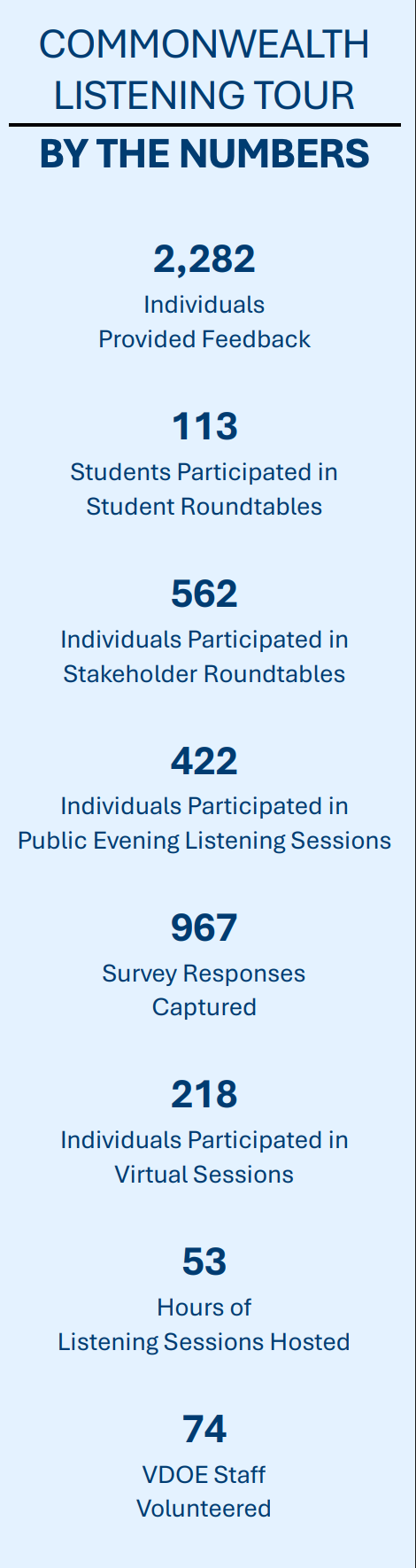
The report, titled Elevating the Voices of Virginians to Strengthen Public Education, synthesizes findings from the Commonwealth Listening Tour, a statewide effort ordered by Governor Abigail Spanberger on her first day in office through Executive Order 4. The tour ran from March 4 in Hampton through April 8 in Alexandria — the eighth and final in-person stop — and gathered feedback from 2,282 participants across 53 hours of sessions.
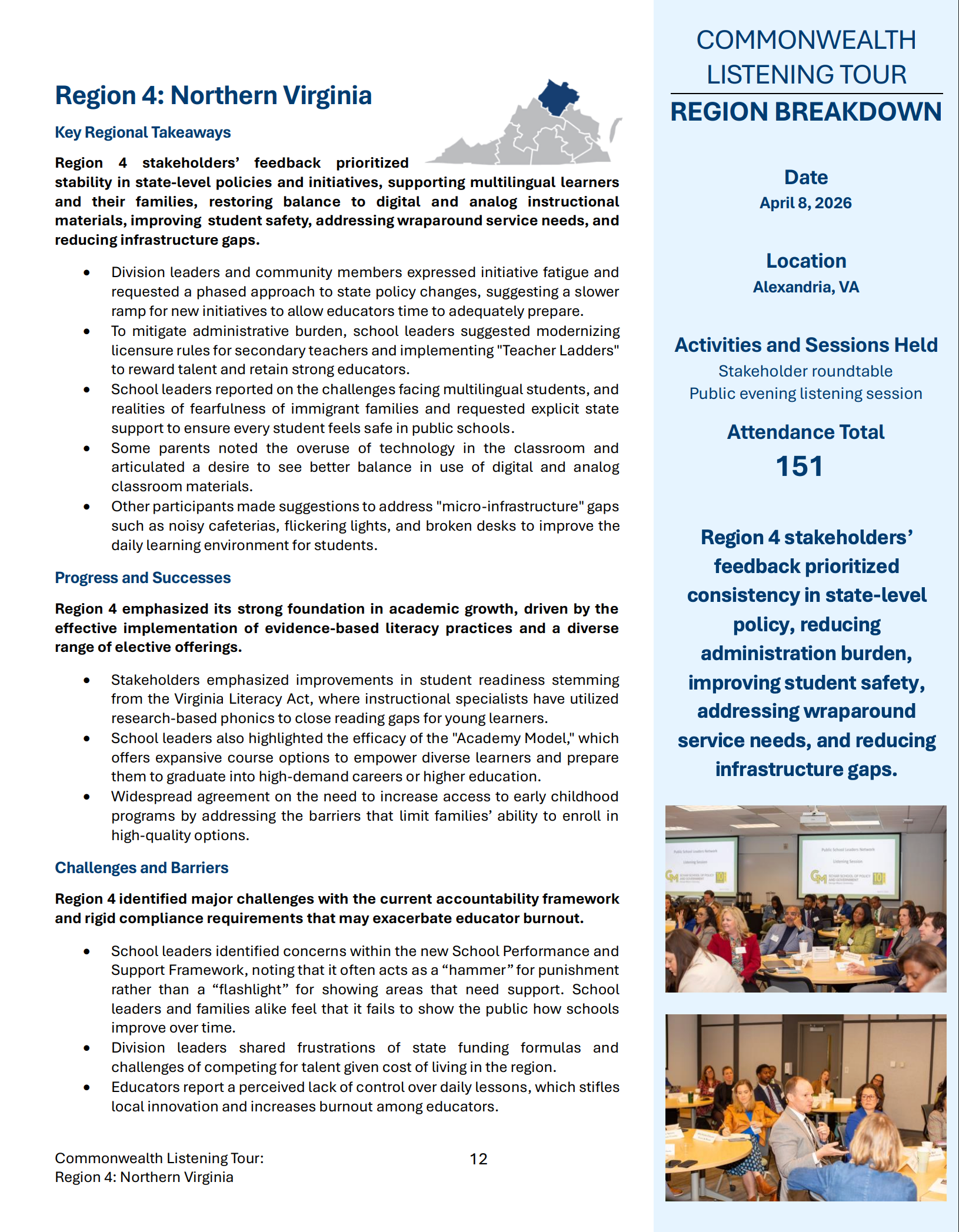
Alexandria's stop drew 151 attendees, the third-largest crowd of any regional session.
 Ryan Belmore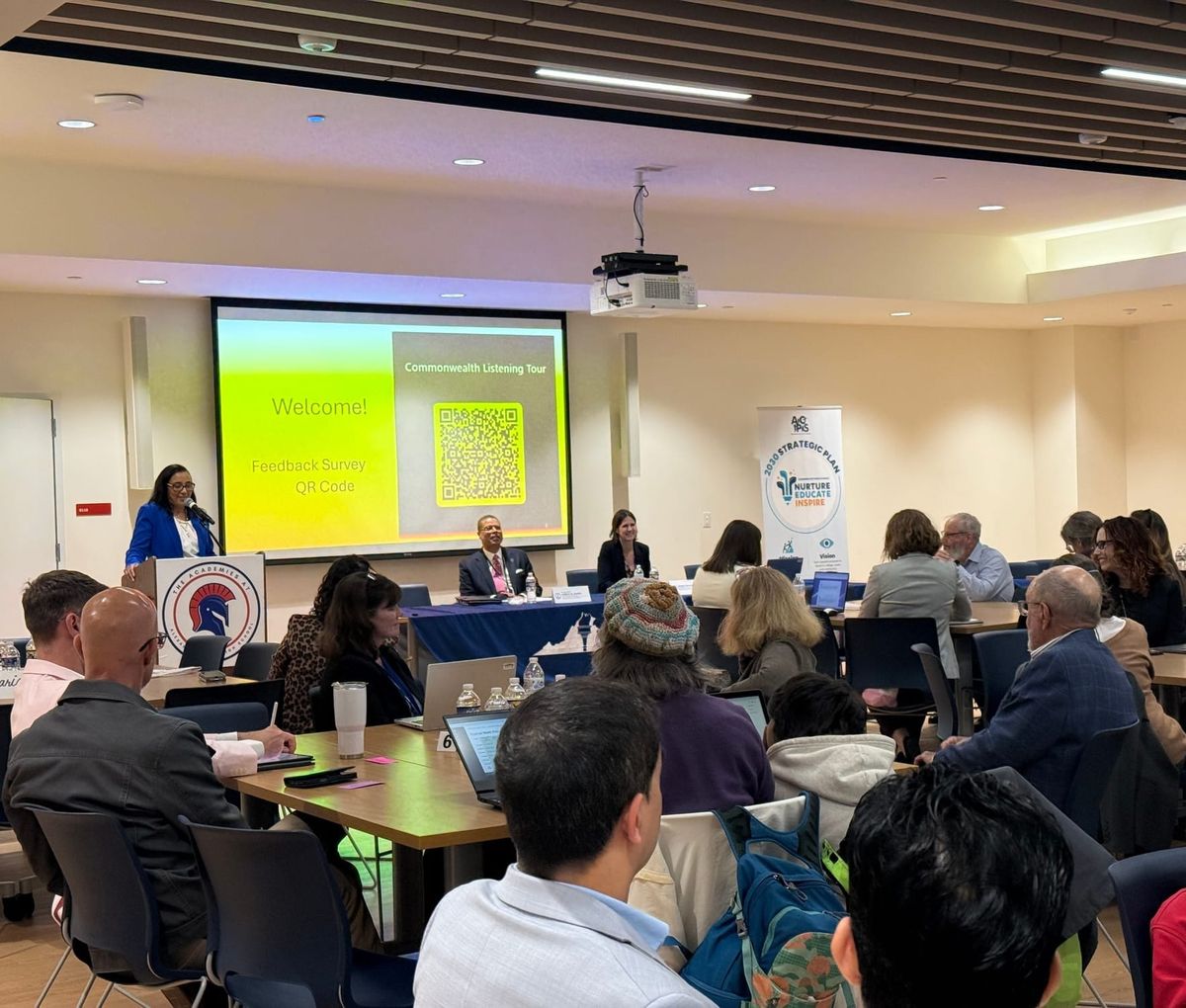
Alexandria's fingerprint on the report
The report's Region 4 summary lists six priority areas raised at the Minnie Howard session, several of which are distinctly Northern Virginia. Among them:
Initiative fatigue. Division leaders and community members asked the state for a phased ramp on new policy changes, citing the difficulty of implementing simultaneous shifts in standards, assessment and accountability. The same theme appeared in regions across the state, but Region 4 leaders specifically requested "a slower ramp for new initiatives to allow educators time to adequately prepare."
Multilingual learners and immigrant family safety. School leaders described "the realities of fearfulness of immigrant families" and asked for "explicit state support to ensure every student feels safe in public schools" — language that did not appear in any of the other seven regional summaries. Interpretation at the April 8 session was offered in Spanish, Arabic, Amharic and Dari, reflecting the linguistic diversity of ACPS and surrounding divisions.
Digital-analog balance. Region 4 parents told state officials they wanted a return to a better mix of physical and digital classroom materials — a theme echoed across rural and urban regions alike.
"Micro-infrastructure" gaps. Participants flagged everyday building issues — noisy cafeterias, flickering lights, broken desks — as drags on the daily learning environment.
Funding and competition for talent. Division leaders cited cost-of-living pressures in Northern Virginia and frustrations with state funding formulas as obstacles to recruiting and retaining strong educators.
The "hammer" critique of school ratings. School leaders said the new School Performance and Support Framework — the school rating system Virginia first implemented for the 2024-25 school year — too often punishes schools without showing the public how they improve over time.
On the success side, Region 4 stakeholders praised the Virginia Literacy Act for closing reading gaps in the youngest learners, the Academy Model for offering diverse career and college pathways, and broadly agreed on the need to expand access to high-quality early childhood programs.
What the state says it will do
The report is paired with a separate VDOE document, Fulfilling the Charge in EO4, that lists actions already taken and steps still in motion. Several connect directly to feedback from Alexandria:
- Accountability changes coming this fall. The state secured an outside vendor to conduct an after-action review of the 2025 SPSF rollout and corrected results for 26 schools whose ratings had errors. Stakeholder feedback — including the "hammer" critique — will inform proposals brought to the Board of Education for the fall 2026 school ratings, with larger changes considered for fall 2027 and beyond. A December 2025 report from the Joint Legislative Audit and Review Commission and 2026 legislation, House Bill 643, also direct VDOE to weigh those recommendations.
- Less testing for high schoolers. Beginning in the 2026-27 school year, Virginia will eliminate the Virginia Growth Assessment and the Integrated Reading and Writing test for high school students — a direct response to widespread concerns about "assessment fatigue" voiced in Alexandria and elsewhere. VDOE plans to issue a request for proposals this summer for a new statewide assessment vendor.
- $10 million for math. The state has awarded Mathematics Innovation Grants to 27 school divisions and seated 12 new members on a Math Task Force. Whether ACPS is among the 27 grantees is not specified in the report; The Alexandria Brief has reached out to ACPS for confirmation.
- A new literacy advisory group. VDOE selected 24 members from a pool of 338 applicants to serve on a new Statewide Literacy Advisory Workgroup, which met for the first time April 16 in partnership with the Virginia Literacy Partnership at the University of Virginia.
State Superintendent Jenna Conway closed the April 8 Alexandria session by calling it "vibrant" and saying she heard "passion" and "commitment" across the tables. "I've heard so many different perspectives tonight, as I have over the course of the last few weeks," she said that evening, "but I also hear your passion, hear your commitment, and truly believe that there is more that unites us than divides us."
Secretary of Education Dr. Jeffrey O. Smith closed the night with a quote from Nelson Mandela: "Education is the most powerful weapon which we can use to change the world."
What's next
VDOE has indicated that a comprehensive report and appendices, separate from the executive summary released Thursday, are forthcoming. Specific proposals to refine the SPSF will go to the Virginia Board of Education in advance of the fall 2026 school ratings.
For ACPS, the report offers an unusual moment of state-level alignment with the concerns its own school leaders raised in person. Whether that translates into the kind of "phased approach" Region 4 asked for, however, will become clearer as the Board of Education takes up the proposals later this year.
The Alexandria Brief
Alexandria, Va., news and information you won't find anywhere else.
The Alexandria Brief has no ads, no paywall, and no corporate owner. It's just me - Ryan Belmore, a journalist and Alexandria resident — covering the city I live in, funded entirely by neighbors like you. Support this work with a monthly, annual, or one-time contribution.
Send feedback, story ideas, news, and tips to ryan@alexandriabrief.com.
Subscribe | Support | About | Contact | Submit News | Standards & Policies