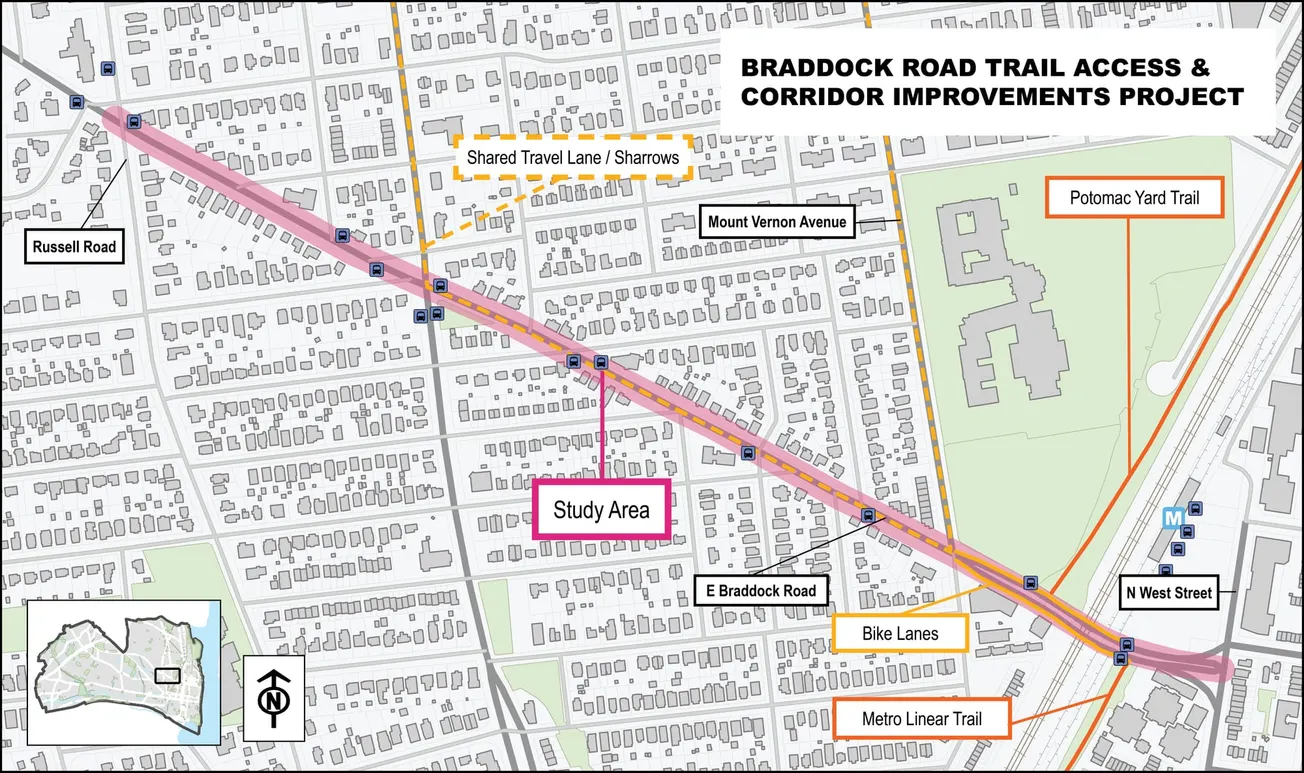
ALEXANDRIA, Va - When the Alexandria City Council convenes on May 16, the seven members on the dais will weigh a project whose supporters say will save lives and whose opponents say will create new dangers. Both sides have been making factual and policy claims for months — on listservs, in petitions, on yard signs, in church letters, in surveys, and at a six-hour public hearing in February. Some of those claims hold up against the documentary record. Some don't. Some name real disagreements about values that the council, not a fact-check, will have to resolve.
This is a reader's guide to nine claims circulating in the public debate, organized by what kind of claim each one is. The first four are factual claims where the record clearly settles the question. The next three are contested inferences where reasonable people read the same evidence differently. The final two are genuine tradeoffs where the disagreement is about values.
What the project actually includes
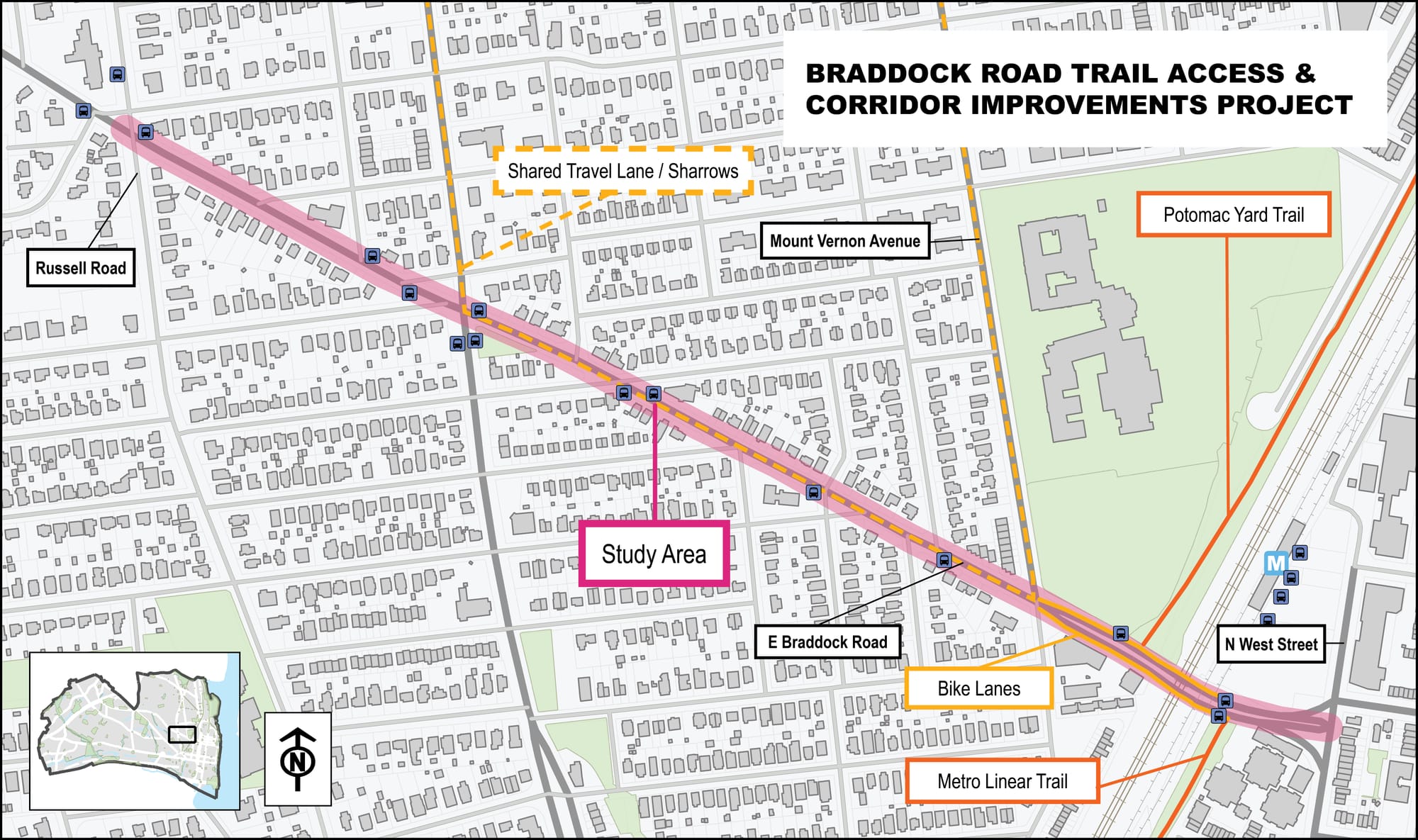
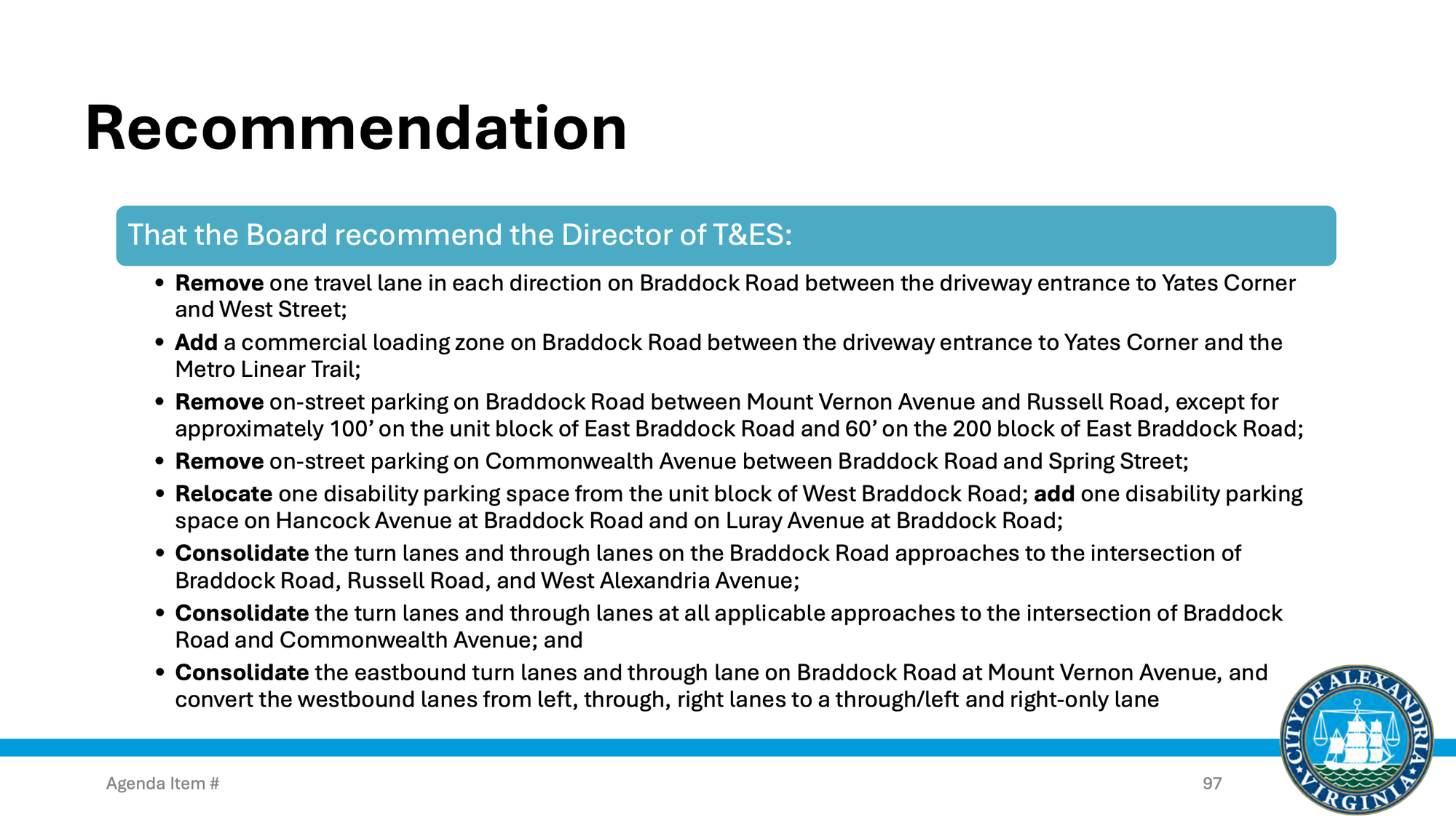
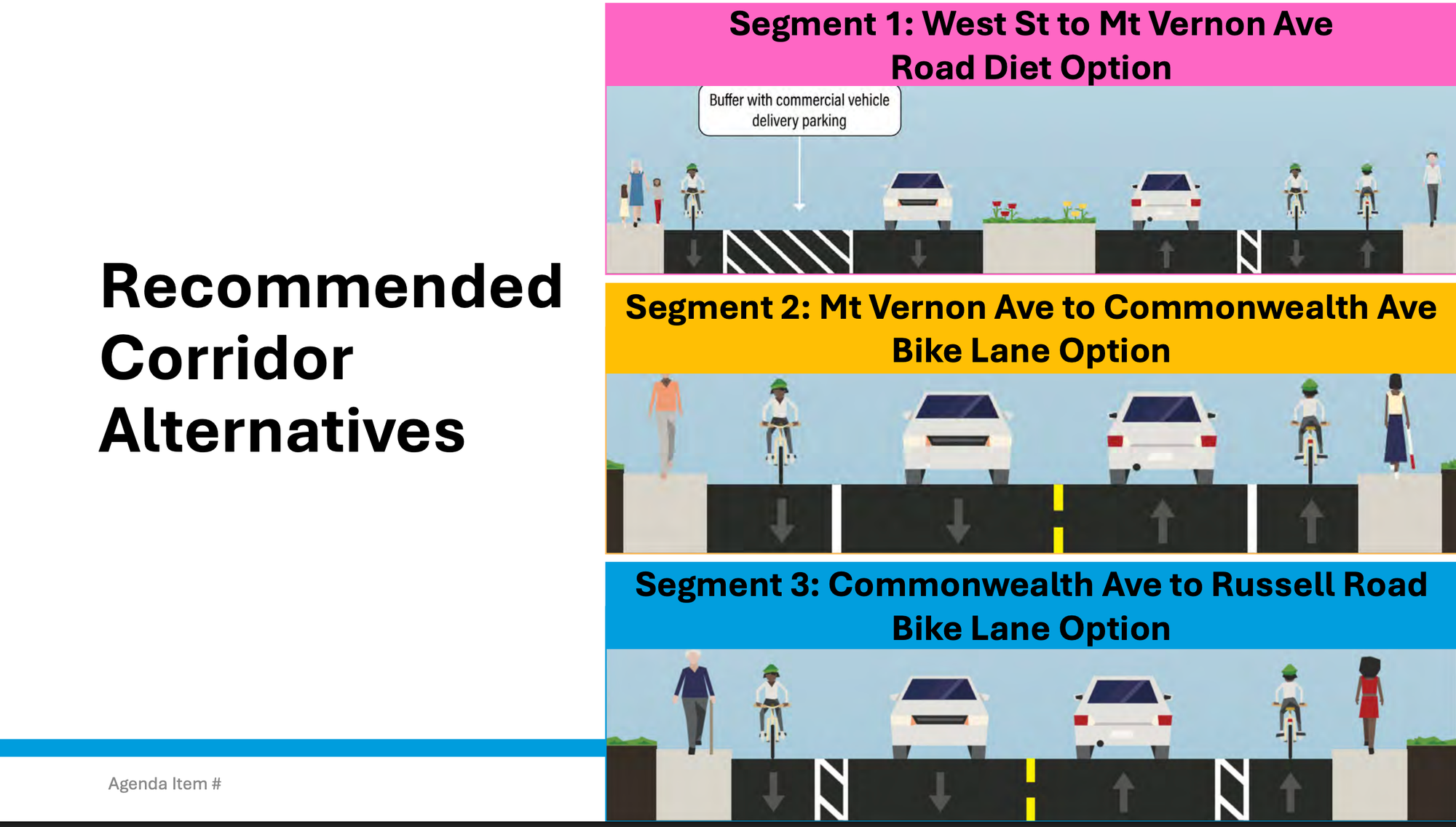
The Braddock Road Corridor Improvements Project is more than bike lanes, though much of the public debate has focused on that one element. According to the recommendation approved by the Traffic and Parking Board on Feb. 24, the project includes:
- Removing one travel lane in each direction on Braddock Road between the driveway entrance to Yates Corner and West Street, near the Metro station
- Adding a commercial loading zone on Braddock Road between Yates Corner and the Metro Linear Trail
- Removing most on-street parking on Braddock Road between Mount Vernon Avenue and Russell Road, with approximately 100 feet preserved on the unit block of East Braddock Road and 60 feet preserved on the 200 block of East Braddock Road
- Removing on-street parking on Commonwealth Avenue between Braddock Road and Spring Street
- Relocating one disability parking space from West Braddock Road and adding two new disability parking spaces, on Hancock Avenue and Luray Avenue at Braddock Road
- Consolidating turn lanes and through lanes at the intersections of Braddock Road with Russell Road, Commonwealth Avenue, and Mount Vernon Avenue
- Adding protected bike lanes along most of the corridor, with a two-way protected bike lane near the Metro station and shorter unprotected segments where parking is preserved
- Shorter pedestrian crossing distances at major intersections, with new median refuges and protected crossings
- Signal timing changes designed to maintain or improve traffic flow
- Emergency Vehicle Pre-emption at the West Street intersection
The project is one of several initiatives the city has identified under its Vision Zero program, adopted by the council in 2017, which aims to eliminate traffic deaths and serious injuries on Alexandria streets by 2028. The city's Vision Zero Crash Dashboard has recorded 478 pedestrian and bicyclist crashes citywide between Vision Zero's adoption in December 2017 and late November 2025, including 19 fatal and 68 causing serious injuries. The 64 pedestrian and bicyclist crashes logged in 2024 were the highest annual total since the program's adoption.
The project's stated foundations also include the city's 2016 Pedestrian and Bicycle Master Plan, the Alexandria Mobility Plan, the Complete Streets Policy, the Environmental Action Plan, and a 2023 Safe Routes to School walk audit at George Washington Middle School.
The Traffic and Parking Board approved the project 6-0 on Feb. 24 after a six-hour hearing in which approximately 37 speakers supported the recommendation, and 29 opposed it. Opponents filed an appeal on March 6 with 53 signatures. Good Shepherd Lutheran Church and Community Praise Church Seventh-day Adventist subsequently joined the appeal. The hearing is scheduled for 9:30 a.m. Saturday, May 16, at the Del Pepper Community Resource Center.
By the time of the appeal hearing, Councilwoman-elect Sandy Marks — who supported the project during her April 21 special election campaign — will have been sworn in on May 12, completing the seven-member council that will hear the appeal.
Factually disputed: Where the record settles the question
Claim 1: "There have only been six minor accidents on Braddock Road since 2017."
The Save Braddock Road petition on Change.org, which had collected 1,563 verified signatures as of April 30, states that "Braddock Rd is already safe between Russell Rd and Mt. Vernon Ave," citing "only six minor car accidents here since 2017 (with 71 west of Russell Road), and no bicycle or pedestrian accidents during that time."
The city's data covers a different time window and a broader area. According to the staff presentation slide on crash history, presented by Complete Streets program manager Alexandria Carroll at the Feb. 23 Traffic and Parking Board hearing, the project area saw 17 total crashes between 2019 and 2023, eight involving injury. A pedestrian was killed at the intersection of Braddock Road and Commonwealth Avenue in 2015. The crash map in the city's presentation shows clusters at the Russell Road approach, the Commonwealth Avenue intersection, the Mount Vernon Avenue intersection, and the Metro station area.
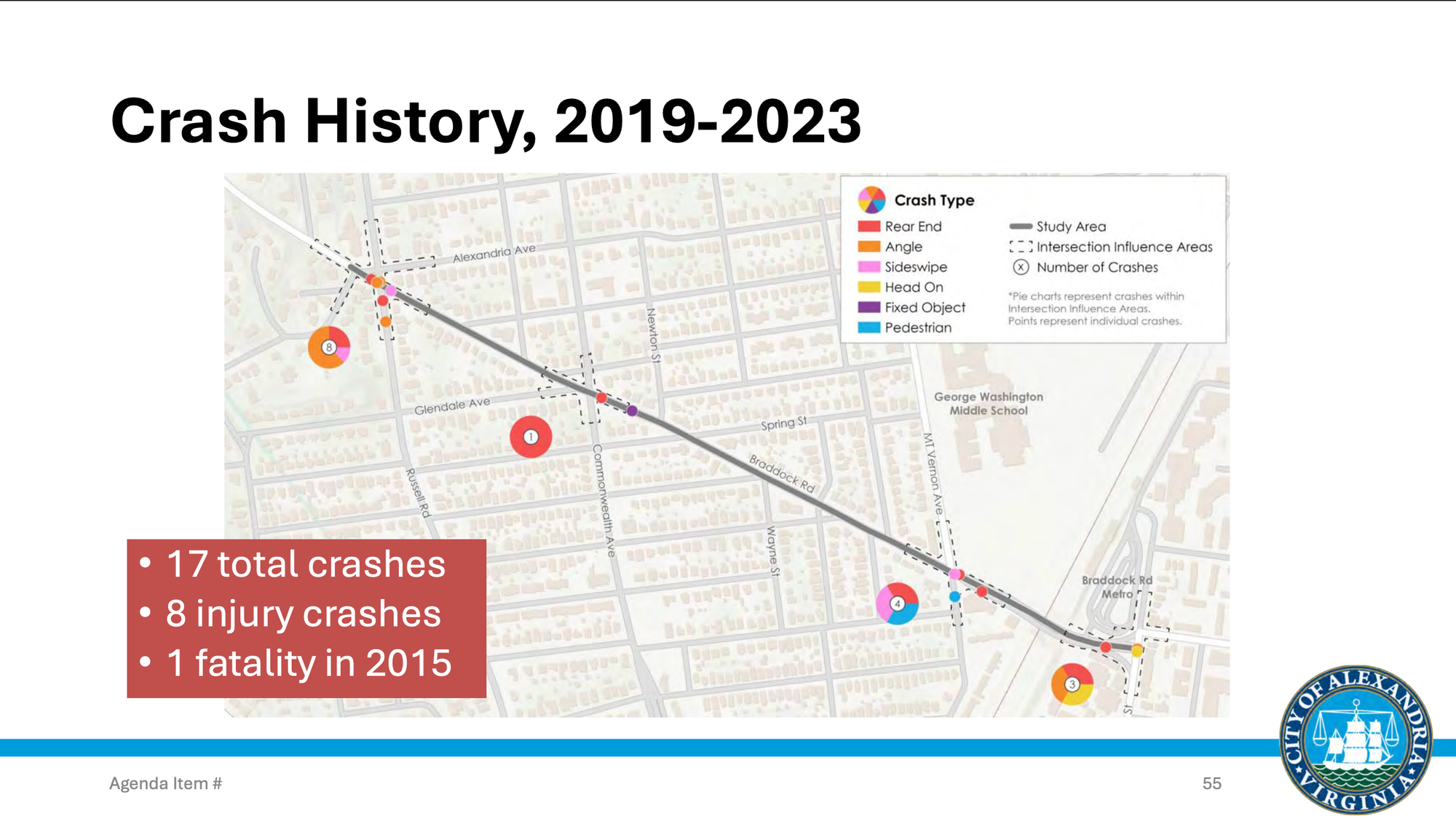
The two figures may not be directly contradictory. The petition's narrow claim — about the Russell-to-Mount Vernon segment, since 2017, 'minor' crashes only — may reflect a specific segment-and-severity definition that excludes some of what the city counts. The city's broader corridor safety case rests on the 2015 fatality at Commonwealth, the eight injury crashes recorded between 2019 and 2023, the speed measurements documented across all three segments, and federal guidance about which design treatments are appropriate for streets at Braddock's traffic volumes and speeds.
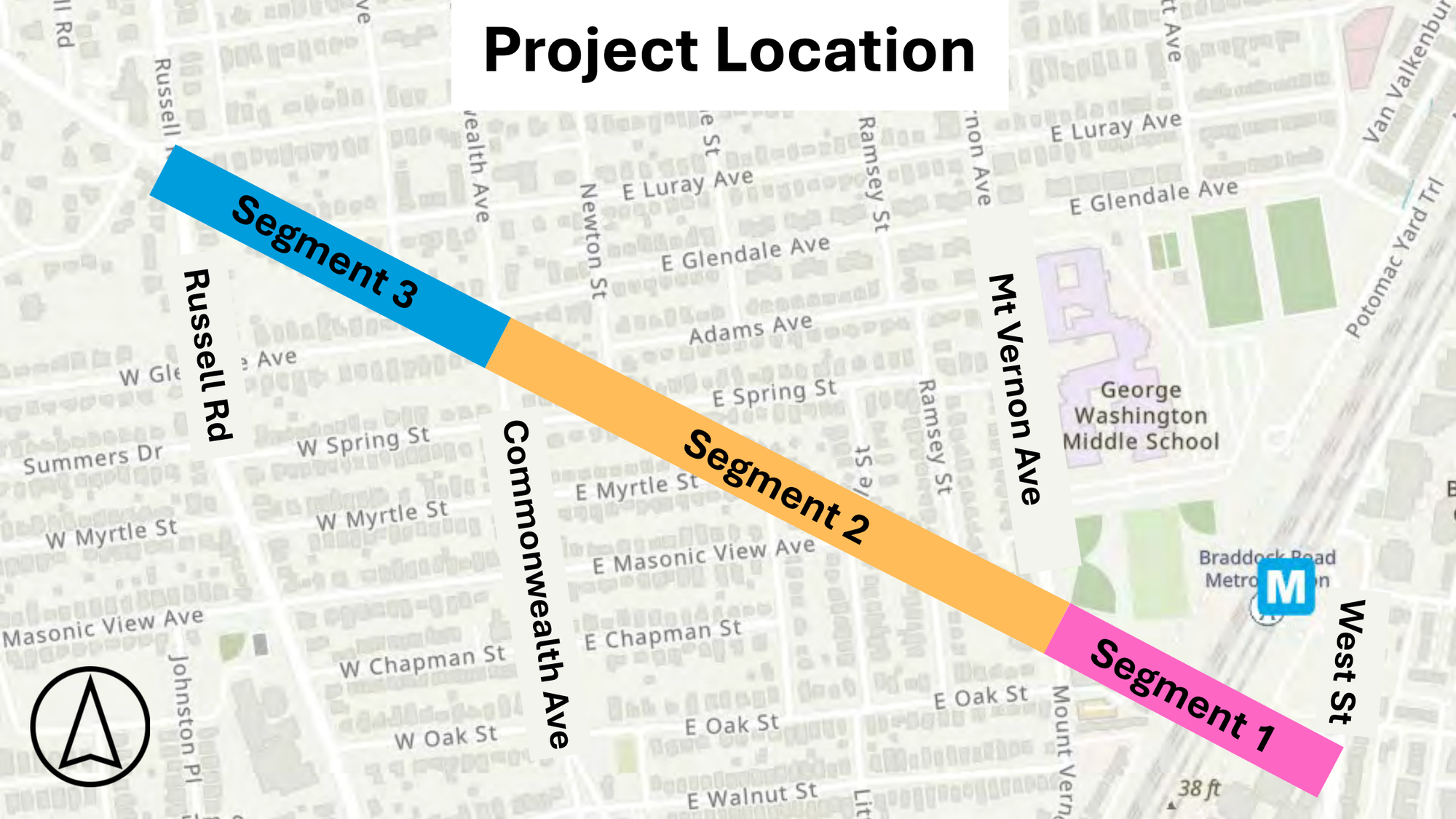
The city's safety case also rests on speed data. The Feb. 23 staff presentation documents 85th-percentile speeds — the speed at or below which 85 percent of vehicles travel — exceeding the posted 25 mph limit across all three segments: 31 to 32 mph between Russell Road and Commonwealth Avenue, 29 to 30 mph between Commonwealth and Mount Vernon, and 25 to 31 mph between Mount Vernon and West Street.
A more recent incident is also relevant. A driver struck a pedestrian at the intersection of Mount Vernon Avenue and East Braddock Road on the evening of Saturday, April 4, according to Alexandria Police Department social media and the Brief's prior reporting. APD said the intersection closed during the investigation and reopened at about 5:46 p.m. The April 4 crash was one of five driver-pedestrian crashes APD posted about during April. The others included a fatal crash at North Saint Asaph and Montgomery streets on April 20, in which a driver struck and killed a 62-year-old woman; a crash near William Ramsay Elementary on April 15 in which a driver struck an 11-year-old boy; and crashes at Mill Road and Eisenhower Avenue on April 1 and at North Van Dorn Street and Sanger Avenue on April 7. APD has not released a formal cause analysis for any of those crashes. The April 4 crash occurred at one of the intersections the Braddock Road project would reconfigure.
Claim 2: "VDOT only flagged the eastern segment near the Metro as a priority."
The Save Braddock Road petition states the coalition supports "the critical safety improvements on E. Braddock Rd between Mt. Vernon Ave & West St, the area needing improvement as identified by VDOT," with shared lane markings and other measures preferred for the rest of the corridor.
The city's own published FAQ on the project page addresses VDOT's role: "It is not a mandate, but VDOT identified the segment between Mount Vernon Avenue and West Street as a statewide priority area for pedestrian and bicycle improvements. The City evaluated the entire corridor based on safety, connectivity, and planning goals."
The FAQ language identifies one segment — Mount Vernon to West Street, the Metro segment — as VDOT-designated. The rest of the corridor was evaluated by the city against its own planning goals, including the 2016 Pedestrian and Bicycle Master Plan, the Vision Zero Action Plan, and the Complete Streets Policy.
At the Feb. 23 staff presentation, a slide titled "Statewide Priorities" showed three priority designations across the corridor — the Metro segment as Very High for bicycle access and High for pedestrian access, the middle segment as High for both, and the western segment as High for bicycle access and Medium for pedestrian access. The slide is a city-produced graphic and does not cite the underlying VDOT documentation. At the Feb. 24 hearing, Complete Streets program manager Alexandria Carroll told the board that VDOT's updated guidance "called out all three segments as a high or very high priority." The Brief has asked the city's transportation department for the underlying VDOT documentation supporting that characterization.
The petition's narrower reading of VDOT's role — that VDOT identified the Metro segment specifically — is consistent with the city's own published FAQ. Whether VDOT's broader priority system also covers the western and middle segments at lower tiers, as the staff slide suggests, is a question the documentary record does not yet fully answer in materials available to The Brief.
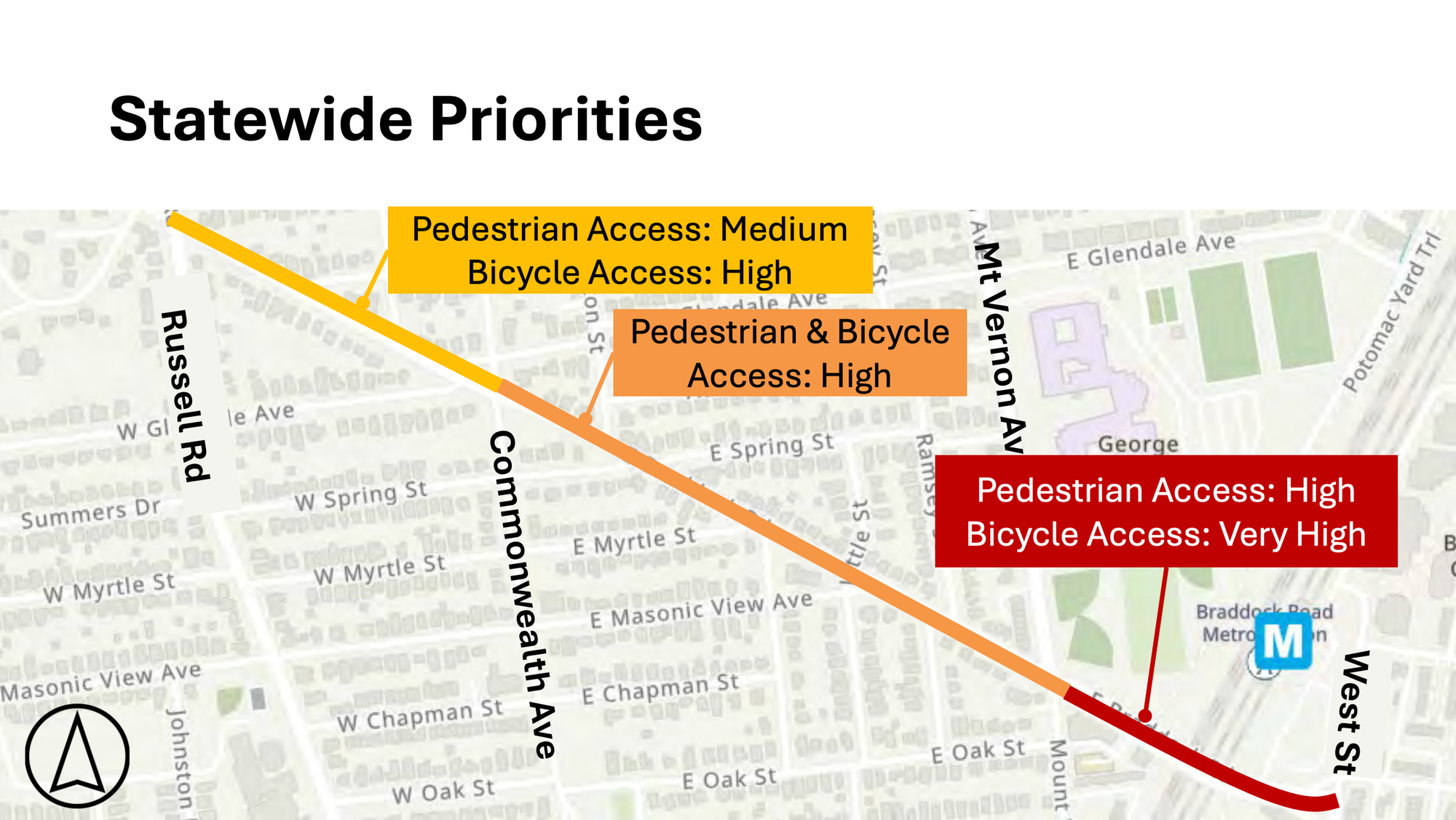
At the Feb. 24 hearing, Carroll told the board that VDOT's older priority designation focused on the Metro area but that VDOT's updated guidance "called out all three segments as a high or very high priority."
The Metro segment is the highest-priority of the three. But the entire corridor is in VDOT's priority system, and the petition's framing — that VDOT identified only the eastern segment — is contradicted by the city's slide and presentation.
Claim 3: "The redesign will prevent emergency vehicles from getting people to hospitals."
Opponents of the Braddock Road Corridor Improvements Project have raised emergency response concerns in two related but distinct framings. The Save Braddock Road petition lists, among reasons for opposing the lane reduction, that the proposal will "slow emergency vehicle response times." A stronger version, that the redesign will prevent emergency vehicles from reaching hospitals, has appeared in listserv discussion and verbal opposition framings, though it does not appear in the petition's published text.
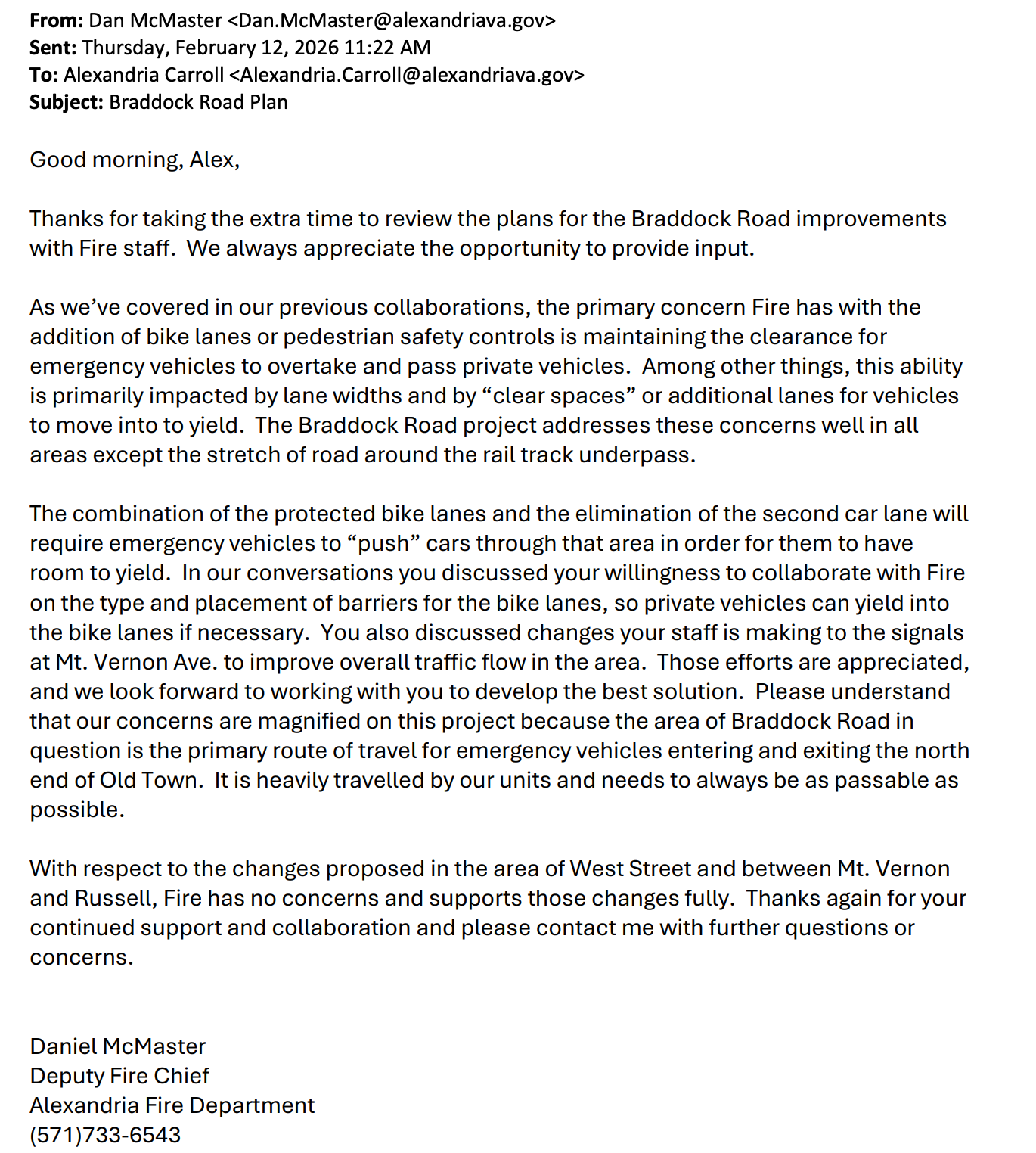
The Alexandria Fire Department's written assessment, in a Feb. 12 email from Deputy Fire Chief Daniel McMaster to Complete Streets program manager Alexandria Carroll obtained by The Alexandria Brief, addresses both versions.
McMaster wrote that "the Braddock Road project addresses these concerns well in all areas except the stretch of road around the rail track underpass" near the Metro station. He explained that the combination of protected bike lanes and the elimination of a second car lane in that stretch "will require emergency vehicles to 'push' cars through that area in order for them to have room to yield."
McMaster wrote that staff is collaborating with Fire on barrier placement that would allow private vehicles to yield into bike lanes if needed, and on signal timing changes at Mount Vernon Avenue. He called those efforts "appreciated" and said Fire looks forward to "working with you to develop the best solution."
McMaster's closing paragraph stated the position cleanly: "With respect to the changes proposed in the area of West Street and between Mt. Vernon and Russell, Fire has no concerns and supports those changes fully."
The city's recommendation includes Emergency Vehicle Pre-emption at the West Street intersection.
What McMaster's email supports: a documented engineering concern about one specific stretch of the corridor — the rail underpass area in Segment 1 — that Fire and city staff are working to resolve through barrier placement, signal timing changes, and emergency vehicle pre-emption.
What McMaster's email does not support: the broader claim that the project will slow emergency response times across the corridor, or the strongest version that has appeared in listserv discussion — that the redesign will prevent EMS vehicles from reaching hospitals. The Better Braddock website, addressing the latter framing specifically, calls that claim "fully made up" while separately acknowledging the underpass concern McMaster raised.
The Fire Department's documented position is more nuanced than either the broadest opposition framing or the pro-project framing taken alone. Fire supports two of the three segments without reservation. Fire has a real engineering concern about one specific stretch. That concern is being addressed through collaborative design changes, not abandoned.
Claim 4: "Bicycles should be registered, taxed, and licensed like cars."
This argument has appeared on neighborhood listservs from multiple residents in connection with the Braddock Road debate.
Setting aside whether it would be good policy, it is not within the city's authority to implement. Virginia state law generally preempts local bicycle registration and licensing requirements. The City of Alexandria cannot lawfully impose a registration or licensing scheme for bicycles regardless of council's preferences. Virginia's 2020 "stop as yield" law specifically allows cyclists to treat stop signs as yield signs under certain conditions — a state-level policy choice that further constrains local regulation of cyclist behavior.
The argument recurs frequently enough in the public debate that it warrants explanation. It will not be resolved by the May 16 hearing because it is not within the council's power to resolve.
Contested inferences: Where the same evidence supports different conclusions
Claim 5: "The Braddock Road Corridor Improvements Project will make the corridor safer for everyone."
This framing appears throughout the Better Braddock website, which launched in support of the project ahead of the May 16 hearing, and in supporter testimony at the Feb. 24 hearing.
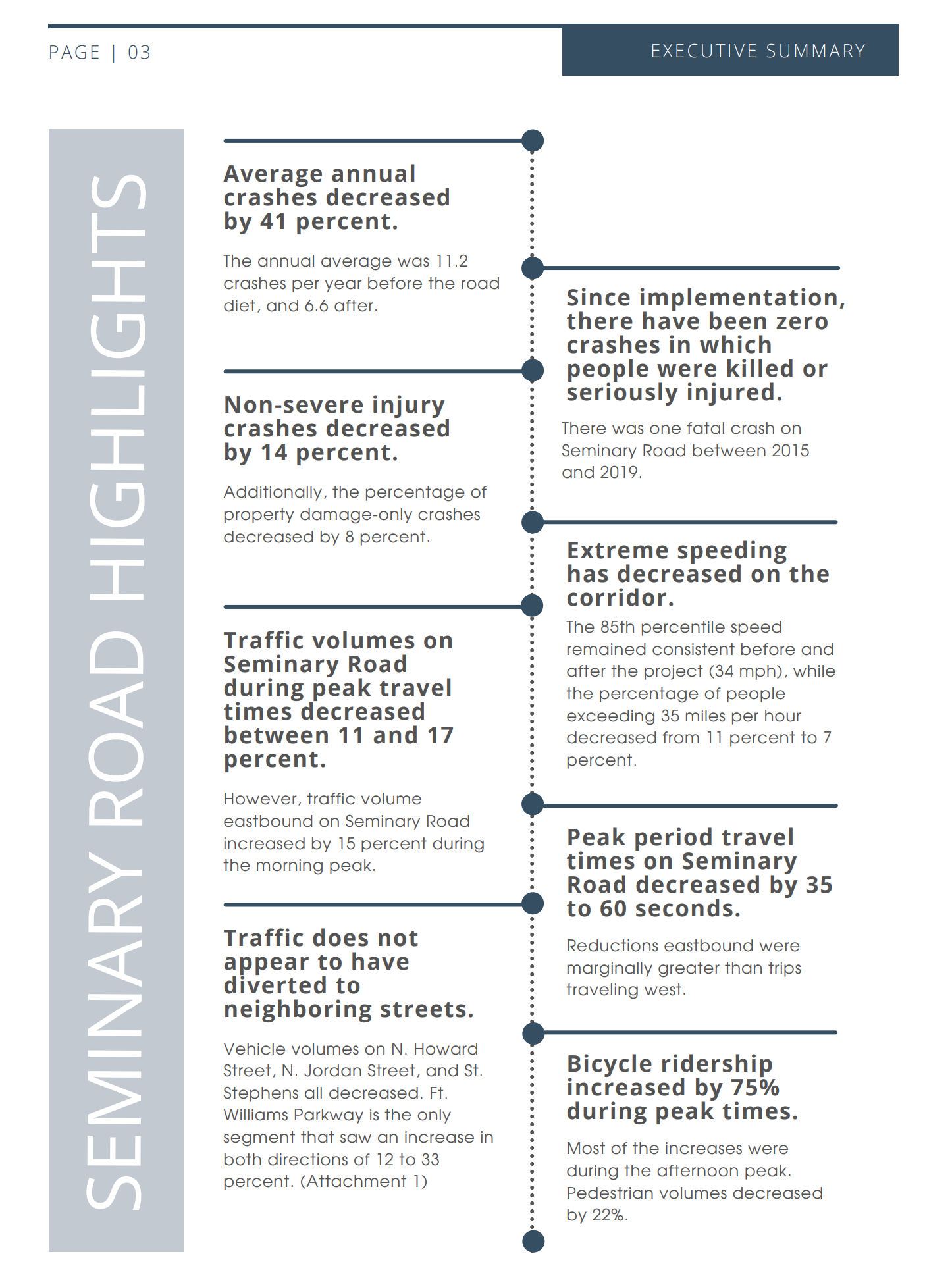
The framing is supported by evidence but is, by definition, a projection of future outcomes rather than a documented fact. The strongest empirical support comes from the city's 2022 post-implementation evaluation of the Seminary Road Complete Streets Project, completed by the Department of Transportation and Environmental Services after a similar road diet was completed in late 2019. The Seminary Road evaluation found that average annual crashes dropped 41 percent, severe-injury and fatal crashes dropped from 0.8 per year to zero, and the percentage of drivers exceeding 35 mph fell from 11 percent to 7 percent.
The project's design choices are also grounded in published safety research. The Feb. 23 staff presentation cites guidance from AASHTO, NACTO, and the Federal Highway Administration on the relative safety of protected bike lanes, shared lane markings, and road diets at various traffic volumes. AASHTO's bicycle facility selection guidance, included on the slide titled "Why not install sharrows?", indicates that at Braddock Road's traffic volumes (6,400 to 15,200 vehicles per day) and speeds (29 to 32 mph 85th-percentile), separated bike lanes or shared-use paths are the recommended treatment. Sharrows are not recommended at those speeds and volumes.
What the evidence supports: the project applies treatments that have produced measurable safety improvements in comparable Alexandria settings and that are consistent with published guidance for streets like Braddock. What the evidence cannot establish: that those improvements will replicate exactly on Braddock Road. Different corridors have different network connections, different driver behaviors, and different exposure profiles. The Better Braddock framing that the project "will make Braddock Road safer for everyone" is a reasonable inference from the evidence available. It is not, until built, a documented fact.
Claim 6: "Seminary Road proves bike lanes don't bring riders."
This argument has appeared on local listservs from multiple residents and in opposition framings of the Braddock project.
The city's 2022 Seminary Road evaluation addresses the empirical question directly. Bicycle ridership at the measured intersection of Seminary Road and Fort Williams Parkway rose 75 percent during peak periods. Total bicycle counts went from four cyclists across measured peak periods in fall 2019 to 16 cyclists in spring 2022.
That is, in absolute terms, a small base. The Seminary Road count documents ridership at one intersection during weekday peak periods. It does not address whether or how often individual residents observe cyclists on the corridor at other times — it cannot speak to whether a given person has personally seen a cyclist there. But it does contradict the broader inference that the reconfiguration produced no measurable change in ridership.
Pedestrian volumes at the same intersection decreased 22 percent over the same period — a finding the city's report did not attempt to explain.
The evidence supports a more nuanced conclusion than either the opposition framing or the supporter response. Ridership at Seminary Road did rise after the reconfiguration, contradicting the "no riders" claim. But the absolute numbers remain modest, and a single-intersection count is not a complete picture of corridor behavior. For Braddock, the more transferable findings from Seminary may be the crash reduction (41 percent) and the speed reduction in extreme speeders (11 percent to 7 percent of drivers exceeding 35 mph) rather than the bike counts.
Claim 7: "The community supports the project."
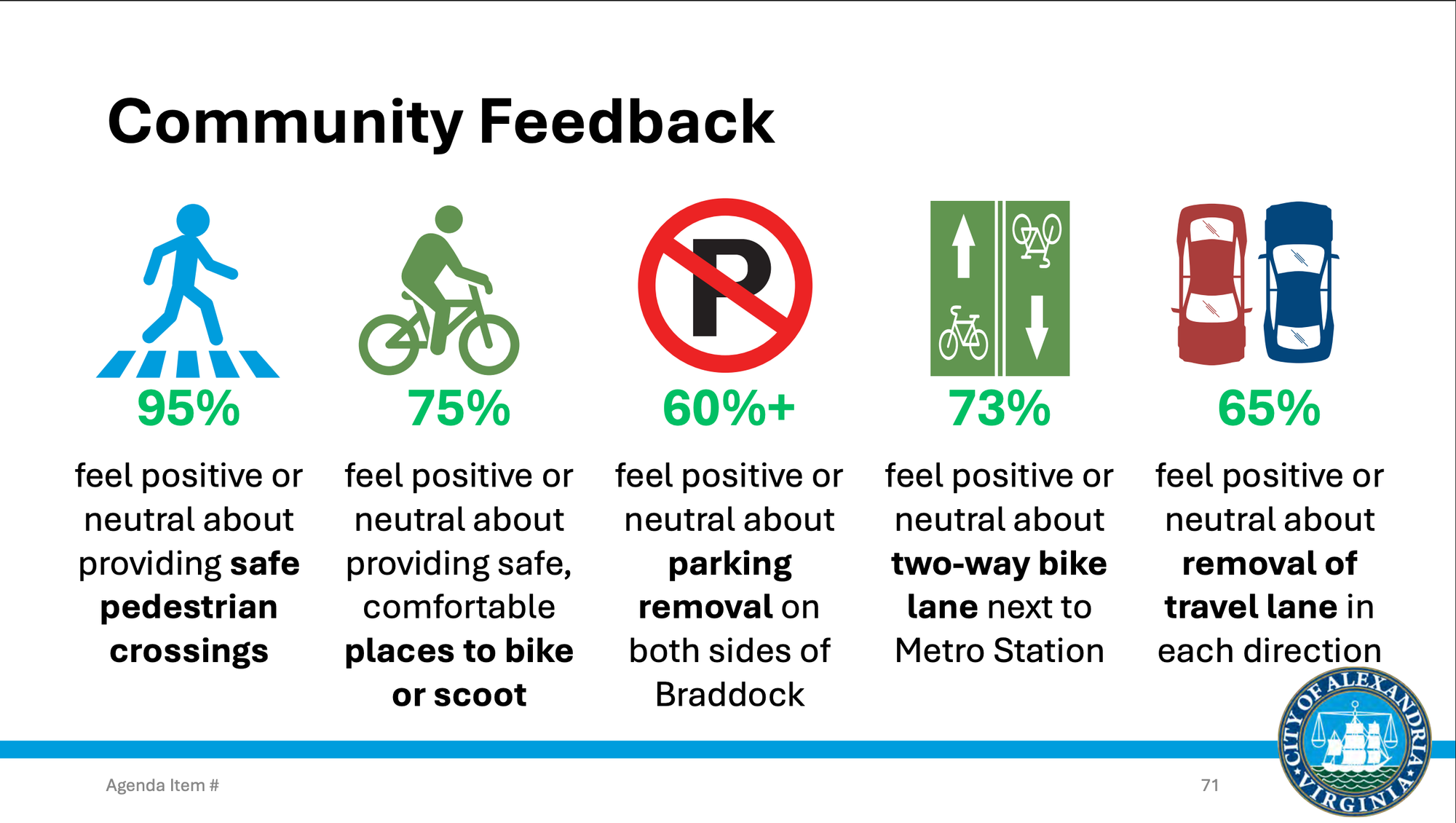
The Better Braddock website and supporter testimony at the Feb. 24 hearing have cited the city's community feedback survey, which produced the figures shown on the staff presentation's "Community Feedback" slide: 95 percent feel positive or neutral about safe pedestrian crossings; 75 percent feel positive or neutral about safe places to bike or scoot; 60 percent or more feel positive or neutral about parking removal on both sides of Braddock; 73 percent feel positive or neutral about a two-way bike lane near the Metro station; 65 percent feel positive or neutral about removal of one travel lane in each direction.
Supporters have also cited the April 21 special election, in which Marks defeated Frank Fannon — who ran explicitly against the project — by 53.52 percent to 29.22 percent. Better Braddock's website and supporter listserv posts have characterized that result as evidence of broad community support for the project.
The numbers are real. The inferences from them are more limited than the framing suggests. The community feedback survey drew 587 responses through self-selected online participation. That is not a representative sample of corridor residents, of project-area neighborhoods, or of city residents as a whole. The "60 percent or more positive or neutral" figure for parking removal — the lowest of the five — combines positive responses with neutral responses, which is a different metric than support.
The April 21 election turned on more than the Braddock Road project. The ballot did not ask voters about Braddock Road. Marks ran on a broader Democratic platform and won citywide in a special election. The election is consistent with the project having broad-based support; it is not, by itself, a referendum result.
The opposition has its own version of this claim. The Save Braddock Road petition has collected 1,563 verified signatures as of April 30, more than 60 times the 25 signatures needed to trigger an appeal. Opposition organizing has documented concerns from named residents, four churches, and the Rosemont Citizens Association. Whether 1,563 petition signers represent "the community" any more than 587 survey respondents do is the same kind of question.
What the record supports: the project has real organized support and real organized opposition. Both sides can document their support. Neither side has a representative measure of citywide opinion. The community is not unified, and the public framings of "the community supports" or "the community opposes" both overstate what the available evidence shows.
Genuine tradeoffs: Where the disagreement is about values
Claim 8: "Side streets will be overwhelmed by displaced parking."
The Save Braddock Road petition states that removing on-street parking will "overwhelm the already full side streets" and adversely affect "52 homes, 4 churches and 5 congregations."
The city's parking analysis, presented Feb. 23, documents 105 total on-street spaces on the affected segments of Braddock Road. The recommendation preserves approximately 100 feet of parking on the unit block of East Braddock Road and 60 feet on the 200 block of East Braddock Road, so the actual number of removed spaces is somewhat less than the full 105.
On utilization, the city's data shows 28 cars parked weeknights, 30 Saturday nights, and 47 Sunday mornings — the church-going peak — out of the 105 total spaces. That is roughly 27 to 45 percent occupancy. The same analysis documents 308 to 310 available spaces on side streets within walking distance at all measured times.
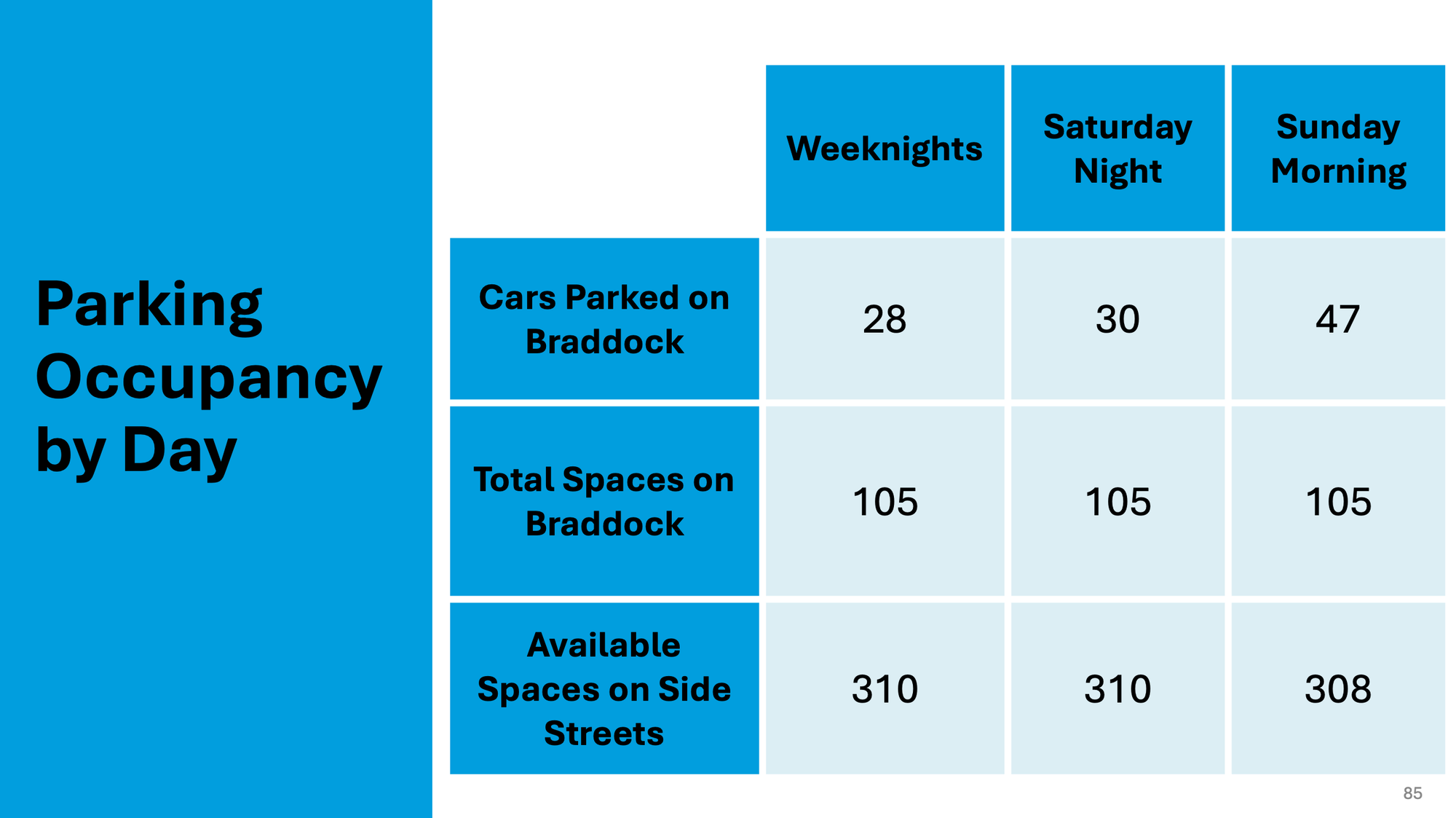
If 47 cars are displaced at the peak Sunday demand and 308 side-street spaces are available, the displaced cars represent about 15 percent of side-street capacity. Whether that is "overwhelming the side streets" or "moderate inconvenience" is a judgment call. The numerical premise — that side streets are already full — is not what the city's count shows.
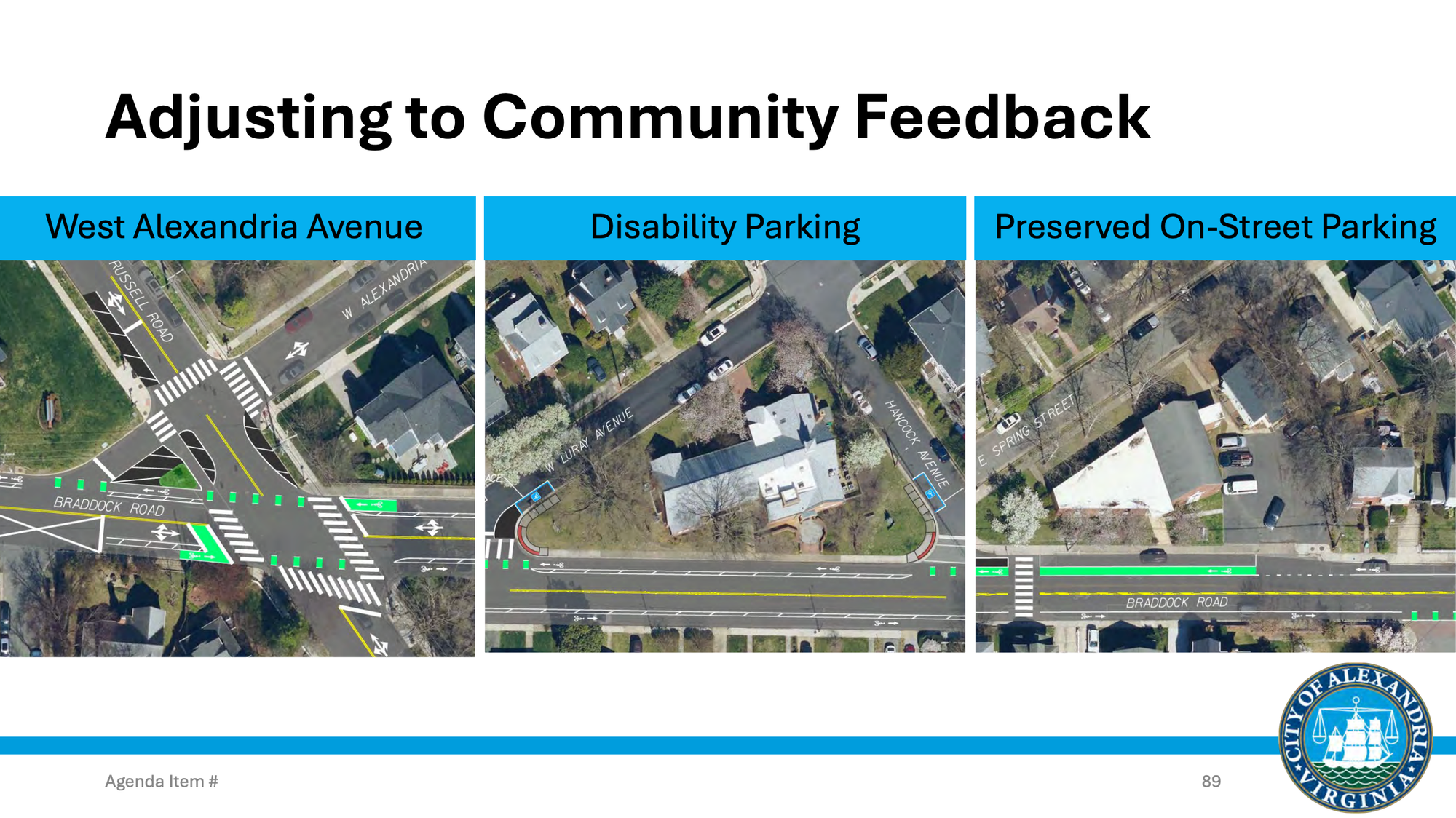
A separate and legitimate question is the impact on the small number of homes on the corridor that lack off-street parking. The Feb. 23 staff presentation notes that "nearly all homes that front Braddock Road have off-street parking" and that staff "worked directly with the one home on the corridor that lacks off-street parking to preserve their access" through the design changes shown on the "Adjusting to Community Feedback" slide. That accommodation is documented but limited. Residents who rely on the corridor for visitor or contractor parking, for guests, or for periods when their driveway is unavailable have a different concern than residents whose own daily parking is at issue, and that distinction is not always preserved in the public debate.
Claim 9: "The disability parking relocation will harm Good Shepherd Lutheran Church congregants."
This is the most legitimate concern raised in the appeal and deserves more careful treatment than either side's rhetoric has given it.
The current configuration places one accessible parking space on the unit block of West Braddock Road, approximately 25 feet from Good Shepherd Lutheran Church's accessible entrance. The church, whose official address is 100 W. Luray Avenue, is a congregation of approximately 200 members. The accessible entrance is on the Braddock Road side of the church.
The city's recommendation removes the West Braddock Road space and adds two new accessible spaces — one on Hancock Avenue at Braddock Road and one on Luray Avenue at Braddock Road. The new spaces are approximately 150 and 175 feet from the accessible entrance, respectively. The count goes from one to two; the distance roughly sextuples.
Pastor Kate Costa testified at the Feb. 24 hearing about the relocation. Pastor Costa has been quoted in opposition materials describing the new spaces as "over six times the distance away" from the accessible entrance. That math is correct.
At the Feb. 24 hearing, in response to a question from board member David Lauritzen about whether the proposed locations were final, Carroll told the board that they were not. Carroll said the city consulted both the city's Office of Human Rights and the U.S. Access Board on the relocation. According to the meeting minutes, Carroll told the board the consultation confirmed the locations met accessibility requirements. Carroll also said: "the project implementation timing has been planned in such a manner to ensure that there is never a time where there is no disability parking adjacent to the church."
When board member Ashley Mihalik asked whether the churches could be accessed from streets other than Braddock Road, Carroll said she could not speak on behalf of the churches but believed they have back entrances that are not ADA-compliant.
The church disputes the city's characterization that staff worked with Good Shepherd on the plan. Denise Gray, a Good Shepherd church member, told The Alexandria Brief by email: "At no time did any member of Good Shepherd agree with or indicate to a City Staff Member that the elimination of the Braddock Road handicapped parking space and the addition of a space on Hancock and one on Luray would be a viable solution." Gray said the church "consistently objected to these proposals and was even told in writing by a former City employee that the Braddock Road handicapped parking space would not be taken away for this project."
Amy Hadley, who chairs Good Shepherd's Community Outreach Ministry, testified at the Feb. 24 hearing that the church hosts INOVA blood drives and a monthly meal program that depend on vehicle access.
The federal accessibility framework matters here. The Americans with Disabilities Act does not require the city to provide on-street parking in any specific location. But where the city does provide on-street parking, federal accessibility standards — including the U.S. Access Board's Public Right-of-Way Accessibility Guidelines — require accessible spaces and direct that they be located to maximize access to nearby destinations. The 2010 ADA Standards' guidance on facility-provided parking establishes the principle that accessible spaces should be "located on the shortest accessible route to the accessible entrance." That principle, while not directly governing on-street parking, is the federal policy lens through which the relocation will be evaluated.
Carroll's testimony that two accessibility reviewers signed off on the relocation is significant. So is the church's account that congregants who currently rely on the 25-foot space will face a 150-to-175-foot walk to the accessible entrance — and the church's separate claim that they were previously assured in writing that the space would be preserved. Both can be true. The council on May 16 will weigh whether legal compliance, in count and approved siting, adequately serves a small congregation with elderly and disabled members for whom the existing arrangement has worked for years.
What council will weigh
The Feb. 23 staff presentation closed with three concepts: "Multiple competing demands for limited space. Guidance from adopted City plans and policies. Highest and best use of public space."
That framing is honest about what is actually before the council on May 16: not a binary safety-versus-parking choice, but a balance among competing legitimate interests. The crash data, the speed measurements, the VDOT designations, the Seminary Road precedent, the parking utilization numbers, and the Fire Department's segment-by-segment assessment all point toward a project the city's standards and its peer comparisons say should work. The disability parking relocation, the church's procedural concerns about engagement, and the residents along the corridor who lack off-street parking all describe real costs that don't disappear when the council votes. The community is not unified, and neither side has a clean claim to popular mandate.
What City Council can do May 16
City Council is hearing an appeal of a Traffic and Parking Board decision, not deciding the project from scratch. Under city code, that gives the council a defined set of options on May 16:
Uphold the board's decision. The council can affirm the Feb. 24 vote and allow the project to proceed as approved. The Traffic and Parking Board's recommendation, including the specific lane consolidations, parking removals, disability parking relocation, and bike lane configurations listed at the start of this story, would move forward toward detailed design.
Reverse the board's decision. The council can overturn the approval entirely. That would return the project to staff without an approved design and effectively end the project in its current form. Staff could begin a new process or shelve the project. A reversal is what the appellants — Save Braddock Road, Good Shepherd Lutheran Church, and Community Praise Church — have asked for.
Modify the decision. The council can uphold the board's approval with specified changes. That could include preserving particular parking spaces, retaining specific turn lanes, adjusting the disability parking relocation, requiring additional engineering review of the rail underpass area Fire Department flagged, or imposing other conditions on staff before implementation.
Remand the decision back to the Traffic and Parking Board. The council can return the project to the board for further consideration with directions on what the board should reconsider — for example, asking the board to evaluate alternatives the council believes were not adequately weighed, or to revisit specific elements such as the disability parking relocation.
Defer the decision. The council can postpone the vote, requesting additional information from staff before deciding. That delays the project's timeline but keeps all options open.
The council does not, on appeal, have authority to design a different project. It cannot, for example, vote to install sharrows instead of bike lanes — that would be a new design choice for staff and the Traffic and Parking Board to develop. The council can direct staff to consider alternatives through a remand or modification, but it cannot substitute its own design for the one before it.
Under city code, four votes of the seven-member council are required to act. A 3-3 tie, possible if one member is absent or recuses, would have the practical effect of failing to reverse and leaving the board's approval in place.
The hearing is scheduled for 9:30 a.m. Saturday, May 16, at the Del Pepper Community Resource Center, 4850 Mark Center Drive. Information about how to sign up to speak, in person or virtually, will be posted on the city website when the hearing is officially docketed.
Updates
Clarification, May 1, 8:45 a.m.: An earlier version of this story characterized the petition's framing — that VDOT identified only the Metro segment of the Braddock Road corridor as a priority — as contradicted by the city's Feb. 23 staff presentation. The city's own published project FAQ identifies only "the segment between Mount Vernon Avenue and West Street" — the Metro segment — as a VDOT-designated statewide priority area, and states that "the City evaluated the entire corridor based on safety, connectivity, and planning goals." The petition's reading is consistent with the city's published FAQ. The staff slide and Carroll's testimony at the Feb. 24 hearing presented a broader characterization of VDOT's designations across all three segments. The Brief has asked the city's transportation department for the underlying VDOT documentation supporting the broader characterization. Story has been updated to reflect this.
Correction, May 1 at 5:55 a.m.: An earlier version of this story incorrectly stated that the percentage of drivers exceeding 35 mph on Seminary Road fell from 28 percent to 7 percent following the 2019 reconfiguration. The 28 percent figure was the pre-2016 baseline; the post-project comparison from the city's 2022 evaluation is 11 percent to 7 percent. The story has been corrected.
The Alexandria Brief
Alexandria, Va., news and information you won't find anywhere else.
The Alexandria Brief has no ads, no paywall, and no corporate owner. It's just me - Ryan Belmore, a journalist and Alexandria resident — covering the city I live in, funded entirely by neighbors like you. Support this work with a monthly, annual, or one-time contribution.
Send feedback, story ideas, news, and tips to ryan@alexandriabrief.com.
Subscribe | Support | About | Contact | Submit News | Standards & Policies