Table of Contents
ALEXANDRIA, Va. — A mother told the Alexandria City School Board on Thursday that her 6-year-old son has not been to school since classes began, because the bus that used to pick him up no longer comes and she cannot walk him there.
She was one of five people, out of 10 who addressed the board, who came to talk about the same thing: the walk zones Alexandria City Public Schools redrew this summer to match new attendance boundaries, and the bus service that ended for some students when they took effect on the first day of school.
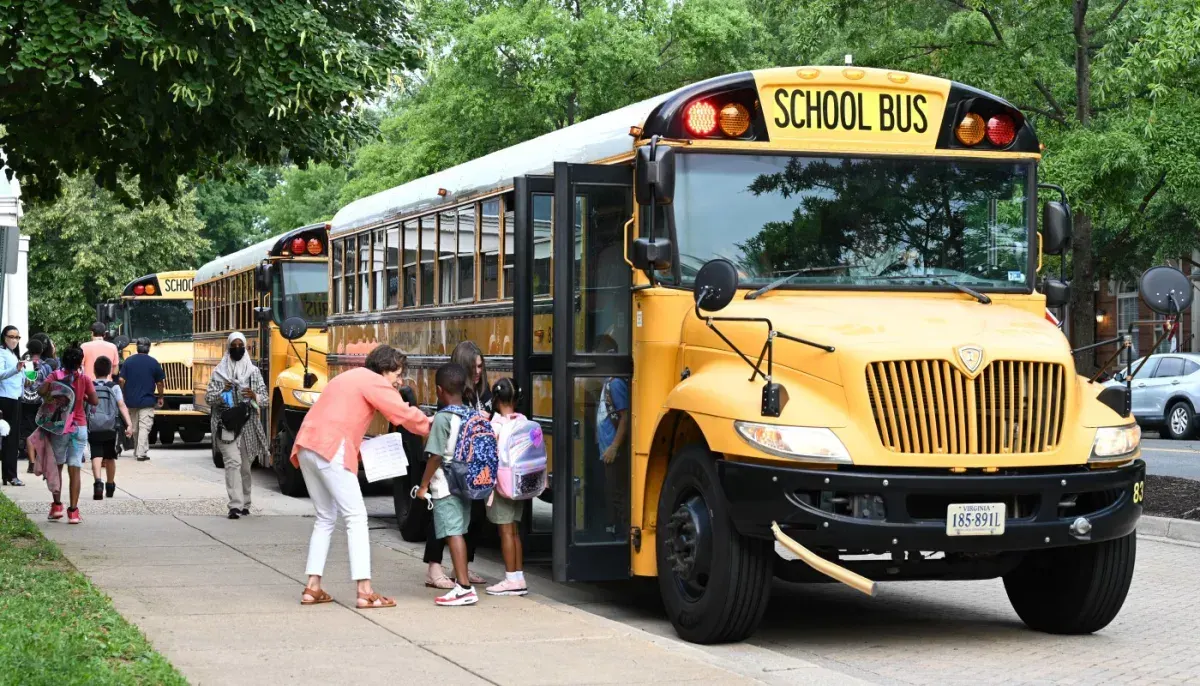
That is the second transportation problem of the young school year, and the one the division has said least about. ACPS has acknowledged a first: buses running late and stops being missed across the division during the opening week.
Marisela Serrano, who lives on Executive Avenue, spoke in Spanish through an interpreter. Three of her children leave the house for school each morning, she said. Her youngest is the one who cannot go.
"From my home, three of my children leave to go to school, but the one that's most impacted is my 6-year-old son because he is unable to walk by himself and I cannot go to school and walk him," she said through the interpreter. She said a health condition limits her ability to walk, that her son has missed school all week since transportation was removed, and that she is worried about his education because he has an Individualized Education Program.
The division does not discuss individual students' records publicly.
Board members did not respond to any of the speakers. Opening the comment period, Chair Christopher Harris said the board welcomes disagreement but that "our role during public comments is to listen, not debate," and that follow-up would be directed appropriately.
The buses that came late
In a statement provided to The Alexandria Brief Thursday evening before the meeting, Chief Operating Officer Dr. Anthony Peña said the division understands the frustration families have experienced during the first week of school, including late buses, missed stops and concerns about student assignments.
"The beginning of every school year includes a period of adjustment as routes stabilize, students become accustomed to new stops and schedules, drivers become familiar with their routes and traffic patterns settle," Peña said.
He said this year that process also involves new boundaries and routes from redistricting, walk zone adjustments, a new transportation routing system, and new traffic and lane configurations in parts of the city affecting travel and arrival times. The division has not specified which street changes it means.
Peña said staff from multiple departments are supporting the transportation team in reviewing concerns, verifying eligibility, correcting assignments and routes and responding to families, with concerns prioritized by urgency so that students who are eligible but not yet properly assigned or routed are handled first.
Acting Superintendent Grace Taylor drew the same distinction from the dais. Previewing her report to the board, she said she would address "school transportation issues and delays, some of which are experienced at the start of the new school year and others related to the adjustment of redistricted school attendance areas and walk zones."
Reliability is a standing problem rather than a new one. The division's transportation office lists improving on-time performance and continuing driver hiring among its strategic goals. A 2025 study of the ACPS system by the TransPar Group identified school bus driver shortages and found the fleet operating at less than 60% of capacity.
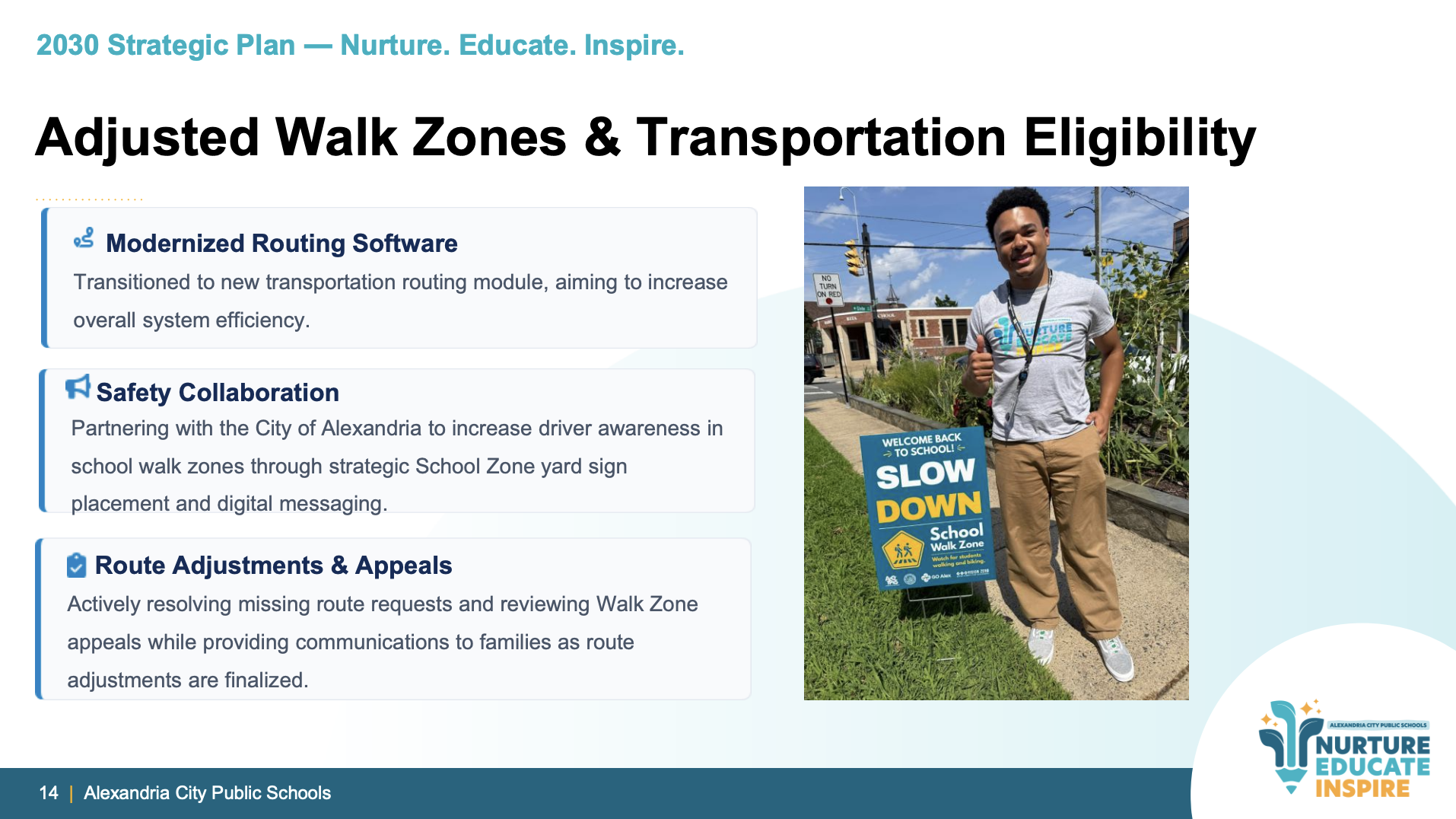
The written Opening of Schools Report that ACPS posted with Thursday's agenda gives transportation one slide, titled "Adjusted Walk Zones & Transportation Eligibility." It says the division transitioned to a new routing module "aiming to increase overall system efficiency," is partnering with the city on school zone yard signs and driver awareness, and is "actively resolving missing route requests and reviewing Walk Zone appeals while providing communications to families as route adjustments are finalized."
The slide does not mention late buses, missed stops, or students who lost bus eligibility.
What changed
The division's transportation policy did not change. Under School Board Policy EEA and its regulations, students in kindergarten through eighth grade who live within one mile of their assigned school are designated walkers, as are high school students within 1.5 miles, unless an unusual walking hazard is identified or an exception is granted.
What changed is where the lines fall. After the board approved new attendance boundaries in June 2025, ACPS redrew its walk zone maps to match them. The division has said one guiding principle of redistricting was to create neighborhood schools where more students could walk instead of relying on buses, and that applying the existing policy uniformly across the new boundaries means some students who previously rode the bus are now walkers.
ACPS worked with the city's Department of Transportation and Environmental Services over seven months to evaluate walking routes, reviewing sidewalks, crosswalks, traffic patterns, crash data and locations with a history of pedestrian concerns. Where the review identified unusual walking hazards, the division has said, walk zones were adjusted. The maps also incorporate traffic and safety infrastructure the city has built since 2018. Distances were calculated by the city using GIS analysis of its sidewalk network, which ACPS has noted can differ from consumer mapping apps.
The maps were last updated July 20. The eligibility changes took effect Aug. 24, the first day of school. ACPS said transportation information letters went out through ParentSquare on Aug. 19 for students fully registered by Aug. 10.
ParentSquare messages go only to enrolled families, and The Alexandria Brief cannot independently review what was sent or when.
The division frames bus service as conditional. Students in grades K-12, its transportation page says, "are afforded the privilege of riding a school bus" when their address falls within the eligible area. Exceptions granted to neighborhoods for specific safety issues along a walk path make those addresses "temporarily eligible" for service, subject to later review — which is why prior exceptions did not carry into this year.
The changes land on top of a boundary shift the board approved in June 2025 affecting roughly 1,400 enrolled students, about 860 of whom were set to change schools this year.
The division has said it notified affected families directly through ParentSquare and the mail, shared general information at the end of last school year and over the summer, and added a feature to its online attendance zone locator letting families enter an address to check whether a student qualifies for a bus. Students zoned to George Mason Elementary School, which is under renovation, continue to receive transportation to the temporary swing space on North Beauregard Street.
ACPS has not said how many students lost transportation eligibility under the revised maps. Without that figure, the scale of the change is not established.
One question, and a $15 FOIA
Jeremy Miller, the parent of a fifth grader at Douglas MacArthur Elementary School, told the board he spent the summer trying to get an answer to a single question.
Miller said that when ACPS advised families on June 30 to check their transportation eligibility, he was shocked to learn the children in his neighborhood would no longer qualify. By his own measurement, the least dangerous route from his house to the school runs about 1.2 miles and requires crossing four-lane Quaker Lane without a crossing guard.
"I emailed ACPS looking for the answer to one simple question: what is the route that exists between my house and the school that is less than one mile and free from unusual hazards?" he said. "Because I honestly have no idea what that route is."
He said the division took several weeks to respond and then sent a generic answer that, among other things, said Google Maps was not accurate. To learn how the distances were calculated, he said, he was told to file a Freedom of Information Act request with the city. He did. After delays, he said, "the city charged me $15 just to send me PDFs of the walk sheds that are already posted on the ACPS website."
The substantive answer, he said, came in the city's staff response, which he read to the board: the city did not conduct a door-to-door route analysis for each student or family, and given the number of students involved across the system, the walk zone analysis was conducted at the school and geographic-area level using GIS.
That distinction is the heart of his complaint. ACPS policy turns on whether a specific address has a walkable route free of unusual hazards.
"ACPS has a very precise policy about who is eligible, but it is relying on imprecise data to make eligibility determinations," Miller said. He told the board the burden should run the other way: if the division cannot show a safe route exists for a given address, that address should be eligible for transportation and the walk shed should be corrected.
The Alexandria Brief has not independently reviewed the city's response.
Tim Mullins, who said his family has been at MacArthur about eight years and now has a fourth grader and a seventh grader, described the same sequence. The family received an email on June 20 saying their daughter would be a walker, he said, and assumed it was an error. It was not.
He said ACPS told him the walk zones were based on a new analysis using GIS and city sidewalk data but would not provide it, directing him to the city instead. "If you have the analysis, just make it public," he said. "I work in government too. It's what you do if you have a good analysis." What the city sent back, he said, contradicted what the division had told him.
Mullins also described a problem with the remedy. Families who believe a route is unsafe may submit a Walk Zone Bus Service Request. But he said the form requires acknowledging that the student is not eligible for transportation — the exact point in dispute — and that he has not filed one for that reason.
The corridor
Victoria Chang, a parent at Mount Vernon Community School, told the board that families in the North Mount Vernon corridor lost bus service this year despite conditions the city has repeatedly documented as dangerous. She noted she is the school's PTA president but said she was speaking in her individual capacity.
"This isn't just about a one-mile walk," she said. "It is about real hazards." She described children navigating stretches of Mount Vernon Avenue with no sidewalks because of construction, cars pulling out of commercial driveways, and crossings at West Glebe Road, which she called a known high-crash intersection.
Chang cited pedestrian fatalities at the intersection in 2016 and 2021 and a Mount Vernon student struck in a crosswalk last spring. She said the city's own planning work identified intersections along the corridor as high-risk, and that while the Traffic and Parking Board approved safety design changes in April 2024, those improvements do not exist on the ground today. The Alexandria Brief has not independently verified the crash history or the status of the approved improvements.
She said about 40 families in the corridor have submitted review requests to the division, that many parents do not own cars or hold driver's licenses, that working parents cannot walk their children to school and still catch their own buses, and that aftercare programs with transportation are full and financially out of reach. She also said recent federal law enforcement activity in the neighborhood has left families uneasy walking.
"Removing this bus disproportionately burdens our Latino families," Chang said. She asked the board to restore service "until streets are truly safe for our kids to walk, as it is outlined in the school board's transportation policy."
Martha Lagos, who told the board she has lived in Chirilagua for 15 years and whose older children attended Mount Vernon Community School, said through an interpreter that she had never seen an impact of this magnitude. To keep working, she said, she now relies on her 17-year-old son to walk his younger sister to school, which makes him miss his own bus.
What the division says about the walk zones
Taylor addressed the walk zone changes directly later in the same report. She said the division had worked through the summer to help families prepare, mailing information directly to affected families and providing the online locator.
"We recognize that implementing these changes has not been without challenges," Taylor said. "In some cases, families identified issues with walk zone information that required additional review and correction, including updates to maps in the attendance zone locator."
That is the only acknowledgment from the division that the maps themselves contained errors. It does not appear in the written report or in Peña's statement.
Taylor said ACPS has asked the Alexandria Police Department to help at intersections flagged for a second look and that the department has been engaged. "We know families want these issues resolved quickly, and so do we," she said. "We know we have more work to do, and we're committed to getting it right."
Much of what Taylor said aloud matched the statement Peña sent The Alexandria Brief about an hour earlier, at points word for word — including the description of an all-hands-on-deck response, the triage of concerns by urgency, and the line that the division knows families want the issues resolved quickly. The two accounts are the division's single prepared position, delivered to the board and to a reporter the same evening.
Board member Ashley Simpson Baird thanked Taylor for the fuller report and asked that the division keep providing transportation updates publicly rather than only by email to board members.
The division's public newsletter, published Friday, did not contain one. The ACPS Express summary of Thursday's meeting lists six items — the Opening of Schools Report, a community donation, the VSBA Media Honor Roll nomination, advisory committee applications, personnel actions and School Board member assignments — and directs readers to BoardDocs for the agenda and documents. It does not mention transportation, the walk zone changes, the public comment period or the budget vote. The same newsletter carried a first-day-of-school recap and an item on the division's gains on state Standards of Learning tests.
What families can do now
Families who believe a walking route is unsafe may submit a Walk Zone Bus Service Request. Prior transportation exceptions do not carry over to this year and must be resubmitted.
ACPS has said final decisions on those requests will be communicated on or before Sept. 30 — more than five weeks into the school year. The division has also said that once transportation-eligible students are placed, it will verify remaining seat availability on each bus to determine whether any exceptions can be accommodated, and that eligibility for exceptions is determined by policy requirements and operational capacity. Under state law, standees are permitted for the first 30 days of the year while the division balances passengers across routes.
Two provisions may matter to families in the meantime. ACPS says it provides transportation for students whose Individualized Education Program or 504 Plan calls for it, including curb-to-curb service where the plan requires an alternative to a neighborhood stop — a route to eligibility that does not depend on walk zone lines. And while a route adjustment is being finalized, a school may issue a temporary bus pass allowing a student to use an existing stop. Bus assignments and stops are updated on Thursdays.
Questions about a specific student's eligibility or bus assignment go to the ACPS Office of Transportation at 703-461-4169 or ask@acps.k12.va.us. Questions about specialized transportation go to spedtransportation@acps.k12.va.us.
Editor's note: The author of this story, Ryan Belmore, does not have children enrolled in ACPS and does not receive the division's ParentSquare messages to families. Accounts of what ACPS communicated to affected families come from the division's public statements and from parents. If your family received a notice about transportation eligibility this summer, he would like to see it: ryan@alexandriabrief.com.
Ryan Belmore is an Alexandria resident and the founder and publisher of The Alexandria Brief. Send tips, feedback, and story ideas to ryan@alexandriabrief.com.