Table of Contents
ALEXANDRIA, Va. — The neighbors fighting a 48-unit residential building at 301 North Fairfax Street have taken their case to the Supreme Court of Virginia, according to a docket released for the court's September writ panel.
The case, listed as Scott Corzine, et al. v. Alexandria City Council, et al., is one of 69 in which the panel will consider petitions for appeal. Monica T. Monday and Michael J. Finney of Gentry Locke, the appellate attorneys who took the case over after it left Alexandria Circuit Court, are listed as counsel.
 Ryan Belmore
Court records show the petition was filed March 26 and the record arrived from the Court of Appeals four days later. Both sets of appellees filed briefs in opposition on April 23. No disposition has been entered.
Seven property owners are appellants: Corzine, Anne Bergman, Chris Brown, Mimi Conger, Neil Hammerstrom, Brian Morris and Joyce Robinson. The appellees are the City Council, the city and the two development entities. Nicholas T. Peal has joined Matthew A. Westover as counsel for the developers.
A writ panel does not decide who wins. It decides whether the court will hear the appeal at all. The court cautions that cases can be removed from the docket at any time up to and including the day of the hearing, and that not every case is scheduled for oral argument.
The filing answers a question left open in February, when the Court of Appeals of Virginia ruled against Corzine and it was not immediately clear whether he and the other property owners would seek further review.
What the February ruling decided
The Court of Appeals held that Alexandria's City Council acted within its authority in approving a special use permit allowing the building a floor area ratio of 2.5 — double the baseline for single-use developments. Judge Vernida R. Chaney wrote the opinion, joined by Chief Judge Marla Graff Decker and Judge Daniel Ortiz. The case was argued at Fairfax.
The court designated the opinion published, giving it precedential value in future cases interpreting similar provisions across Virginia, and described the question as one of first impression.
Everything turned on Section 5-305 of Alexandria's zoning ordinance, which sets floor area ratios in the Commercial Residential Mixed Use High zone. Subsection (A) caps single-use development at 1.25. Subsection (C) allows up to 2.5 with a special use permit, for projects where at least half the floor space is residential and commercial use does not exceed a ratio of 1.25.
The owners argued the project is only residential, so subsection (A) governs. They also argued subsection (C)'s reference to "the commercial use" — the definite article, rather than "a" or "any" — presumes commercial space exists, and so excludes wholly residential buildings.
The court disagreed on both points. It read the section's opening sentence, which ties the permitted ratio to the type of use and whether a permit is sought, as a roadmap: subsection (A) covers single-use projects that seek no permit, and subsection (C) takes over once one is sought. On the definite article, the court held the clause functions as a ceiling rather than a requirement — it caps commercial density where commercial use exists but does not mandate any. A commercial ratio of zero does not exceed 1.25, the court wrote, so the criterion was met.
The court also noted the owners' position was internally inconsistent: they asked the court to disregard the italicized phrase introducing subsection (C), "Mixed use or residential/SUP," while relying on the parallel italicized phrase in subsection (D) to establish that it applies to continuum of care facilities.
A third argument, that a separate provision requiring compliance with the most restrictive requirement in cases of conflict should cap the ratio at 1.25, failed because the court found no conflict — the subsections govern different situations.
The ruling affirmed Alexandria Circuit Court Judge Lisa B. Kemler, who sustained the defendants' demurrers and dismissed the complaint with prejudice in a May 10, 2024, letter opinion. The full opinion, Record No. 1015-24-4, is posted at vacourts.gov.
The project
The property sits at the corner of Queen Street in the Old and Historic District and holds a three-story office building put up in 1977. William Thomas Gordon III and his son, William Thomas Gordon IV, bought it for $4.6 million in 2014. The developers, 301 N. Fairfax LLC and 301 N Project Owner LLC, propose demolishing it for a four-story building with 48 units, 67 below-grade parking spaces and a rooftop terrace. It contains no commercial space.
City Council voted 6-1 on Jan. 20, 2024, to approve the permit and rezone the property from Commercial Downtown to CRMU-H. Councilor John Chapman dissented. The council had deferred an initial vote from December 2023 after opposition triggered a protest petition requiring a supermajority.
The owners sued Feb. 16, 2024, asking the circuit court to declare the permit void from the outset and to bar the city from issuing permits for the project. Both sets of defendants demurred the following month.
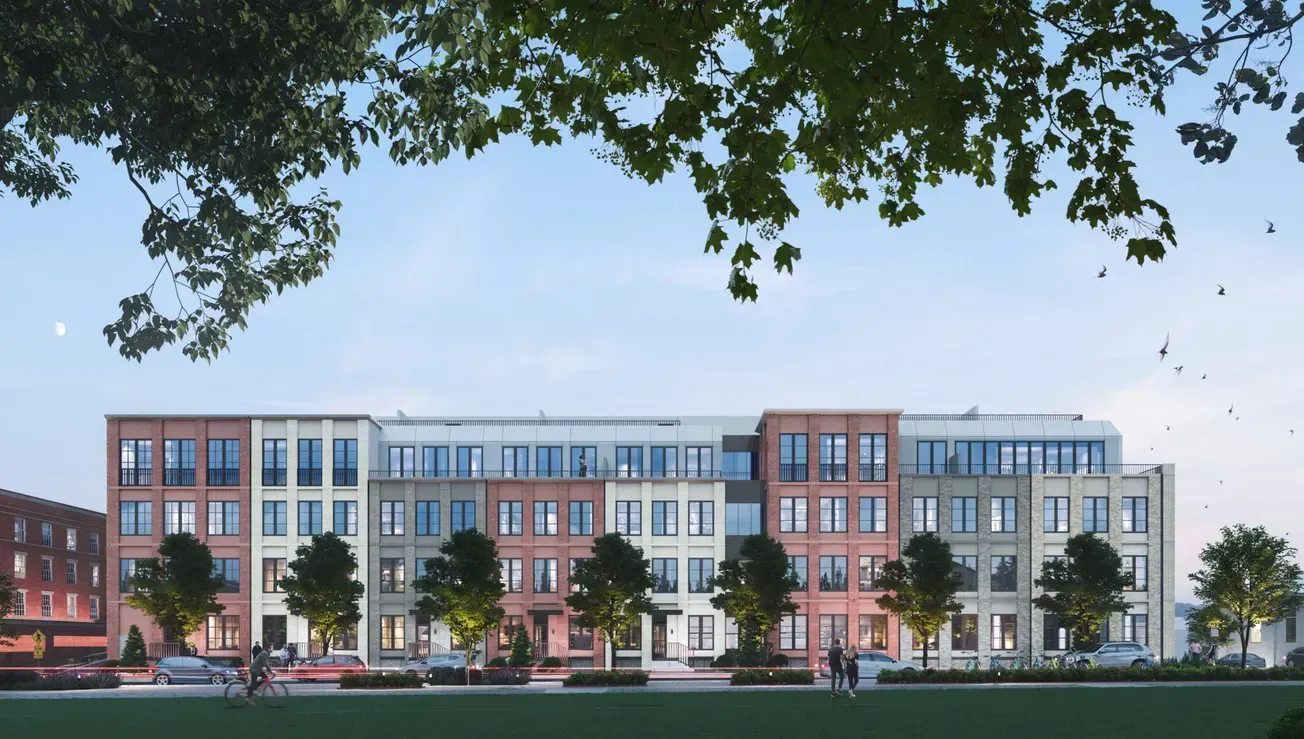
More than two and a half years after the approval, the project's architect still lists it as proposed. Winstanley Architects & Planners describes a four-story building of one- to three-bedroom homes with a rooftop terrace, designed in two expressions: a palazzo-inspired facade on Queen Street with a defined base, middle and cornice, and a lower-scaled treatment on North Fairfax Street broken into townhouse-like segments with individual stoops for the ground-floor units. The firm cites brickwork, cast stone accents and traditional window patterns meant to sit with the surrounding 18th- and 19th-century buildings, and a Green Globes 2 rating, which it equates to LEED Silver. The Board of Architectural Review approved the design.
The architect lists the client as Hoffman & Associates. The court identified the developers as 301 N. Fairfax LLC and 301 N Project Owner LLC, and the property owners as the Gordons.
Senior Assistant City Attorney Travis S. MacRae represented the city and council before the Court of Appeals. Matthew A. Westover and Brooke N. West of Walsh, Colucci, Lubeley & Walsh represented the developers.
A separate case
The appeal is distinct from Burks v. City of Alexandria, the challenge to the Zoning for Housing initiative that eliminated single-family-only zoning. Judge H. Thomas Padrick Jr. granted the city summary judgment in that case in November, and the plaintiffs filed a notice of appeal in December. The Coalition for a Livable Alexandria, which organized the opposition, raised $28,000 in February to fund it.
Both are residents challenging city land-use decisions, but they involve different ordinances, different plaintiffs and different courts.