ALEXANDRIA, Va. — A regional planning board votes Wednesday on minimum service standards for bus systems across metropolitan Washington, including hours and frequency targets that local agencies such as DASH would then be asked to adopt.
The National Capital Region Transportation Planning Board, the federally designated planning organization for the region, meets virtually from noon to 2 p.m. Councilman Canek Aguirre serves as its second vice chair.
The guidelines come out of DMVMoves, the regional transit plan the board accepted in January. They sort routes into three tiers by the density of the areas they serve, measured as residents plus jobs per acre, and set minimums for each.
For core routes, the standard is 16 hours of service a day and a bus every 15 minutes in the densest tier, 14 hours and every 20 minutes in the middle tier, and 12 hours and every 30 minutes in the least dense. Coverage routes, which connect lower-density neighborhoods to hubs, range from 14 hours and every 30 minutes down to 10 hours and hourly. Peak routes get four hours a weekday at frequencies set as needed.
One change would apply across the board: a single frequency standard all day, eliminating separate rush-hour and off-peak targets.
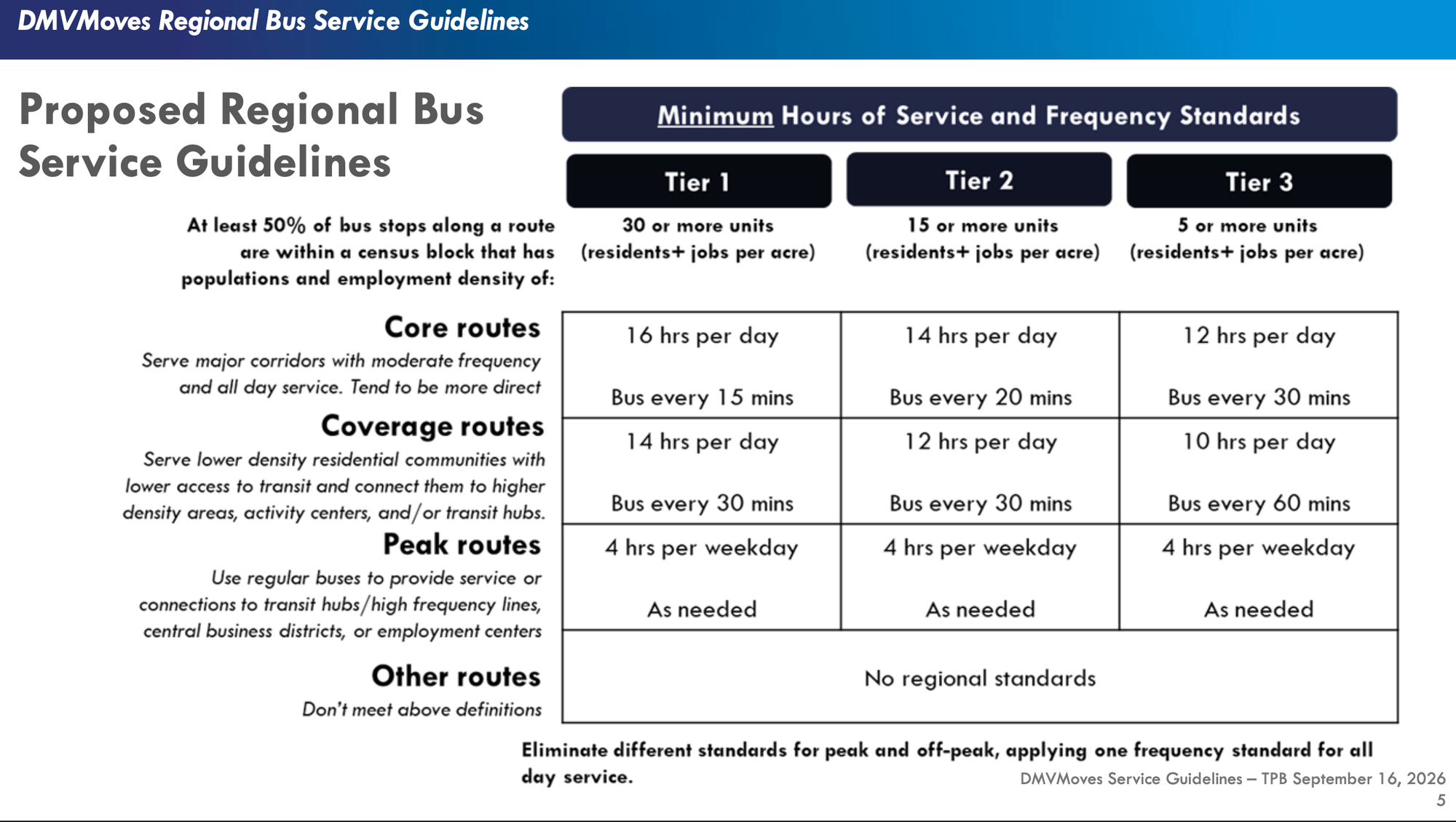
The guidelines are not binding. Board materials note that agencies may have to trade off frequency on individual routes against keeping service within walking distance of most of their service area, and that some routes may not meet the standards while still meeting other goals or legal requirements.
If the board adopts the resolution, local transit agencies will be asked to adopt the guidelines themselves, through formal adoption, a transit strategic plan update or internal guidance.
The board will also be briefed on a regional analysis of how temperatures at or above 95 degrees affect transit, and on proposed targets for travel time reliability.
Meeting materials are at mwcog.org.
Ryan Belmore is an Alexandria resident and the founder and publisher of The Alexandria Brief. Send tips, feedback, and story ideas to ryan@alexandriabrief.com.
© 2026 Alexandria News, LLC. All rights reserved. This material may not be published, broadcast, rewritten or redistributed without permission.