Table of Contents
ALEXANDRIA, Va. — Alexandria City Public Schools students improved on every Standards of Learning subject test last school year, and in history and social sciences the division now passes at a higher rate than Virginia as a whole, according to results the Virginia Department of Education released Tuesday.
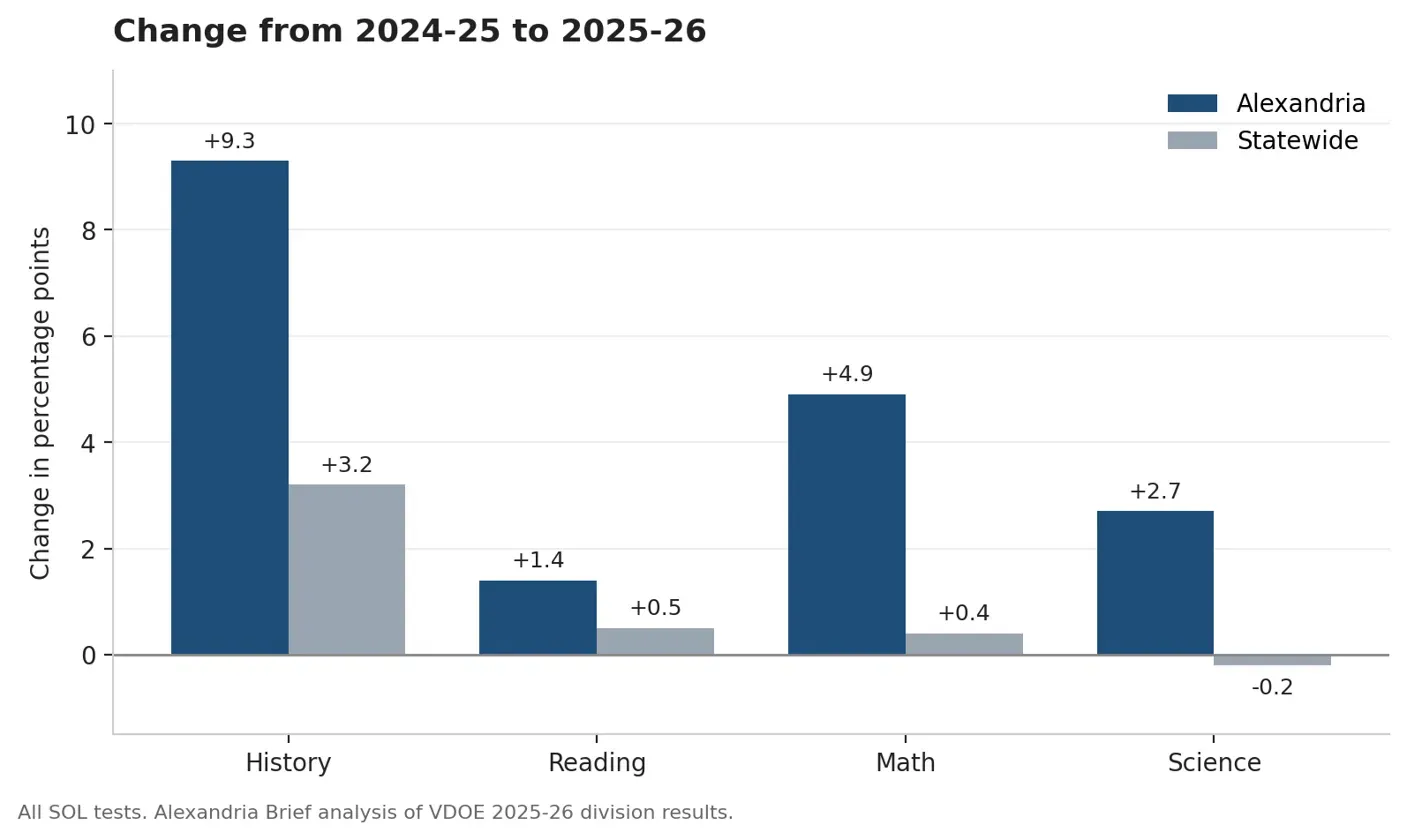
Alexandria's history pass rate rose from 61.9% to 71.2% — a 9.3-point gain, nearly three times the statewide improvement of 3.2 points in that subject. It is the only subject in which the division outperforms the state, and the shift is recent: Alexandria trailed Virginia in history in each of the two prior years.
History SOLs are given in fewer grades than reading or math. Alexandria students took about 2,200 history tests last year, against roughly 8,000 each in reading and math.
Math rose from 54.6% to 59.4%, a gain of nearly 5 percentage points at a time when the statewide rate moved four-tenths of a point. VDOE named Alexandria to a list of 10 divisions that posted 5-point math gains. Reading rose 1.4 points, from 61.6% to 63%. Science rose 2.7 points, from 53.5% to 56.1%, while the statewide science rate slipped two-tenths of a point.
The results cover the 2025-26 school year, the final full year under former Superintendent Melanie Kay-Wyatt, who resigned in March and left the division Aug. 12. Acting Superintendent Grace Taylor has led ACPS since that evening.
Taylor called the results a major accomplishment for the division and credited students, educators, school leaders and families. In a media advisory issued Tuesday, she said improving pass rates in every content area shows the focused work in ACPS schools is making a difference, and that the division will keep building on the progress while intensifying efforts to close achievement gaps.
School Board Chair Christopher Harris said the results reflect what is possible when staff and families stay focused on academic excellence, and that gains in every content area show the division's strategies are working. He said there is more work ahead.
The division still trails the state
Alexandria's pass rates remain well below Virginia's in three of four subjects. An Alexandria Brief analysis of VDOE's division-level files, comparing all SOL tests taken last year, puts the division 11 to 15 points behind statewide rates in reading, math and science — and slightly ahead in history.
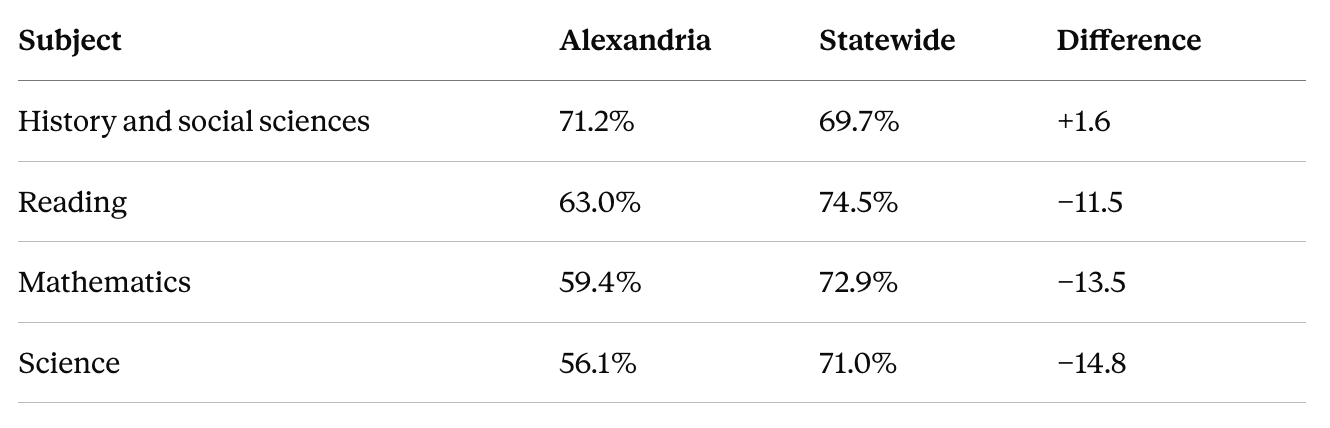
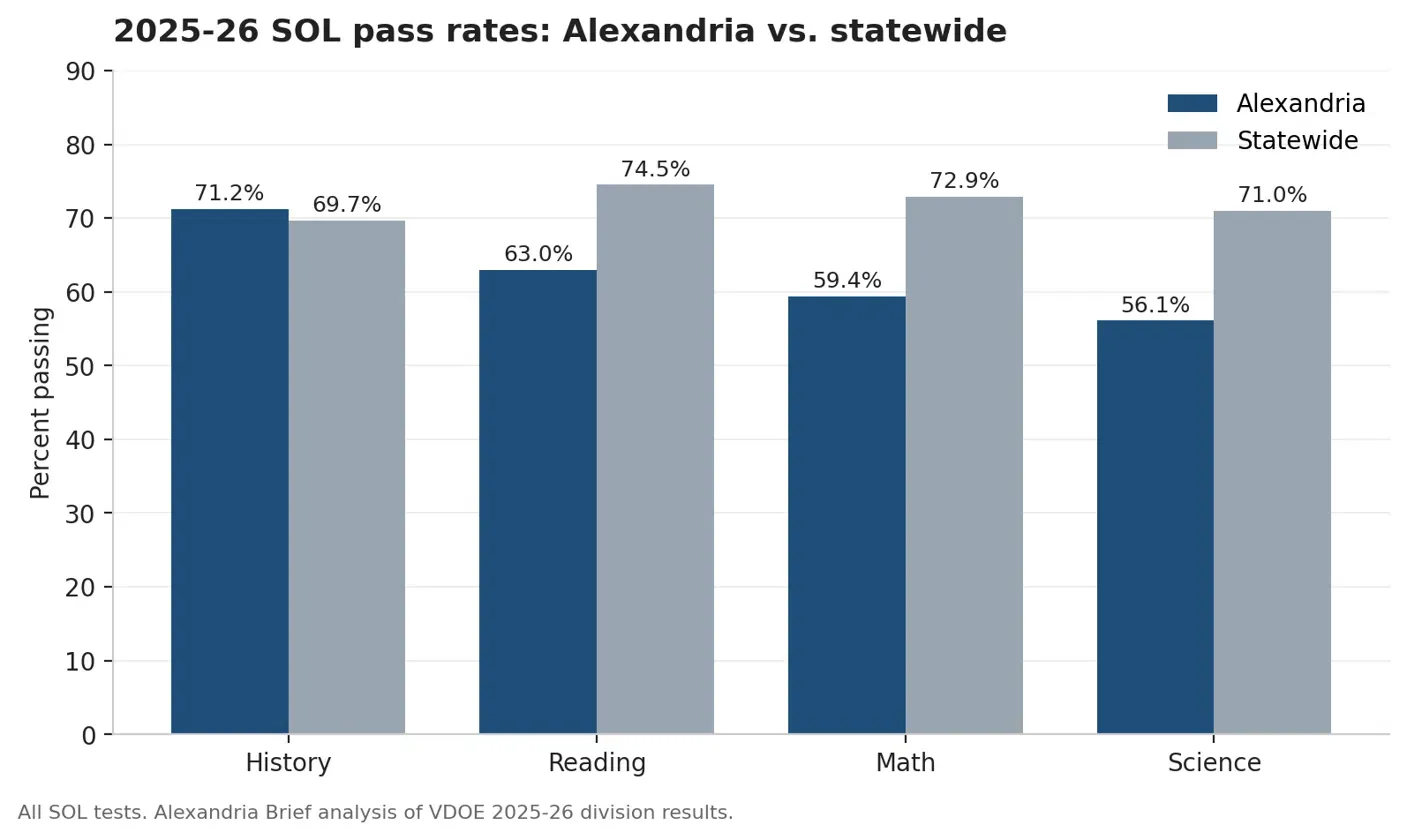
The history result is a reversal. Alexandria passed at 63.9% in history in 2023-24 against a statewide 65.2%, and at 61.9% in 2024-25 against 66.5%. Last year the division moved ahead.
Among students in grades three through eight, 61.2% of Alexandria students passed reading and 55.3% passed math last year. Statewide, the figures were 72% and 69%. ACPS confirmed those calculations.
The division said the gap narrowed last year. ACPS gained 3.1 percentage points in math and 1.5 in reading among grades 3-8, against statewide gains the division put at 0.3 and 0.5 — narrowing the math gap by 2.8 points and the reading gap by 1. In response to questions from The Alexandria Brief, Daryl Johnson, executive director of communications for ACPS, said that while work remains, outpacing statewide improvement is what is required to close the historical gap.
Some of the one-year improvement also follows a down year. Alexandria's math pass rate fell slightly in 2024-25, and its history rate fell about 2 points. Measured against 2023-24, math is up 4.6 points over two years and history 7.3.
What drove the numbers
The history gain traces to two tests taken by nearly all students at their grade level. Virginia Studies rose 12.2 points, to 72.1%, on about 1,025 test takers. Civics and Economics rose 6.3 points, to 73.9%, on about 966. Neither population changed meaningfully from the prior year.
The math picture is more complicated, and reflects a change in which students take which test.
Sixth grade math produced the division's cleanest gain: 39.3% to 52.5%, a 13.2-point improvement among an essentially identical number of students. Third, fourth and fifth grade math each rose 1 to 3 points. Seventh grade math fell 3.4 points, echoing a statewide dip in that grade.
The largest jump in any math test came alongside a sharp change in enrollment. Geometry pass rates rose from 45.2% to 70.4% — while the number of Alexandria students taking the test fell from 909 to 496, a decline of 45%. Over the same period, Algebra I test takers rose 25%, from 1,176 to 1,474, and the Algebra I pass rate was flat, slipping from 72.2% to 71.5%.
That pattern does not appear elsewhere in Virginia. Statewide, the number of students taking Geometry rose about 5% last year and Algebra I enrollment was essentially unchanged.
Asked what accounts for the difference, ACPS said the shift stems from a course-sequencing change the division made in 2024-25 that gives students the option of taking Pre-Algebra in eighth grade. More students now take Algebra I in ninth grade, the division said, and Geometry follows Algebra I.
An Alexandria Brief analysis of VDOE's division-level test files shows how sharp that change was.
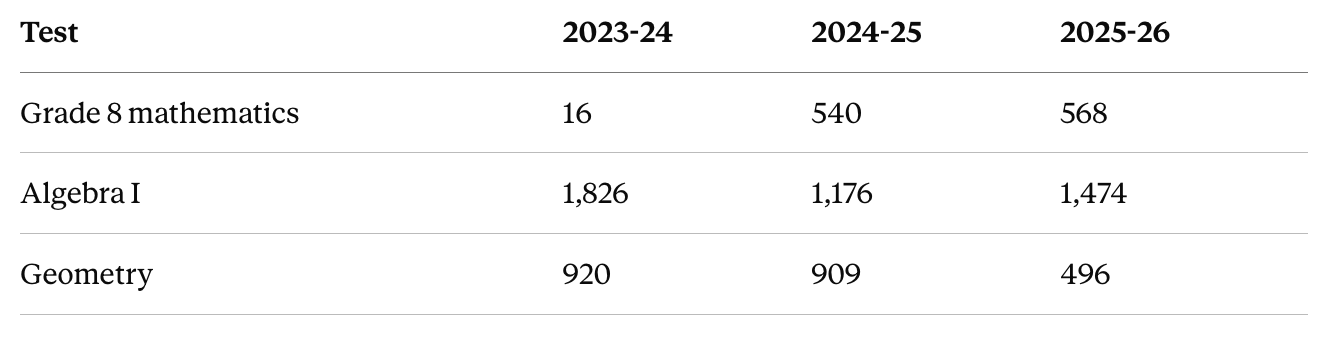
In 2023-24, 16 Alexandria students took the eighth grade math SOL — nearly every eighth grader took Algebra I instead. The following year, 540 students took the eighth grade test and Algebra I enrollment fell by 650. A year later, the smaller Algebra I cohort reached Geometry, and Geometry enrollment fell by more than 400.
Pass rates in both courses rose over the same period. Algebra I passed at 63.7% in 2023-24, before the change, and at 71.5% last year. Geometry passed at 47.7% in 2023-24 and 70.4% last year. The division did not say whether it attributes those increases to instruction, to the change in which students take each course, or to both.
The eighth grade track
Before the change, Alexandria accelerated more of its eighth graders than any other division in Virginia. In 2023-24, 16 Alexandria students took the eighth grade math SOL, against 1,826 who took Algebra I. The next-lowest division was Radford City, where about 20% of students in that band took the grade-level test. In most Virginia divisions, a large majority do.
Alexandria's Algebra I pass rate that year was 63.7%, against a statewide 85.4%. About 660 Alexandria students did not pass.
Eighth graders who are not placed in Algebra I now take Pre-Algebra and sit for the grade 8 math SOL. Last year 568 Alexandria students took that test and 23.2% passed, up from 18.7% in the first year of the change. The statewide pass rate on the same test was 62.7%.
The two groups are not directly comparable. Half of Alexandria students counted in math participation are English learners and nearly 60% are economically disadvantaged, shares well above the state's. The students now taking the eighth grade test are also largely the same students who previously sat in Algebra I, where most of them did not pass either.
Reading gains were uneven by grade. Third, fourth and seventh grade were nearly flat, rising less than a point each. Fifth, sixth and eighth grade rose 2.3 to 2.9 points. End-of-course reading slipped three-tenths of a point.
Gaps persist
Alexandria's overall figures are shaped by who takes the tests. Of the 8,183 students counted in math participation, 4,089 — almost exactly half — are English learners, and 4,779 are economically disadvantaged.
Several of those groups improved faster than the division as a whole in math. Economically disadvantaged students gained 6.8 points, to 48.2%. Black students gained 4.8 points, to 52.4%. Hispanic students gained 4.6 points, to 44.6%. English learners gained 3.8 points, to 36.5%.
ACPS said in its advisory that every major student group gained in both history and math, that students with disabilities improved in all four subjects, and that English learners gained 11 points in history. Each of those claims matches the state data.
The gaps themselves changed little. In reading, 84% of white students passed, compared with 61% of Black students, 46% of Hispanic students, 31% of students with disabilities and 28% of English learners. The English learner reading rate was unchanged from the prior year. In math, 82% of white students passed, compared with 45% of Hispanic students and 28% of students with disabilities.
VDOE said statewide that achievement gaps between student groups persist and require urgent attention.
Participation
Alexandria tested 98.2% of students in math, 98% in reading and 97.5% in science, above the 95% federal participation threshold and close to statewide rates.
Students with disabilities fell below that threshold in all three subjects: 94.5% in math, 93.9% in reading and 92.5% in science. Federal law applies the 95% standard to student groups as well as to divisions overall.
ACPS said it is aware and will work with staff and the Virginia Department of Education on a plan to improve participation for any group that fell below the target. The division said under-participation factors into a school's mastery index calculation within the School Performance and Support Framework — the state accountability ratings due in October.
What's next
VDOE staff are scheduled to present the statewide results to the Virginia Board of Education on Wednesday. School-level results are available on the VDOE website, and the department said its School Quality Profile reports will be updated in the coming weeks.