Table of Contents
ALEXANDRIA, Va. — Alexandria far exceeded its goals for repairing affordable apartments and sheltering homeless residents over the past five years while falling well short on building new units, according to a draft city housing report released Friday for public comment.
The Consolidated Annual Performance and Evaluation Report, required annually by the U.S. Department of Housing and Urban Development, measures the city's use of federal housing money against the goals it set in its 2022-2026 Consolidated Plan.
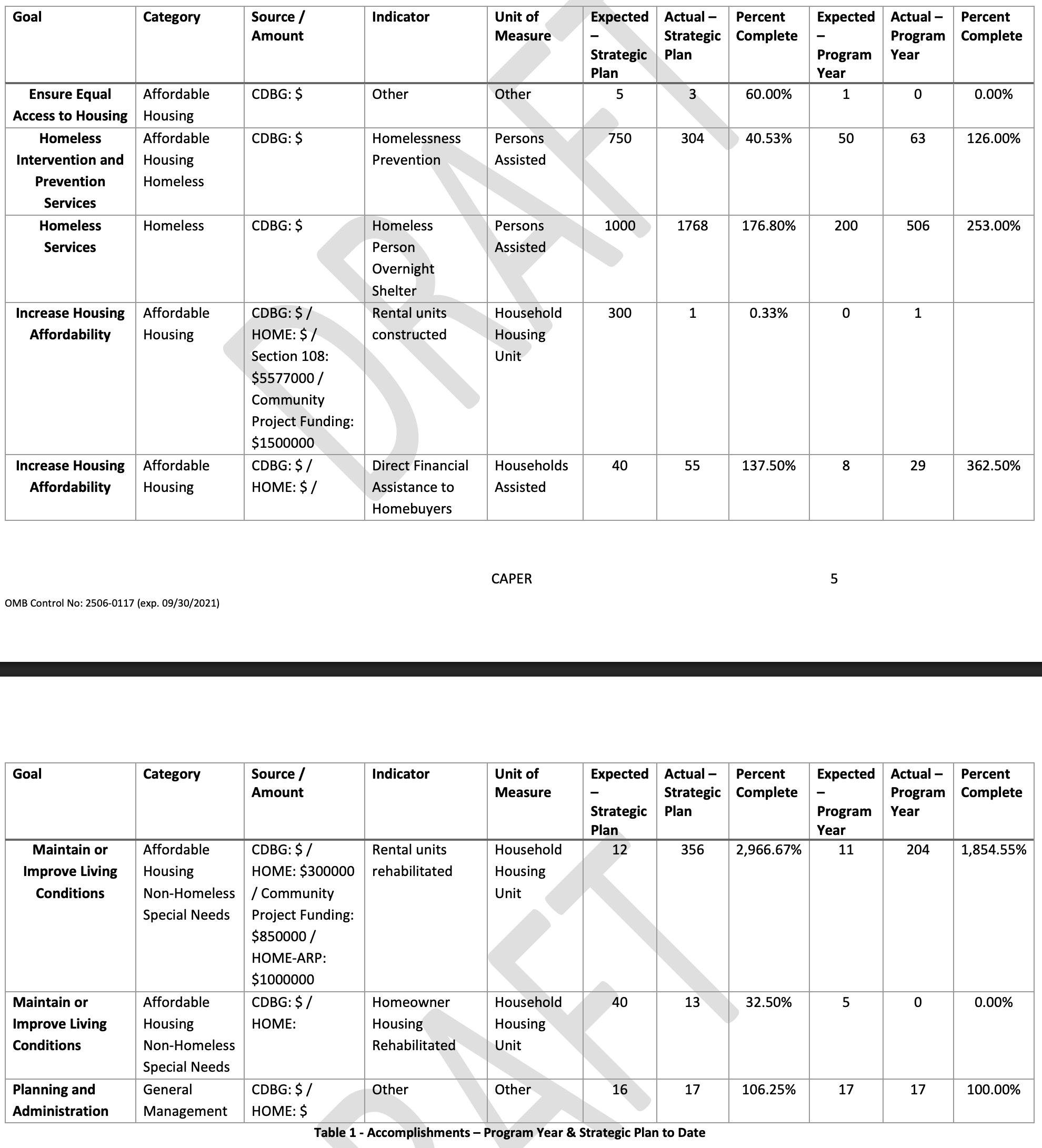
The report shows the city rehabilitated 356 rental units over the plan period against a goal of 12, and 204 in the past year against a target of 11. It sheltered 1,768 people against a five-year goal of 1,000 and assisted 55 homebuyers against a goal of 40. In the past year, the city helped 29 first-time homebuyers and prevented 63 people from becoming homeless, both above target.
Over the same period, one new rental unit was constructed against a five-year goal of 300. That unit came online in the fiscal year that just ended.
The construction figure counts only units built with the federal money the report tracks: Community Development Block Grant and HOME funds, a Section 108 loan and Community Project Funding. The city produces affordable housing through other tools the report does not count, including density bonuses, its Housing Trust Fund and low-income housing tax credits. The report notes that new construction can be funded only with HOME dollars, and describes construction as the city's highest priority.
The report closes out the 2022-2026 plan. Council adopted its successor in April, a five-year consolidated plan the city acknowledged was being written as federal funding failed to keep pace with need.
The construction figure lands against a backdrop the city documented in its Housing 2040 plan, adopted in June: market-affordable units in Alexandria fell from roughly 18,000 in 2000 to 6,900 in 2025, a 62% loss, and about 2,100 committed affordable units have affordability restrictions set to expire by 2040.
Three other five-year goals were not met. The city rehabilitated 13 owner-occupied homes against a goal of 40 and none in the past year against a target of five. A goal of assisting 750 people through homelessness prevention produced 304. A fair housing access goal of five was met three times.
The city aimed to house two special-needs households and housed none. The report says the program was not well advertised and few households knew about it, and that the city will change how it is delivered and marketed this fiscal year.
The report attributes part of the gap between targets and results to estimating. It cites an incorrect estimate of how many households could be served through the Transitional Assistance Program. On rehabilitation, it credits a shift away from single-family homes toward multi-unit buildings, which it calls an effective use of block grant funds, and says demand for single-family rehabilitation is falling while demand for services is rising.
The report also identifies a state restriction as one of the greatest regulatory barriers to affordable housing: Virginia does not allow the city to require developers to contribute to affordable housing. All such contributions are voluntary, except where developers use zoning provisions that trade added density for affordable units. The city studied a possible inclusionary zoning policy in fiscal 2025 and approved its Housing 2040 plan in June.
Spending
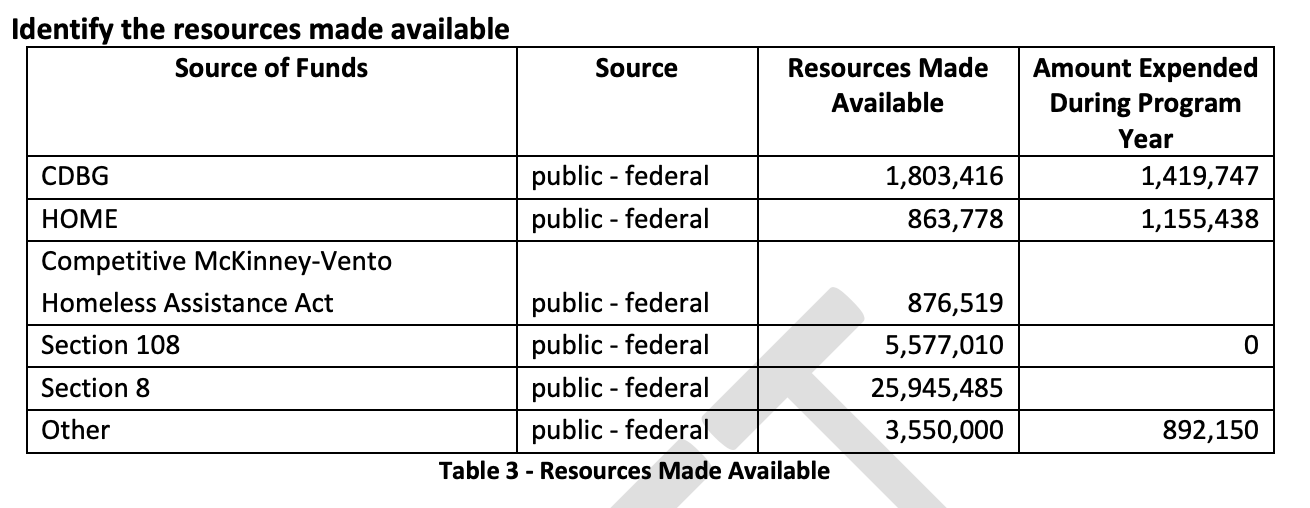
The city had $1.8 million in block grant funds available and spent $1.42 million. It had $863,778 in HOME funds and spent $1.16 million, drawing on prior balances. A $5.58 million Section 108 loan was available and none was spent during the year. The city reported $414,445 in program income, all of it spent.
The Section 108 loan supports Housing Alexandria's Sanse/Naja project, which the report describes as 100% affordable. The city also put Housing Trust Fund money and a Housing Opportunities Fund loan toward the project, which is set to receive low-income housing tax credits, state bond funding, city HOME funds and private financing. The report's description of the project's size does not reconcile: it gives an estimated 474 units, then lists 416 rental units and 79 for-sale condominiums, which total 495. Elsewhere the report says the Section 108 loan funds construction of 79 affordable units for households between 40% and 80% of area median income.
Who was served
The report's demographic table lists 324 families assisted with block grant funds and 24 with HOME funds, but its own narrative says block grant programs served 705 families. The city attributes the gap to a missing category: 465 families identified as "other multi-racial," which the HUD table does not include, and 25 of those also identified as Hispanic.
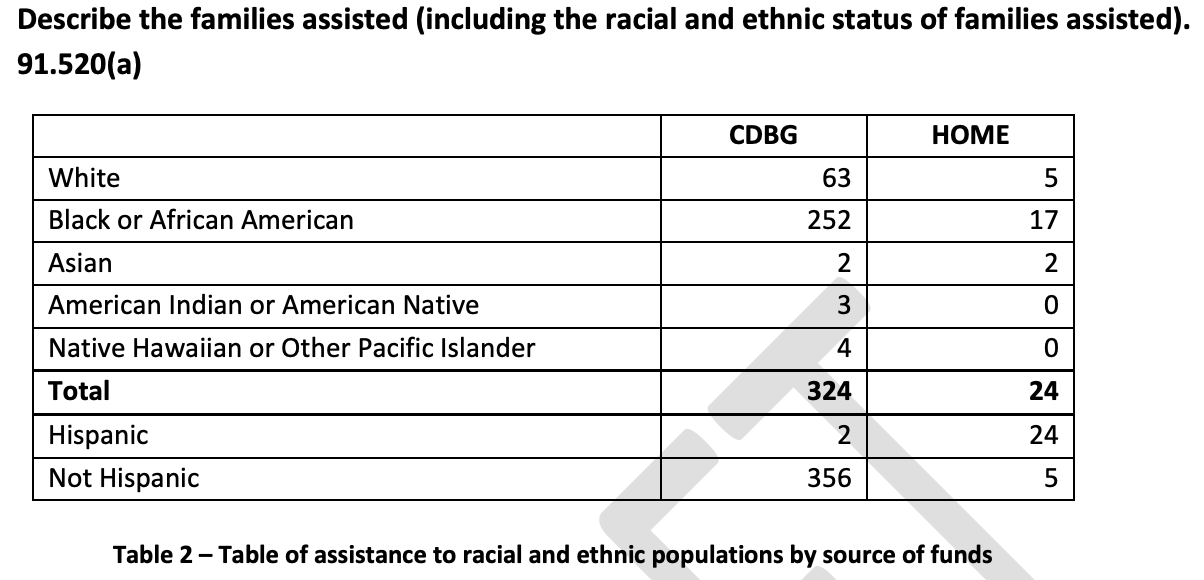
The ethnicity rows do not match the racial totals either. The table reports 2 Hispanic and 356 non-Hispanic families under the block grant column, totaling 358 rather than 324, and 24 Hispanic and 5 non-Hispanic under HOME, against a column total of 24. The narrative describing the 29 homebuyers says one identified as "other multi-racial" and four identified as Hispanic but declined to state a race. The narrative also refers to program year 2025 figures in a report covering city fiscal 2026.
Housing authority transition
The report documents management changes at the Alexandria Redevelopment and Housing Authority. CEO Erik Johnson was dismissed in August 2025, and City Council asked every member of ARHA's Board of Commissioners to resign the following month. Council appointed a new board, reserving three seats for residents, and an interim CEO was selected.
A working group of ARHA staff, city code enforcement officers and Office of Housing employees was formed to address building code violations at ARHA properties. ARHA tenants described mold, mice and erroneous removal notices at a City Council budget hearing in March. That same month, Mayor Alyia Gaskins and the Mayor's Interfaith Council announced an effort to clear about $1 million in back rent owed by close to 500 ARHA households. The report says the changes have brought more residents to board meetings, and states that ARHA is not designated a troubled housing agency.
Fair housing testing
The city contracted with the Equal Rights Center to test Alexandria's rental market for discrimination. Housing providers found in violation were required to complete certified fair housing training. The city held trainings on disability rights and on Virginia's source-of-funds protection law, and says it is maintaining resources for continued testing.
How to comment
Written comments will be accepted through Sept. 7 by email to kimberly.cadena@alexandriava.gov or by mail to the Office of Housing, 100 N. Pitt St., Suite 425.
A public hearing is set for Sept. 3 at 6:45 p.m. in the Gold Room of the Nannie J. Lee Recreation Center, 1108 Jefferson St., during the Alexandria Housing Affordability Advisory Committee's regular meeting. The hearing will also take comment on the city's housing plan for fiscal 2028.
The draft is posted on the Office of Housing website and available in hard copy at the office and at city libraries. Translated and accessible versions are available on request.
The report states that notices about the comment period were published during the week of Aug. 17, 2025, in two newspapers of general circulation, one of them Spanish-language. The comment period it describes runs from Aug. 21 to Sept. 7, 2026.