Table of Contents
ALEXANDRIA, Va. — Families applying for public housing or a voucher in Alexandria would face a limit on how much they can own under draft policies the housing authority has opened for public comment. Families already in the programs would not.
The Alexandria Redevelopment and Housing Authority is taking comment through Sept. 22 on its 2027 Annual PHA Plan and on revisions to the two rulebooks governing its programs — the voucher administrative plan and the public housing Admissions and Continued Occupancy Policy. The revisions implement the Housing Opportunity Through Modernization Act, a 2016 federal law, by Jan. 1, 2027. Proposed changes are marked in red in the posted drafts.
Under the drafts, an applicant family cannot be assisted if its net assets exceed a threshold HUD adjusts annually — $52,787 in 2026 — or if it owns real property it could live in, has the right to occupy and has the authority to sell. ARHA states it has no discretion to waive that limit at admission.
Where federal rules gave the agency a choice, it took the more protective option for people already housed. Both drafts adopt total nonenforcement of the asset limit for current participants, applying it only to new admissions. A tenant or voucher holder whose savings cross the threshold will not lose assistance over it.
Other provisions end the earned income disallowance for people with disabilities on Jan. 1, 2026, make revoking consent to check financial records grounds for denial or termination, and — in the voucher plan only — require ARHA to report anyone it formally finds to be unlawfully present to the Department of Homeland Security within 45 days of a quarter's close, citing a Dec. 16, 2025, letter from the HUD secretary.
The agency plan's own checklist marks the element covering eligibility, selection and admissions as not revised.
What else is in the plan
By ARHA's accounting, little else changed. The plan's checklist flags only two revised elements: financial resources and operation and management. The agency lists $50.6 million in planned resources for the year, including $27.5 million in voucher assistance payments, $3.3 million in public housing operating funds and $2 million in capital funds. The table is labeled FY 2025 in a plan for fiscal 2027.
The operations section confirms a change at the top. Interim CEO Rickie Maddox left in June to pursue other opportunities in affordable housing, and Roy O. Priest returned as interim chief executive. Priest led ARHA from June 2007 through January 2018, and the plan credits him with redeveloping 621 mixed-income units and building a pipeline of more than 530 more. He previously spent 17 years at HUD. He will serve while ARHA conducts a national search for a permanent chief executive.
The plan carries forward what it calls ARHA's continued goal of repositioning its public housing: within five years, the agency says, it will not own or manage housing subject to an annual contributions contract funded by Section 9 operating subsidy and capital funds. It reports 409 public housing units and 2,300 vouchers, a combined 2,709.
That shift changes the funding platform rather than the housing. Under the Rental Assistance Demonstration, the plan says ARHA retains ownership and management, residents remain eligible after conversion, and properties gain access to debt and tax-credit equity for renovations they have not received. Chatham Square, Braddock/Whiting/Reynolds, Old Dominion, West Glebe and James Bland I and II are approved for RAD, with the last three complete. Samuel Madden, Andrew Adkins, Ladrey and Yale Drive would convert through Section 18. Park Place and Saxony Square finished in 2023.
Where the projects stand
The plan restates the status of projects the Brief has covered as they developed.
At the Ladrey Senior High-Rise, the demolition-and-replacement plan gave way to a renovation. Council authorized up to $20 million in revenue bonds in April to rehabilitate the 11-story building at 300 Wythe St., preserving 159 deeply affordable apartments, with construction due to start in January 2027 and finish in the third quarter of 2028. Residents were relocated by January 2026 and hold a guaranteed right to return. A court upheld the underlying land-use approvals in July.
The agency plan adds that building permits are expected in the second and third quarters of this year, and that the number of project-based vouchers at Ladrey "may be reduced to at least 120," down from the 170 units originally slated for conversion. That figure counts voucher subsidy rather than the 159 apartments the bond financing preserves; ARHA has not explained how the two relate.
At Samuel Madden, construction is underway on Madden North — 207 affordable units, resident amenities and space for a nonprofit food pantry, backed by 65 project-based vouchers — with occupancy anticipated in the fourth quarter of 2027 and Madden South financing expected to close by the end of 2028. Andrew Adkins, 90 units, has been separated into its own disposition application, with approval expected this quarter. Yale Drive, the 40-unit former Cameron Valley site, received disposition approval this year; a developer solicitation is planned for 2027, coordinated with the Duke Street Small Area Plan.
How to comment
Written comments and questions are due Sept. 22 and will be addressed in the final versions or considered in next year's plans.
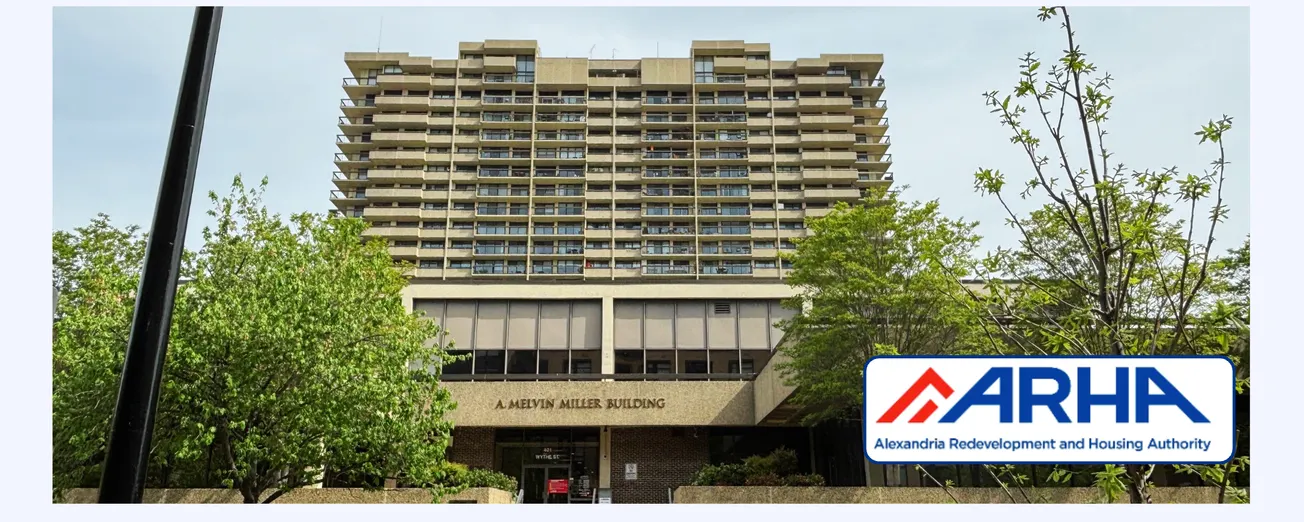
The public hearing is at ARHA's main office, 401 Wythe St., on Sept. 23, and can be attended by Zoom using meeting ID 838 9542 9602. The notice sets the hearing from 5:30 to 6:30 p.m.; a passage inside the agency plan gives the time as 6 p.m. The Board of Commissioners votes at 7 p.m. Sept. 28.
Comments can also be sent to Denise Kaffka, director of compliance, operations and policy, at dkaffka@arha.us or 703-549-7115, ext. 1400, or Lennin Lopez, compliance analyst, at ext. 1401. Questions about attending the board meeting should be directed to Juwahn Brown at jbrown@arha.us or ext. 1101.