ALEXANDRIA, Va. — Unplanned asbestos abatement at City Hall has used up the renovation project's base contingency, General Services Director Jeremy McPike told City Council on Tuesday, and staff will provide the council with an update on the numbers later this year.
Councilwoman Jacinta Greene asked whether the project remains within budget.
"We are within the resources," McPike said. "We had not planned the additional $3 or so million for asbestos, and so that takes away from our contingency. And so leading into a project like this, with the historic structure, we've eaten up essentially our base contingency, which was really tight on a project like this."
He said it is not a position the city likes to be in, and that staff is working through solutions, including value engineering with the contractor to bring numbers down. The city is working with the contractor toward a guaranteed maximum price, and McPike said an update would come to council later this year after that work is finished with the City Manager's Office.
The city did not mention cost when it announced the asbestos delay on Sept. 1, and whether the extra abatement would affect the budget had remained an open question. The project is budgeted at $123.6 million in the city's capital plan, with an $85 million construction contract awarded to Grunley Construction Company.
Where the asbestos was
Before construction began, the city commissioned a hazardous materials survey that tested 224 samples from the building. It found asbestos in ceiling and floor tile adhesives, vinyl floor tile, roof flashing, parapet tar and door caulk, and lead-based paint in eight locations, including the wood grid in the council chamber.
The additional asbestos, according to a slide shown to council, was in the masonry façade structures of the 1960s infill, a part of the building the survey had not flagged. The city said on Sept. 1 that the material was found in the 1960s south façade and the east and west interior courtyards, and that the unforeseen conditions pushed completion back by 10 weeks to fall 2028.
What crews have found inside
Assistant Director of Capital Projects Jenine Kotob walked council through what demolition has exposed in the 1800s-era Kluse Building.
Columns inserted during the 1960s infill construction were sistered to the original structure, leaving a historic wood column cut and joined to a steel beam. Behind walls, crews found horsehair plaster still carrying pastel paint, an old staircase removed in the 1960s, decorative painted trim, and an unexplained metal ceiling configuration at Cameron and Fairfax streets that appears in no documents.
The most striking find was a playbill dated to about the 1870s, legible enough to read the actors' names and the admission prices, 10 and 20 cents. Staff believes it advertises an adaptation of Jack Sheppard, a play that traveled the East Coast, featuring a teenage actress billed as Minnie Palmer. Kotob said a worker on the Kluse Building likely attended the show and tucked the bill into the wall.
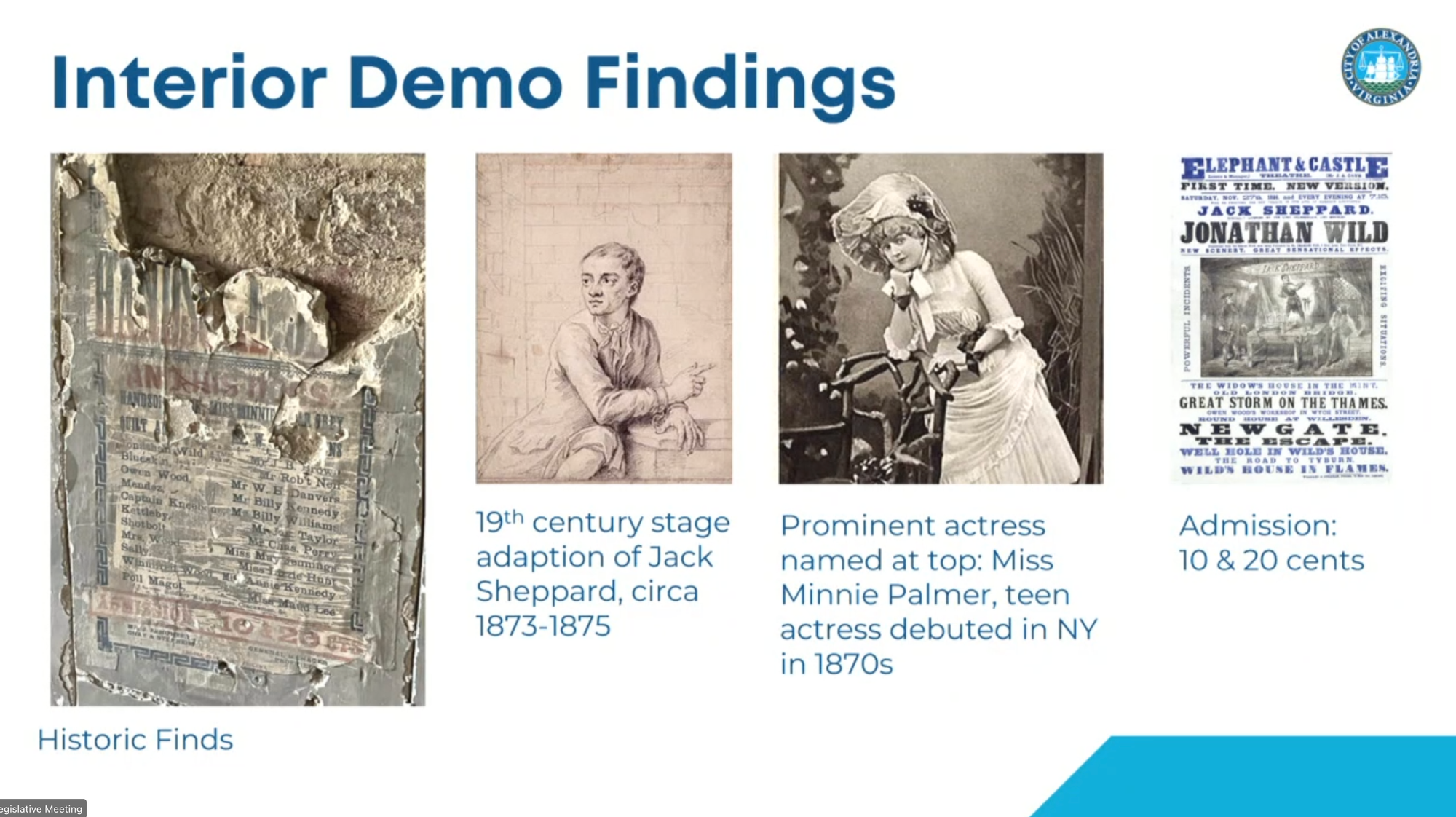
"This is our own little time capsule discovery," she said. The city is working out how to protect and display it, though the location falls in future office space rather than a public floor.
Kotob said exterior masonry is also a problem. Mortar on the Kluse Building's brick is failing in places and must be repaired before work continues. Exposed wood ceilings will have to be fireproofed to meet code, she said. The city is not trying to recreate a history that was never visible, she said, but to use the volume of the spaces.
What comes next
McPike said drill rigs around the site have been preparing for supportive excavation and shoring, and crews have installed dewatering wells to control groundwater once foundations are disturbed.
With asbestos removed from the 1960s section, demolition of that portion of the building comes next, running through the fall and winter. That work opens the way to excavate the basement and then demolish the garage. Once the garage is out, crews install the geothermal field beneath it, roughly 120 to 130 wells at 400 feet, that will heat and cool the building.
There will be noise for the foreseeable future, McPike said.
He said the team is looking for ways to deliver the garage early, knowing how much the parking matters, though the site is tight and the sequencing constrained. Shaving even a month off would help, he said.
Responding to the neighborhood
McPike said several changes came from community feedback. Additional parking signage with QR codes now directs drivers to available spaces, and the city restriped Cameron Street to clarify lanes after the realignment.
On contractor parking, a frequent complaint, he said the contractor now photographs the surrounding blocks every couple of hours and keeps an accountability log to confirm its workers are parking off-site. Many contractor vehicles in Old Town, he noted, belong to unrelated jobs at neighboring homes and businesses.
Mayor Alyia Gaskins said the findings matter beyond the construction schedule.
Much of the project is about preserving a building the city needs, she said, and there were conditions behind the walls affecting its safety and, in turn, the city's ability to deliver services. It is also a chance, she said, to learn about the city's history and decide how to tell that story.
McPike said he hopes to return periodically as the project hits milestones.
Watch the presentation
The update starts at just about 2:30 in the video below.