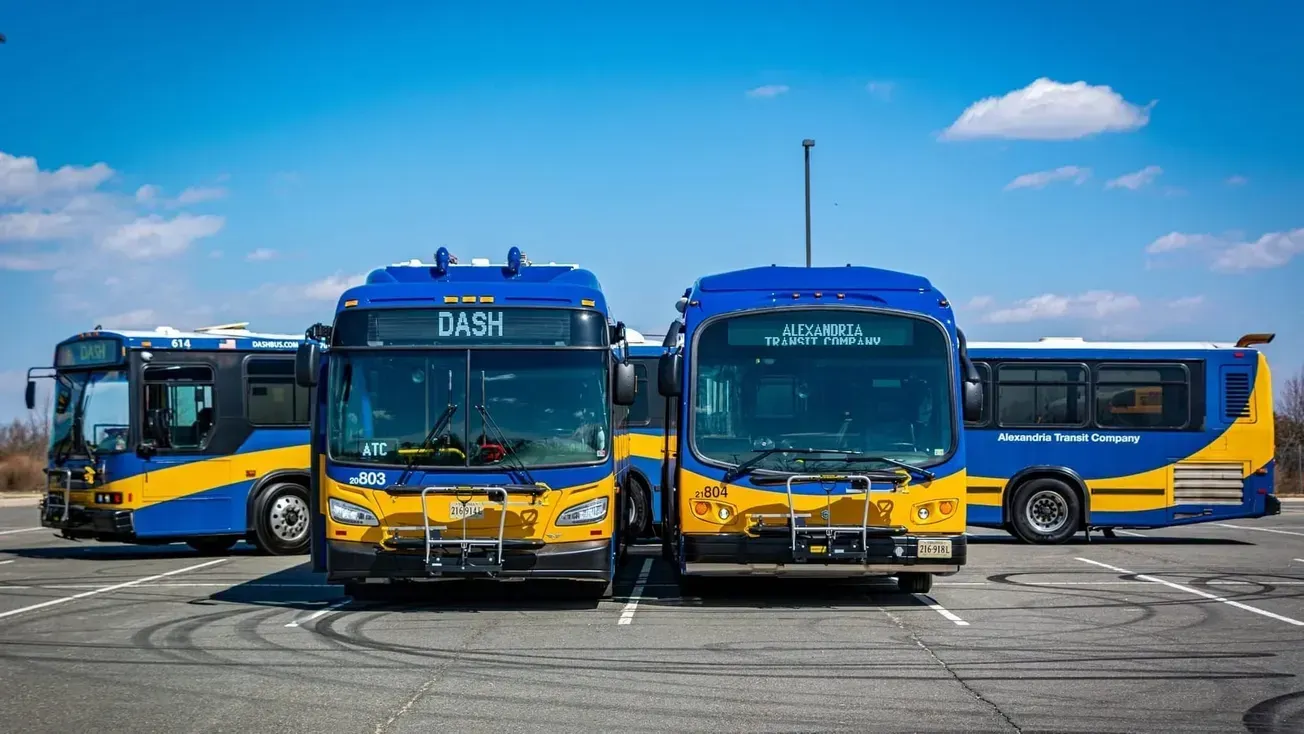
ALEXANDRIA, Va. — Virginia's transportation department is building scenarios for consolidating DASH with three neighboring bus systems, and Mayor Alyia Gaskins told City Council on Tuesday that the review leaves out the thing Alexandria cares about most: what it would mean for individual neighborhoods.
Lawmakers ordered the study in the two-year budget they passed in June, directing the Department of Rail and Public Transportation to evaluate combining DASH, Arlington Transit, the Fairfax Connector and Fairfax City's CUE into a single regional bus system. The report is due to the chairs of the Senate and House transportation committees by Dec. 15.
Gaskins raised it Tuesday night during the portion of council's meeting when members report back from the regional boards they sit on. She is Alexandria's member of the Northern Virginia Transportation Authority, which received a presentation from DRPT on Sept. 10. It was not an agenda item, and council took no action.
Her main question, she said, was how the department will conduct the evaluation and what criteria it will use.
"Lots of things are feasible," she said. "That doesn't mean it doesn't have an impact or unintended consequences."
Why Alexandria built DASH
The concern is rooted in the reason DASH exists. Alexandria created its own bus system because a larger regional system was not serving the city, Gaskins said, and the city has since worked to ensure every neighborhood has service.
"Just because you can consolidate it doesn't mean that we won't be back in the same place," she said. "There's a real risk that that might not be the case."
Among the things the study is not examining, she said, are neighborhood impacts. Alexandria should press for a way to measure the effect on neighborhoods and on access as the review continues, she said.
Data the Northern Virginia Transportation Commission presented this month frames the distinction she is drawing. Local systems, such as DASH, account for 68% of transit service hours in Northern Virginia and run intra-jurisdictional services that connect neighborhoods to the regional network, with a focus on coverage. Metro Bus provides the other 32%, moving people between jurisdictions on high-ridership routes. Northern Virginia's buses carry about 677,000 riders a week, according to state performance data, with local systems accounting for 404,000 and Metro Bus 274,000.
The same presentation shows DASH ridership up 10% year over year in fiscal 2026, among the region's strongest gains. Loudoun County Transit led at 28% and Metrorail rose 9%, against a 6% regional increase and 3% nationally.
What the study is required to examine
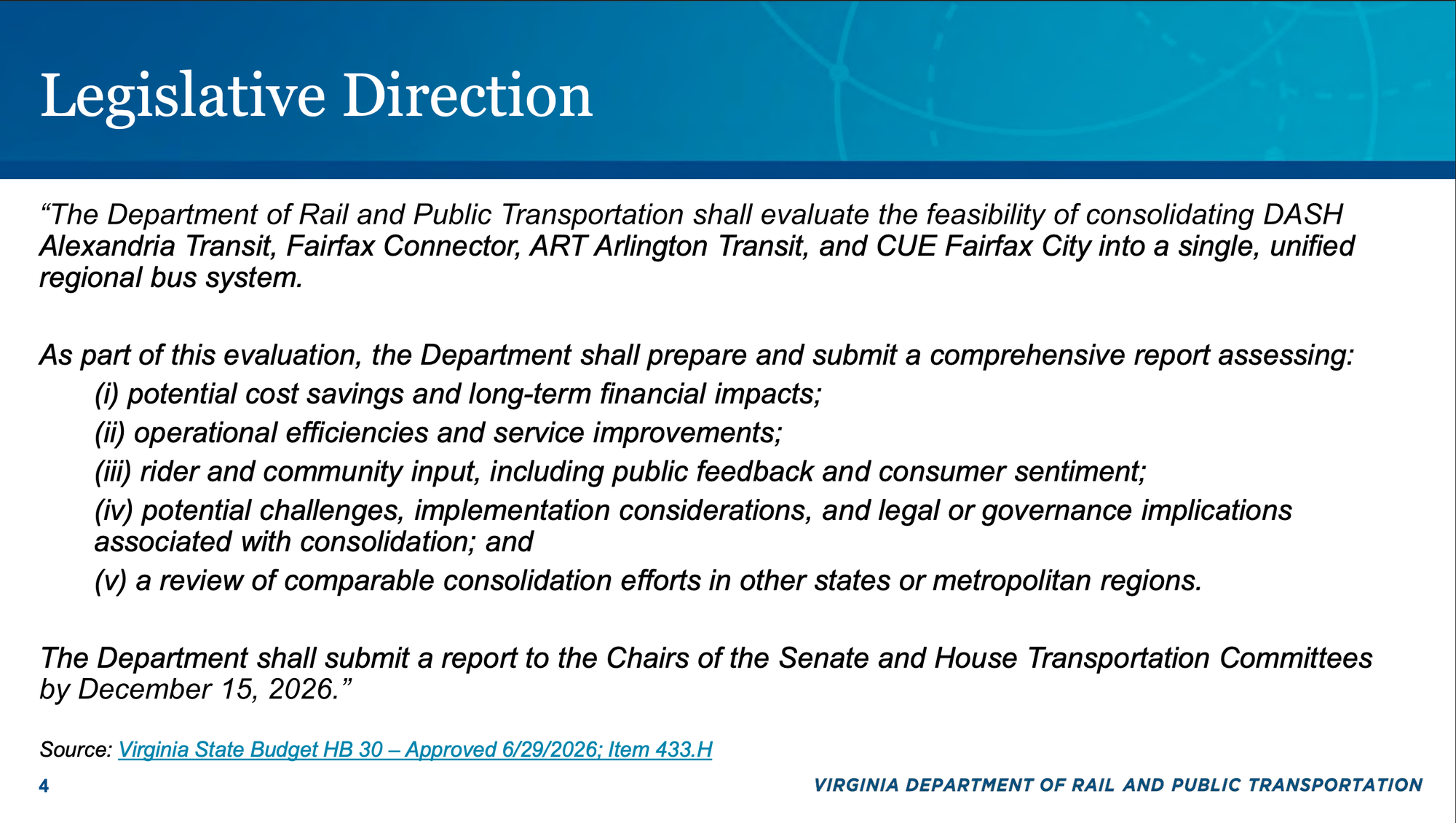
The budget language requires DRPT to assess five things: potential cost savings and long-term financial impacts; operational efficiencies and service improvements; rider and community input, including public feedback and consumer sentiment; potential challenges, implementation considerations and legal or governance implications; and a review of comparable consolidation efforts in other states or regions.
In slides presented to the transportation authority on Sept. 10, DRPT said the analysis will consider a range of options rather than an all-or-nothing consolidation, and that transit agencies, local governments, labor representatives, WMATA, regional bodies, and riders will have opportunities to weigh in. The study is organized into eight tasks covering governance, operations, finances, legal questions, national comparisons and stakeholder engagement.
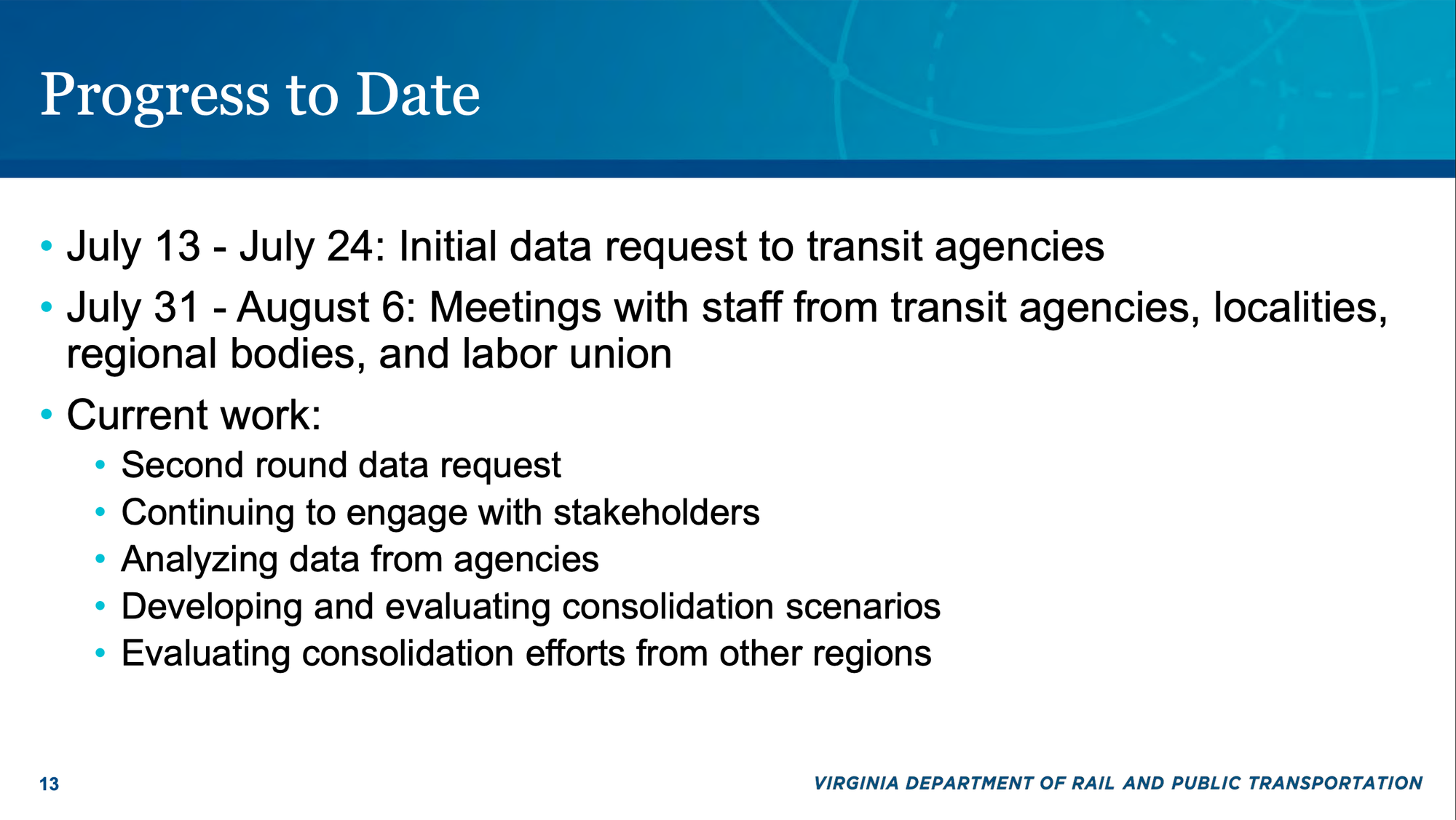
The work is further along than Tuesday's discussion suggested. DRPT sent an initial data request to the four agencies in mid-July and met with agency, locality, regional, and labor union staff in early August. Its current work, according to the September slides, includes analyzing agency data, developing and evaluating consolidation scenarios, and reviewing consolidation efforts in other regions.
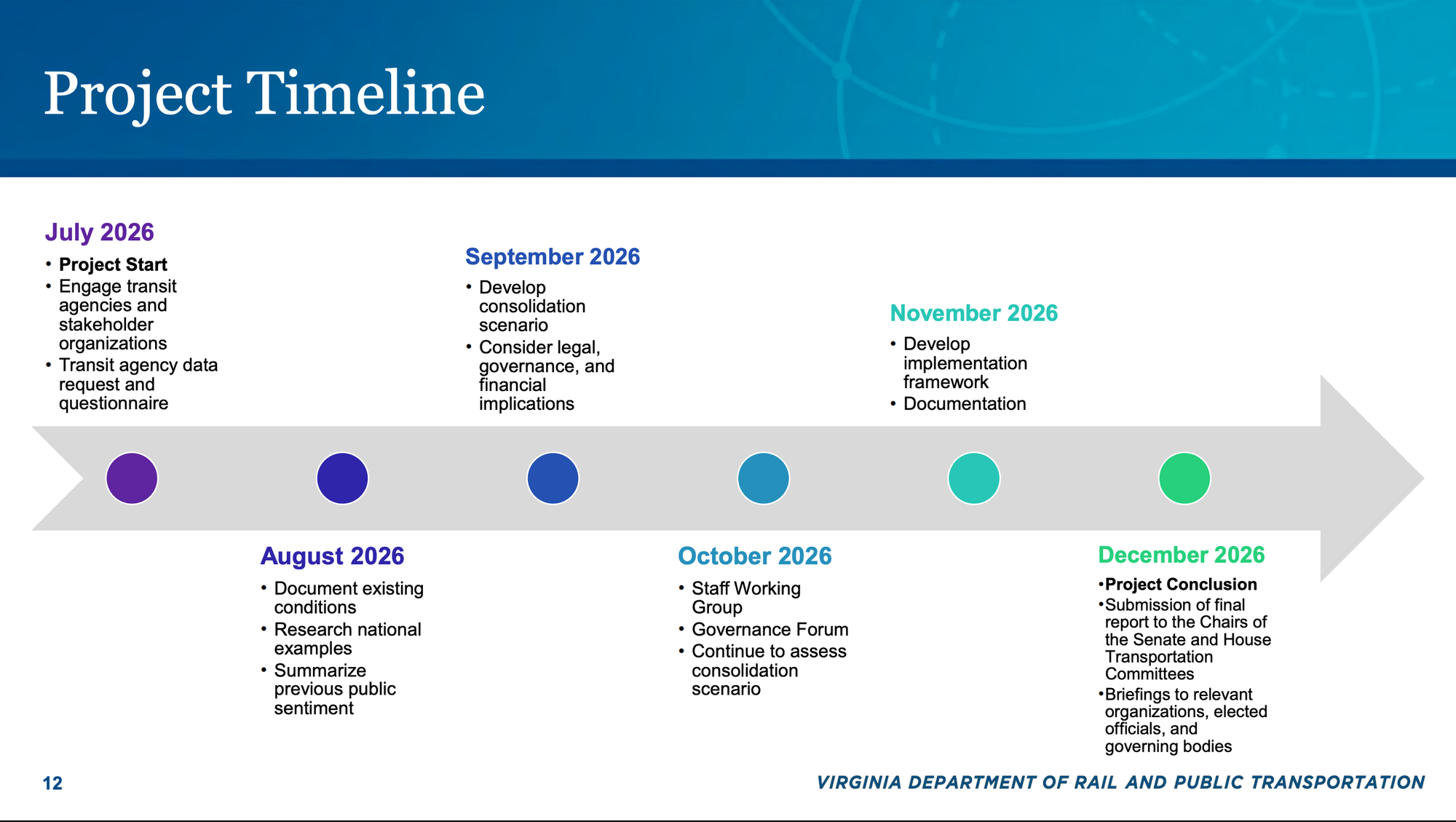
The project timeline in the same deck assigns September to developing a consolidation scenario and weighing its legal, governance, and financial implications. October is for the staff working group, the forum and continued assessment of the scenario. November is set aside to develop an implementation framework, with the final report going to legislators in December.
Where the idea came from
The study emerged alongside the state's decision to invest more in Metro. Senate Majority Leader Scott Surovell, D-Fairfax, argued in June that if taxpayers are being asked to fund the transit authority at higher levels, the region's agencies should be pressed to operate more efficiently.
Every Northern Virginia locality running its own bus system is "incredibly inefficient," Surovell said then, with separate garages, purchasing systems, fare systems and operator contracts. Before 1980, he noted, all of those services ran under WMATA as a single entity.
The study is one piece of a larger reckoning over how the region pays for transit. The same budget put $153 million in state general funds toward WMATA operations across two years, required NVTC jurisdictions to contribute $136 million a year collectively beginning in fiscal 2029, and authorized localities to seek a 1% local option sales tax that could fund transit, school construction or both, subject to referendum. It also ordered DRPT to review WMATA's own cost-savings and efficiency efforts, with that report due Oct. 15.
What happens next
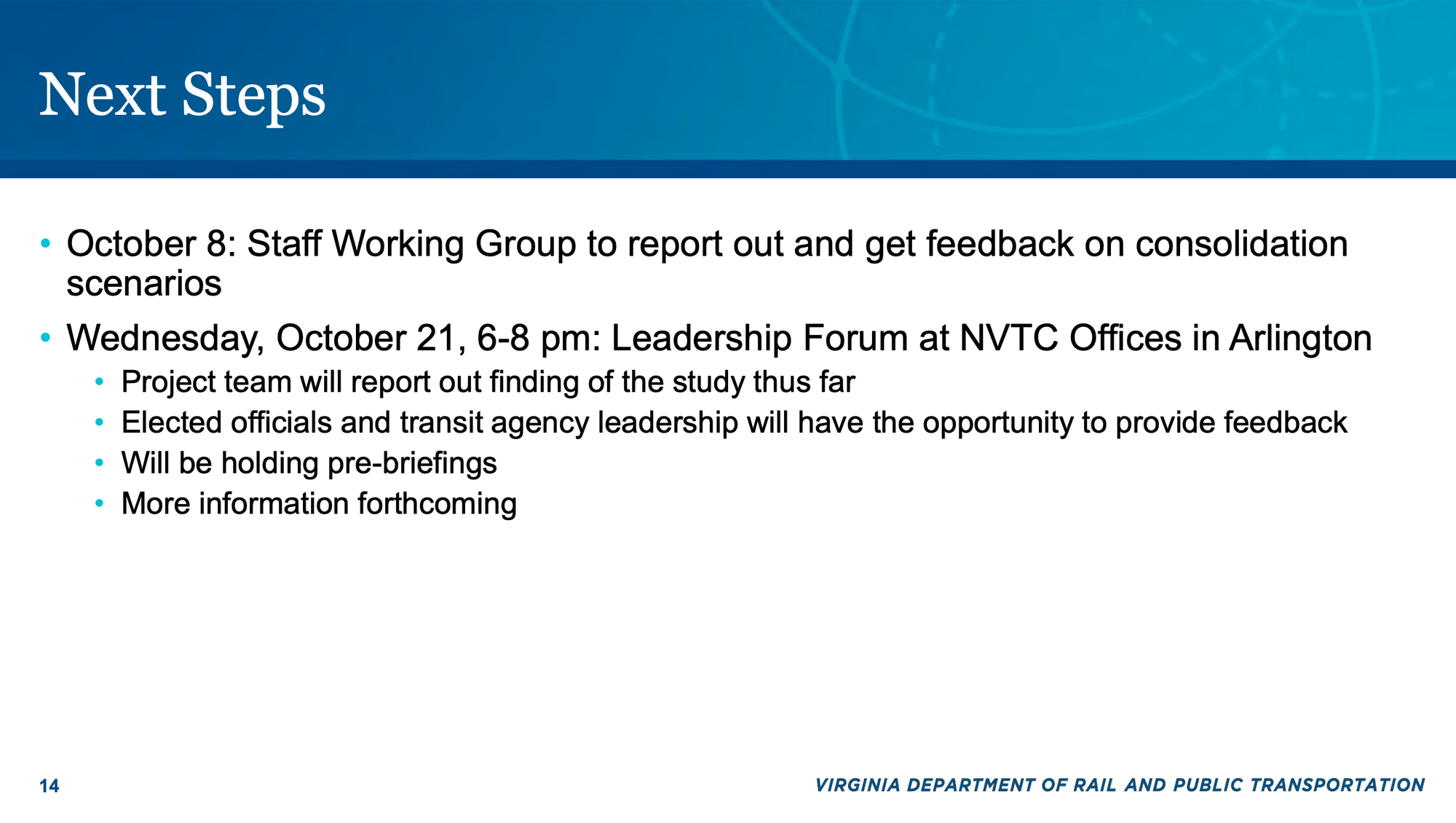
A staff working group is scheduled to report out and take feedback on consolidation scenarios Oct. 8. A leadership forum follows from 6 to 8 p.m. Wednesday, Oct. 21, at the Northern Virginia Transportation Commission offices in Arlington, where the project team will present findings so far and elected officials and transit agency leadership can respond. DRPT says pre-briefings will be held and more information is coming.
Gaskins said she intends to be there, and that several other council members plan to attend to argue that neighborhood effects and unintended consequences be studied.
Whether the public can attend the October forum is unclear. DRPT's website describes a governance forum "open to the public" this fall, and the study timeline lists one in October. But the slide describing the Oct. 21 event says the project team will present findings and that elected officials and transit agency leadership will have the chance to respond, without mentioning public attendance.
DRPT's engagement plan also lists a separate public regional roundtable to share findings and take input from riders, the general public and advocacy groups. No date has been announced for it.
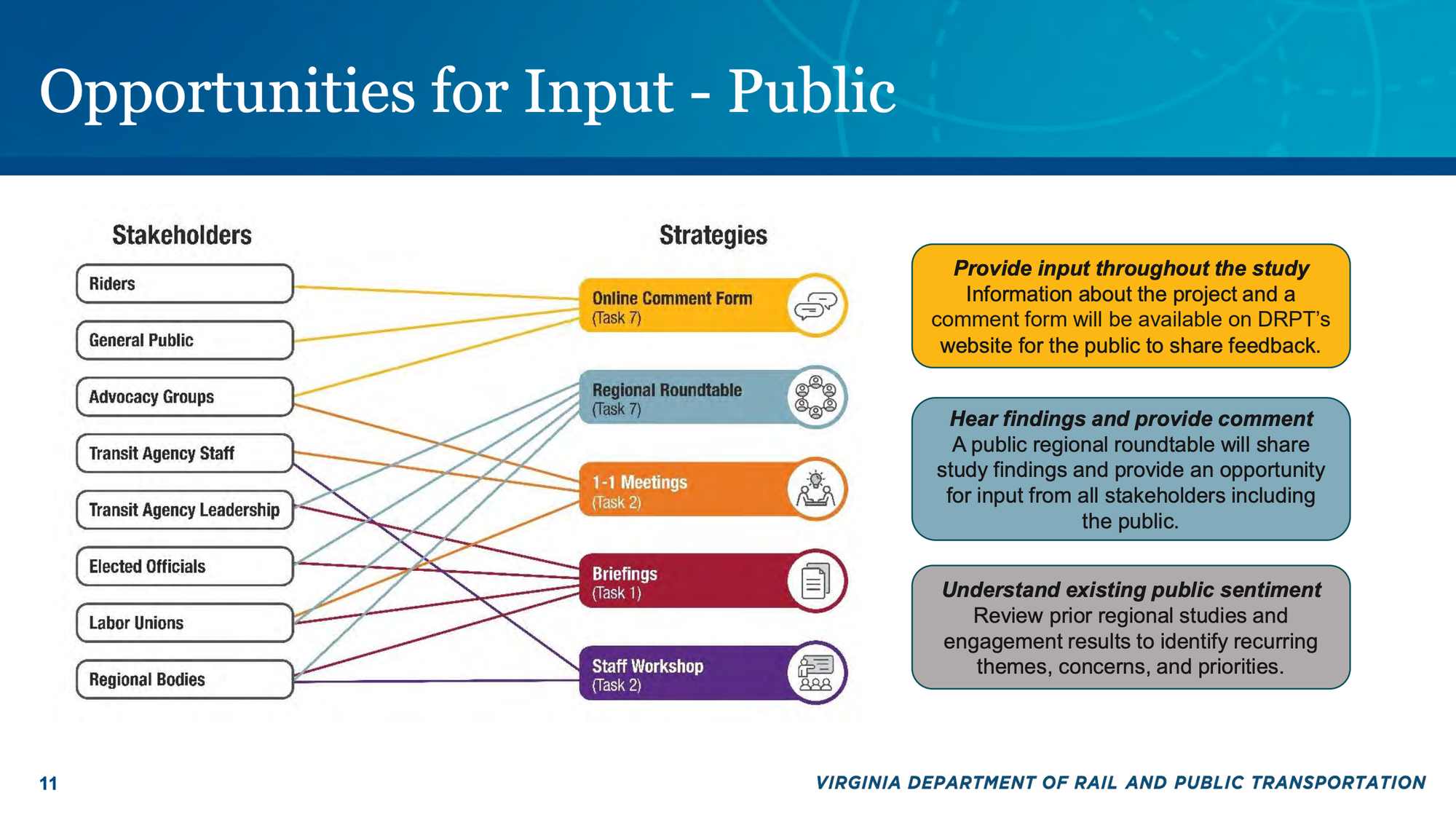
Residents do not have to wait for a meeting to weigh in. DRPT is accepting comments and questions via a form on its study page, where people can also upload a letter and request to be notified about the fall governance forum, which the department describes as open to the public.
Alexandria's seats at the table
The city is represented in most of the rooms where this is being discussed. Gaskins sits on the transportation authority alongside DRPT Director Mariia Zimmerman.
Vice Mayor Sarah Bagley chairs the Northern Virginia Transportation Commission this year, the agency hosting the October forum, and Councilman Canek Aguirre is a commissioner. So are two delegates representing parts of Alexandria, Kirk McPike, appointed in April after four years on council, and Alfonso Lopez. Zimmerman is a commissioner there as well.
Reporting on the state budget to that commission, Bagley noted that DRPT and others are studying operational considerations for local bus systems and that NVTC is monitoring the work. Staff list the consolidation study among several they are tracking, according to NVTC's September meeting materials.
A system already under scrutiny
The study lands as DASH works through its own budget problems. The transit system overspent its fiscal 2026 budget by $3.7 million, roughly 10% of its operating budget, and did not learn of it until after the year closed. A $3.2 million placeholder left in a spreadsheet made internal reports show a nearly balanced budget; as late as June, the board was told the year would finish even.
Council and the Alexandria Transit Company board hold a joint work session on the overrun Wednesday from 5:30 to 7:30 p.m. in the DASH board room at 3000 Business Center Drive. Gaskins turned down the board chair's request to postpone it.
The overrun came in a year when DASH set a ridership record of about 6.9 million trips. Council approved $43.4 million for DASH and the King Street Trolley in fiscal 2026, up 6.6%, with the city covering roughly 83% of the system. DASH has run fare-free since 2021.
Gaskins also reported that the transportation authority approved the reallocation of funds among several projects. Transit projects are planned 6 to 10 years in advance, she said, and costs are reevaluated as they near completion, while other projects become construction-ready and require attention sooner.
With the report due in December, the Oct. 21 forum is one of the last scheduled chances for localities to weigh in.