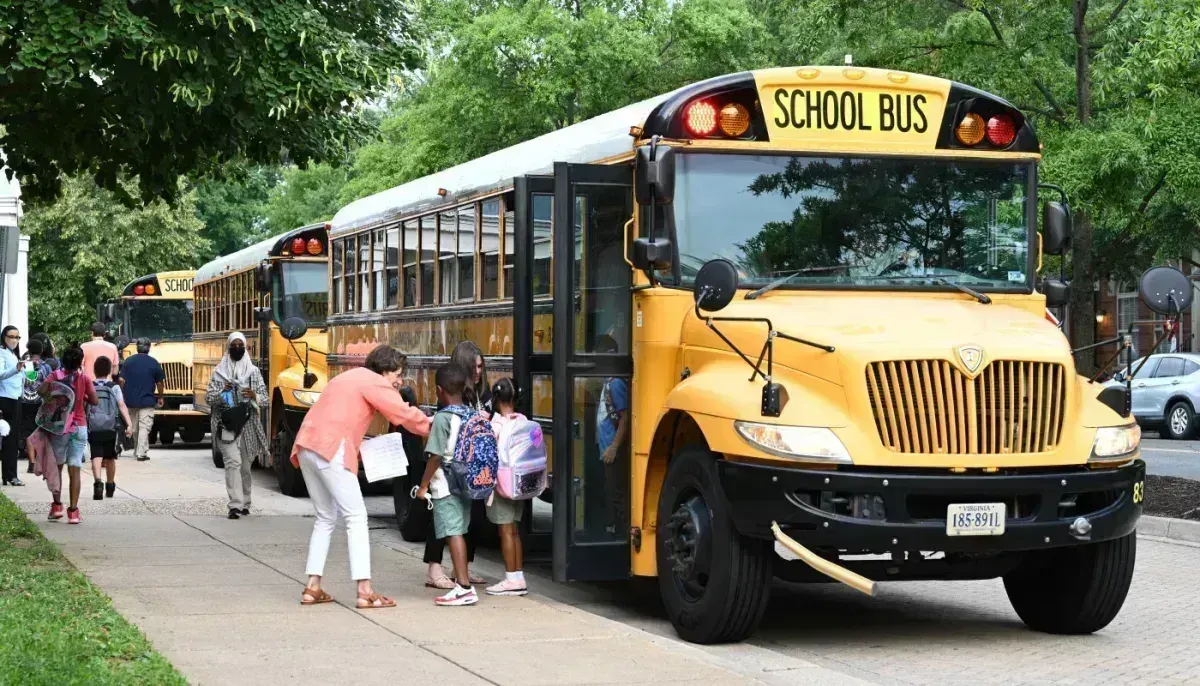
ALEXANDRIA, Va. — Alexandria City Public Schools named four of the areas where it is reviewing whether children who lost bus service this year should get it back, and set a day-by-day schedule for deciding, in a presentation Monday to a joint City Council and School Board subcommittee.
Mayor Alyia Gaskins chaired the meeting, joined by Councilman John Taylor Chapman, School Board Chair Christopher Harris and board member Ryan Reyna. City Manager James Parajon and Hillary Orr, the city's deputy director of transportation planning and mobility, attended, along with Acting Superintendent Grace Taylor and senior ACPS staff.
The presentation described the four as examples rather than a complete list. They are Mount Vernon Avenue and Glebe Road for Mount Vernon Community School; Duke Street, Quaker Lane and Seminary Road for Douglas MacArthur Elementary; Alabama and Kentucky avenues for Charles Barrett Elementary; and Sanger Avenue and Beauregard Street for Ramsay Elementary.
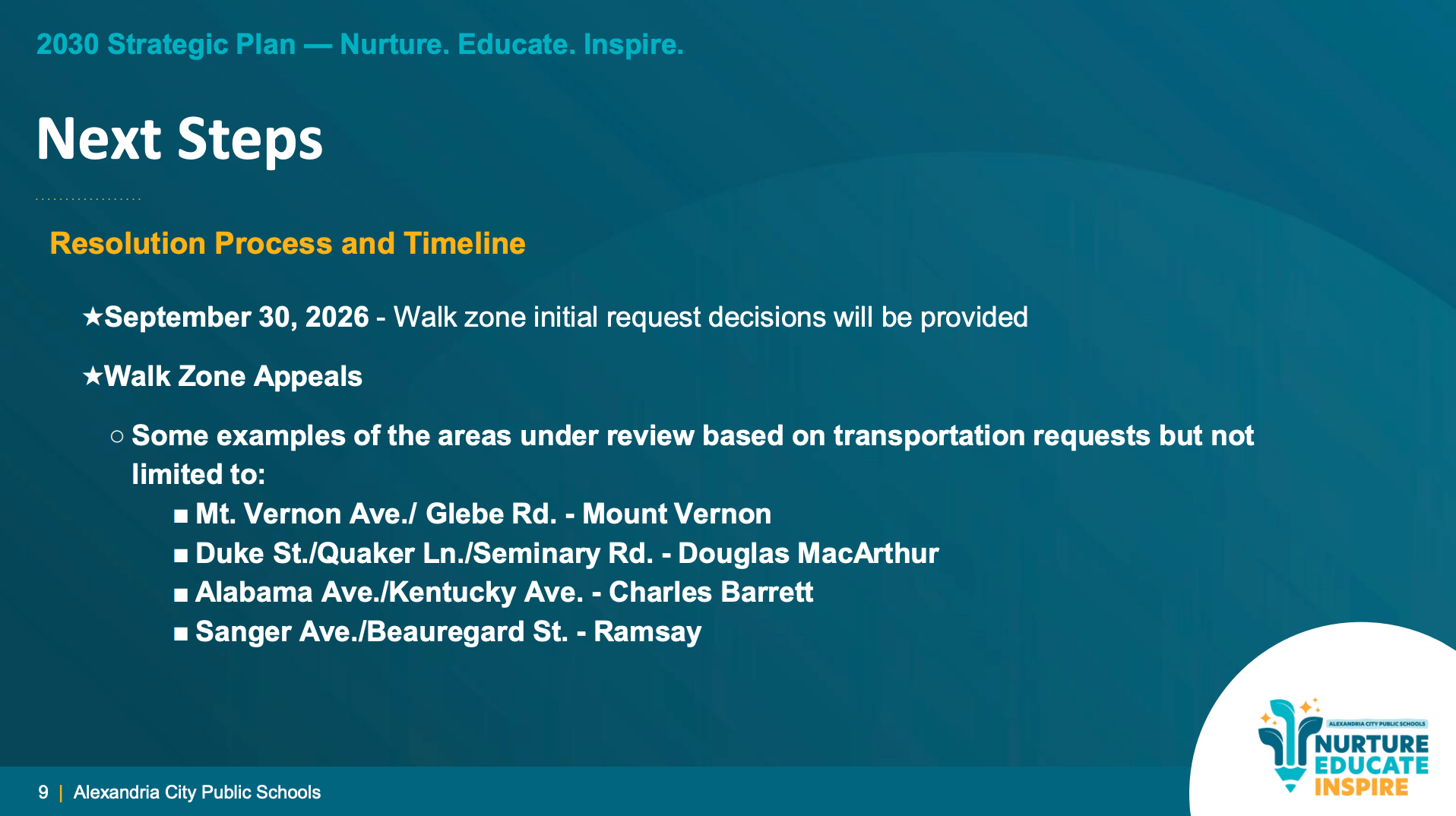
It is the first time the division has publicly named the locations under review. Parents from the Mount Vernon Avenue corridor have addressed the School Board at three consecutive meetings, and board member Tim Beaty raised Charles Barrett from the dais Thursday, saying he believed more than 100 students there who rode a bus last year no longer do.
Chief Operating Officer Anthony Peña said 100% of students who were eligible and requested transportation by Sept. 10 have been routed, up from 97.5% a week earlier. About 7% of students remain in what he called walk zone requests, the families who live inside a walk zone but say the route is unsafe. ACPS has not said how many students lost bus eligibility when the new walk zones took effect.
How the decisions get made
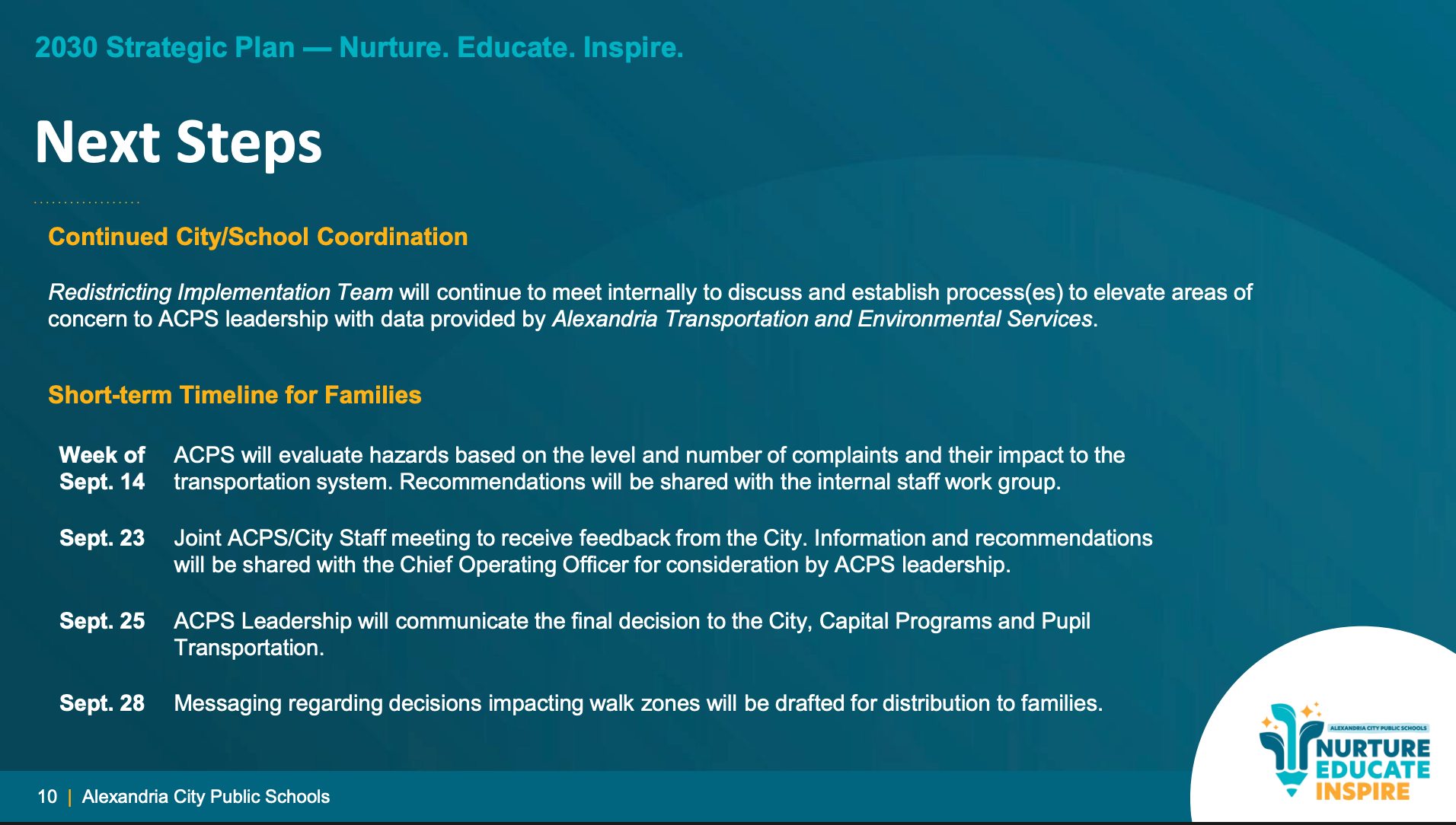
The presentation says that during the week of Sept. 14, ACPS will evaluate hazards based on the level and number of complaints and their impact to the transportation system.
Peña described the work in more detail. Staff spent last week categorizing the concerns families raised and are using the city's GIS data to make recommendations to Peña and Acting Superintendent Grace Taylor this week and next. He said he and other staff walked routes themselves, timing lights and crossings, and that he met with Deputy City Manager Yon Lambert on Friday.
The division is treating the review as systemic rather than case by case, he said, because a family that never filed a request may live in the same area as one that did.
Staff have built a rubric to keep the decisions consistent. It will stay internal until the decisions go out, Peña said, though each family's letter will explain the criteria behind a yes or a no.
"Currently, it's not public, to retain integrity of the process," he said.
Mayor Alyia Gaskins asked whether any of it could be shared without compromising the review, saying that as a parent who receives the division's communications, she would not have known what "hazardous" meant without watching a School Board presentation. Peña said the division's regulation already defines hazards and is posted online. Gaskins said the more the division can publish about how decisions are made, the better.
The timeline that follows runs: a joint ACPS and city staff meeting Sept. 23; a final decision communicated by ACPS leadership on Sept. 25; messaging drafted for families Sept. 28; and decisions delivered through ParentSquare by Sept. 30.
Approval won't mean a bus on Oct. 1
Peña cautioned that families approved for transportation should not expect it immediately.
"I don't want families to think, yep, if I get approved, I'm getting a bus October 1st," he said. The division is down to 16 driver vacancies from 18 last week, is running some double routes and is balancing daily call-outs. "As long as we have the driver capacity and ability, buses will be provided for those who qualify. If we do not have it, we'll also let you guys know the timeline."
Board Chair Christopher Harris asked whether the driver shortage was influencing any walk zone decisions. "No, sir, they are mutually exclusive," Peña said. "It is to resolve based on board regulation policy."
What counts as a hazard
Harris also asked whether "unusual hazard" is clearly defined and whether the city and the division use the same standard.
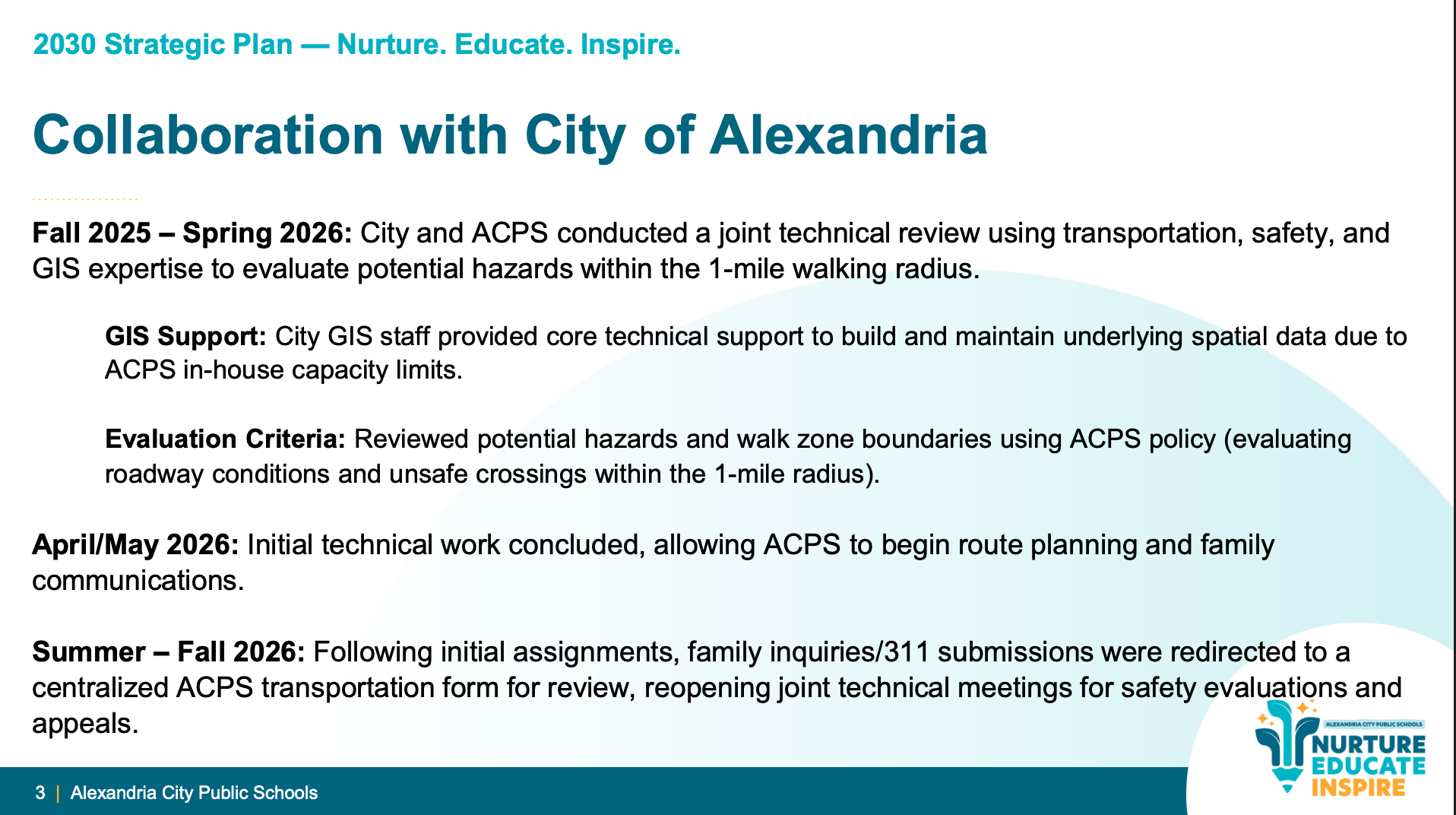
Amanda Ou, the division's executive director of facilities, read from a list drawn from a walk zone presentation in June: no sidewalks, no marked or signalized crossing on a non-residential road, high incident crossings, and no identifiable alternative route within the policy distance. She said the city and ACPS agree on what the hazards are.
Hillary Orr, the city's deputy director of transportation planning and mobility, said staff also weigh roadway geometry, since intersection design can produce higher speeds, along with crash history. She noted a limit built into the policy: if a hazard exists within the mile but another path under a mile avoids it, the student is expected to walk the alternative rather than qualify for a bus. That distinction accounts for some of the gap between families who believe a hazard makes them eligible and staff who have concluded otherwise.
Gaskins asked whether that alternative path is communicated to families. Peña said not always directly, and described visiting a location listed as having no sidewalk and finding one across the street.
The timing problem
Gaskins raised a difficulty that may shape the next two weeks. If ACPS identifies an intersection during its review, and the city determines the fix needs Traffic and Parking Board approval, the change might not be heard until November or December.
"What then are we able to communicate to the parent on September 30th if we can't review or make a change to their intersection for several months?" she asked.
Orr said some changes are quick and others are not. A leading pedestrian interval, which gives walkers a head start, generally requires a companion no-turn-on-red restriction, and that needs Traffic and Parking Board approval. Signal timing changes typically take a month or two depending on the queue. Larger intersections are capital projects measured in years.
Councilman John Taylor Chapman asked whether council could create a faster path for some changes, with an appeals process attached. Gaskins said she would ask the city attorney what flexibility exists.
Board member Ryan Reyna pressed for interim steps, noting that planned improvements in the Mount Vernon area may not arrive until 2028 or 2029.
"We're moving as fast as we can to get answers by September 30th, but that's still 16 days away," Reyna said. "And we've got students that need to get to school every single day."
Taylor said ACPS asked the city in early August about shifting crossing guards and wants to revisit it. City Manager James Parajon raised another option for the hardest locations: that they receive transportation. "The one that I can think of is the Mount Vernon one," he said.
Why this year is different
Taylor addressed why families who had buses last year do not have them now. The last redistricting was in 2018, she said, "and we did not implement walk zones. It should have been implemented then. So students across the city were given transportation."
Peña made the same point. "There's a misnomer out there that this is a new thing, but this has been in practice for years," he said. "We just finally have, in collaboration, making this a process that's being implemented effectively."
Chapman asked whether families understood during redistricting that minimizing bus dependency was one of the guiding principles. "Some of what I'm hearing doesn't seem aligned with that understanding," he said.
Harris said the five guiding principles were communicated repeatedly through focus groups and community meetings, and that the division was clear the principles would have to be balanced against one another. "We made sure we reinforced that every meeting, every engagement, every communication to the families," he said.
What's next
Gaskins listed the subcommittee's follow-up items: crossing guard placement, what flexibility the city has to accelerate approvals, what can be done for families immediately, communications, student presence at the Bradlee Shopping Center, and aligning city and school commercial driver's license training.
The School Board's Governance Committee takes up revisions to the student transportation services regulation Friday at 7:30 a.m.
The subcommittee meets next on Oct. 19 at 5 p.m. in the School Board Meeting Room at 1340 Braddock Place.
Related stories
ACPS says walk zone reviews lacked educators who could judge whether a 5-year-old can walk to school
Alexandria's first week of school brought late buses, missed stops and children with no ride at all
Ryan Belmore is an Alexandria resident and the founder and publisher of The Alexandria Brief. Send tips, feedback, and story ideas to ryan@alexandriabrief.com.