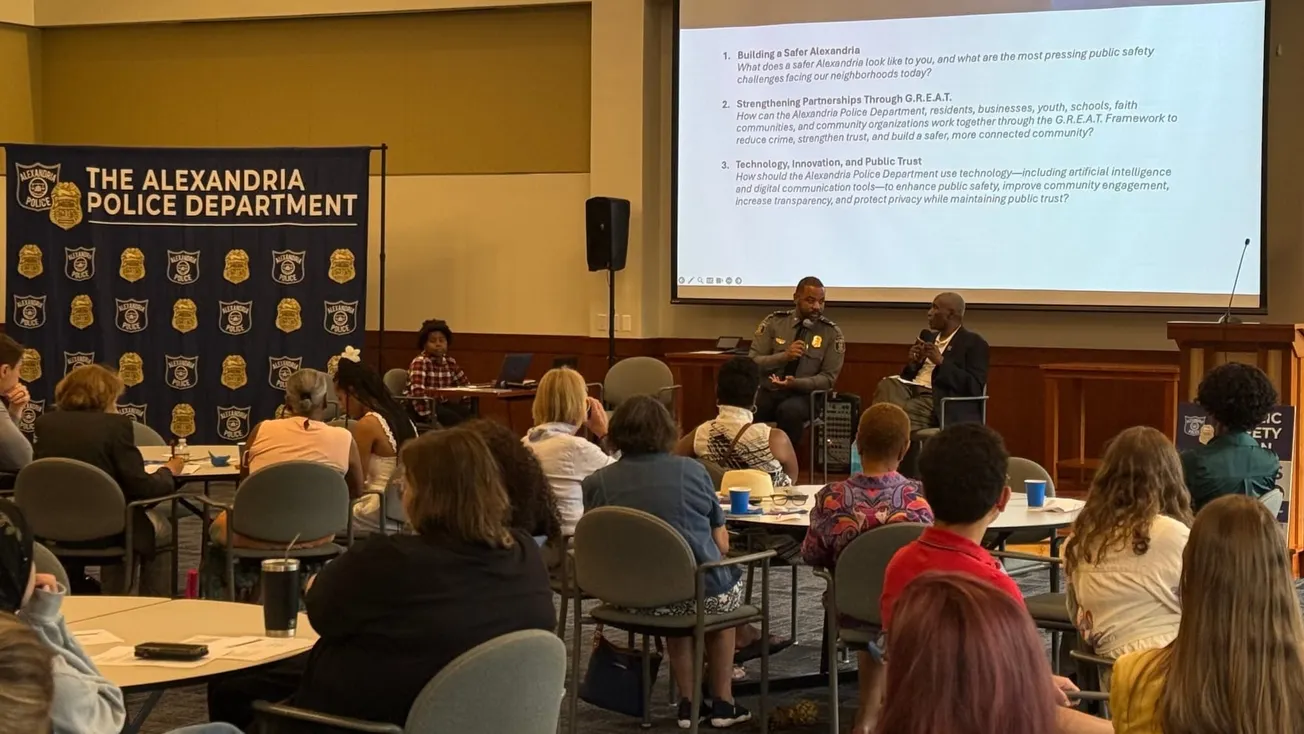
ALEXANDRIA, Va. - Before he became a police chief, Tarrick McGuire went to Ecuador.
It was around 2015, and the State Department had asked him to travel to Quito to speak about American policing — at a time when cities across the country were in open debate about what police should be doing and how they should do it. He went anyway, despite a State Department travel warning for the region.
What he found surprised him. National police force. Year-long academies. Officers standing in intersections in militarized uniforms with automatic weapons. A fundamentally different relationship between the badge and the street.
He came home with a conviction that has shaped everything since.
"Policing in America is designed based off of how people see their police departments," McGuire told a crowd of approximately 100 residents Tuesday morning at Virginia Theological Seminary. "It replicates in a fashion of the people that serve and how they want their police to police their community."
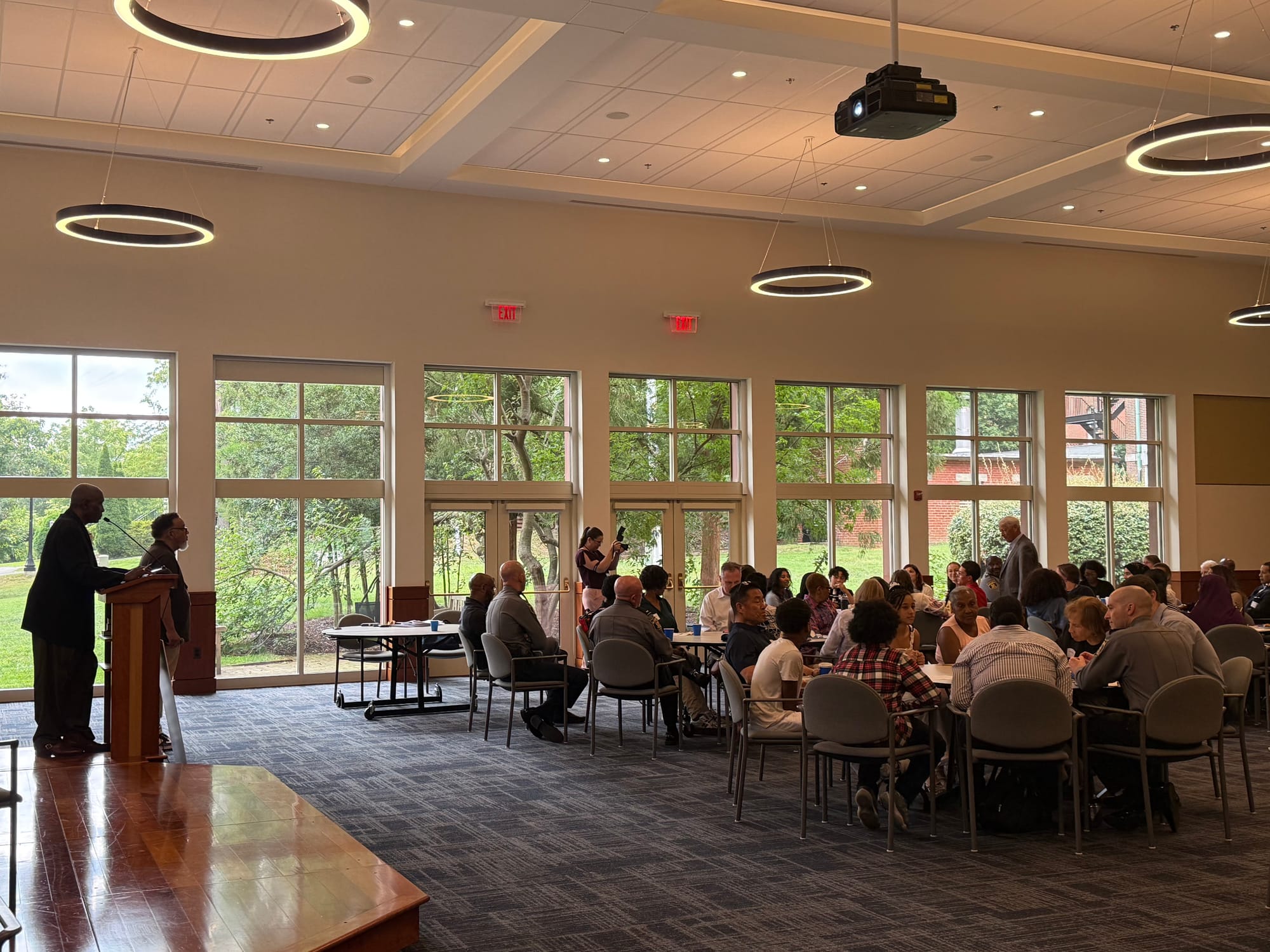
That philosophy is the foundation of the Alexandria Police Department's G.R.E.A.T. public safety framework — and Tuesday's gathering at VTS's Lettie Pate Conference Center was the latest stop in a summer-long community engagement effort that will culminate in a department report expected in September.
What the Plan Is
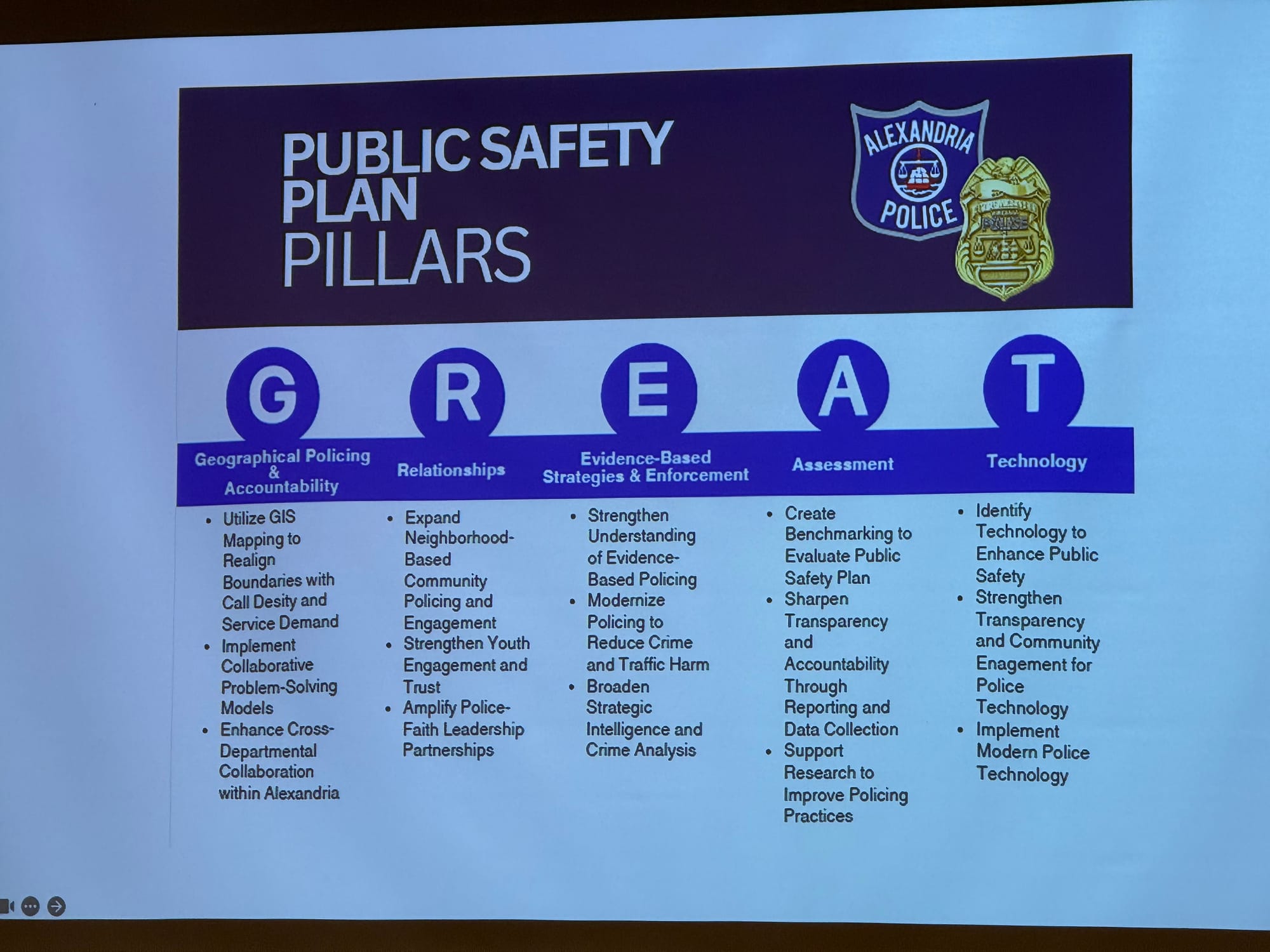
The Brief has covered the G.R.E.A.T. framework since McGuire presented it to City Council in June. Its five pillars — Geographical Policing and Accountability, Relationships, Evidence-Based Strategies and Enforcement, Assessment, and Technology — organize the department's priorities around data-driven deployment, community trust, crime reduction, transparency and modern tools.
Tuesday was the next step after the June 18 invitation-only Public Safety Summit at the same venue. Convened by the Concerned Citizens Network of Alexandria, the Alexandria Host Lions Club, Virginia Theological Seminary and the Partnership for a Healthier Alexandria, the session drew approximately 100 invited residents — a deliberately broader cross-section of the community that included recently promoted APD officers, clergy, nonprofit leaders, school board chair Chris Harris — who arrived unannounced — and youth from Alexandria City High School.
Col. Jim Paige, executive director of CCNA, set the tone early. "We're here because we want to hear what you have to say about our community and how we can make it better," he said. "This is not about putting the chief on the spot. It's about how we address it together."
What Residents Said
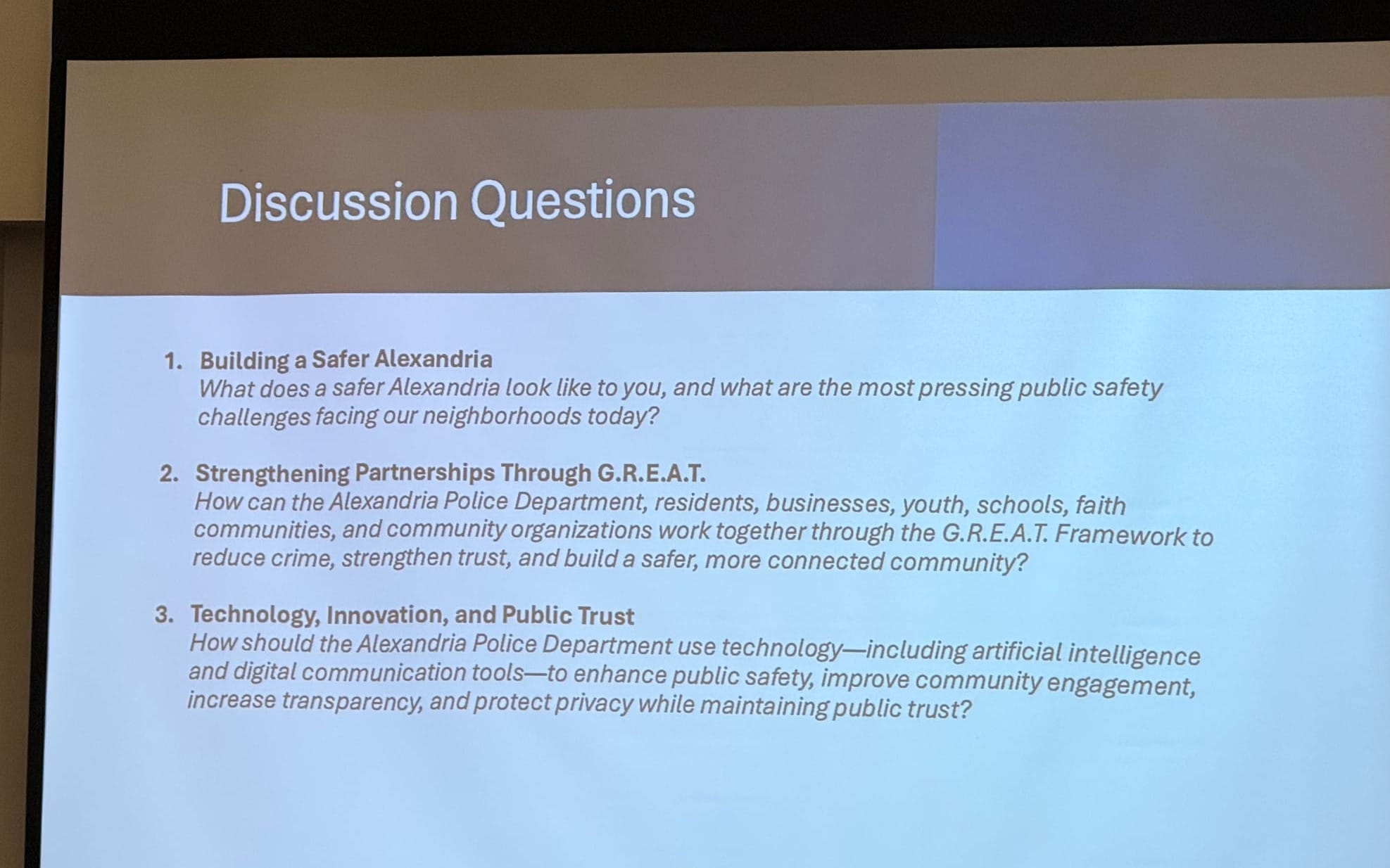
After McGuire's presentation, residents broke into small groups to respond to three discussion questions: what a safer Alexandria looks like to them, how the community and APD can partner through the G.R.E.A.T. framework, and how the department should use technology — including artificial intelligence — while protecting privacy and maintaining public trust.
The themes that came back were consistent across tables.
Youth came up repeatedly — not just the need for more activities, but the need for activities young people actually want. "Not just what adults think youth want to do," one facilitator reported back. A youth citizen police academy was floated by Assistant Chief Tina Laguna, who said the department is planning to reinstitute the program within the next month or two, built in part around helping young people understand their rights.
Traffic and pedestrian safety drew significant concern, particularly around scooters and cyclists running red lights. Assistant Chief Jason North was direct: "I'm not proud to say it, but this police department can't be everywhere at once." He said the department focuses its traffic enforcement on crash data and the most severe incidents rather than trying to cover every violation. Laguna added that APD has been running a summer social media campaign aimed at pedestrians, cyclists and scooter riders about road awareness.
Residents near Stevenson Avenue raised concerns about safety as new development — a hospital and condos — changes the character of the corridor. Re-entry support for people returning from incarceration came up at multiple tables. Scams and fraud, particularly targeting elderly residents, were flagged as an underreported problem.
The technology question generated the most nuanced conversation. Residents raised concerns about AI, unemployment and privacy. McGuire, earlier during his presentation, acknowledged the tension directly, using a Walmart self-checkout as an analogy for how AI is already embedded in daily life, then making the case for why APD needs to keep pace with surrounding jurisdictions.
"If we do not have the technology we need here within the city, and we look at Fairfax, Prince William County, PG County, D.C., and they have those tools, it creates an information gap," he said.
He confirmed that body cameras and dash cams — long absent from APD — are now being installed in vehicles after more than a year in procurement. The department is also evaluating real-time crime centers and drone technology, both of which would require city council approval and budget authorization.
A Different Kind of Room
Laguna, who until recently oversaw the department's school resource officers among other responsibilities, offered one of the morning's more candid moments when asked about community trust.
"I don't wear this uniform day in and day out," she said. "When I take it off, I'm a woman and I'm a person of color. And sometimes people make assumptions. So we live in a world where there are a lot of assumptions. We've all got to be a little bit better and just smile and say hello and start that conversation."
The room itself reflected what Paige described as the point of the exercise — people who didn't know each other, sitting together, finding common ground. Facilitators asked each table to identify one person they hadn't met before. Paige, wrapping up, pointed to a moment where a resident named Howard connected with a woman working on AI applications for the police department. They found each other in the room.
"That's the rhythm of being in the room together," he said.
School board chair Chris Harris, who arrived mid-session, was pulled to the front by Paige for an impromptu introduction. Harris kept it brief — he was there to listen, he said — but the moment underscored what McGuire has been building toward: a public safety conversation that pulls in schools, health departments, faith communities and city planning alongside the police department.
"It's not about Tarrick McGuire and the cops," Paige said in his closing remarks. "It's about all of us. These sessions are about us."
What's Next
Tuesday's session was one of several community meetings APD plans to hold across Alexandria's neighborhoods this summer. Community organizations are planning events in Del Ray, Old Town, Arlandria, and the West End.
After completing the series, the department plans to release a report in September summarizing what it heard and outlining a path forward for implementing the G.R.E.A.T. framework.
The department will collect written feedback from Tuesday's table discussions and share it among the organizing partners.