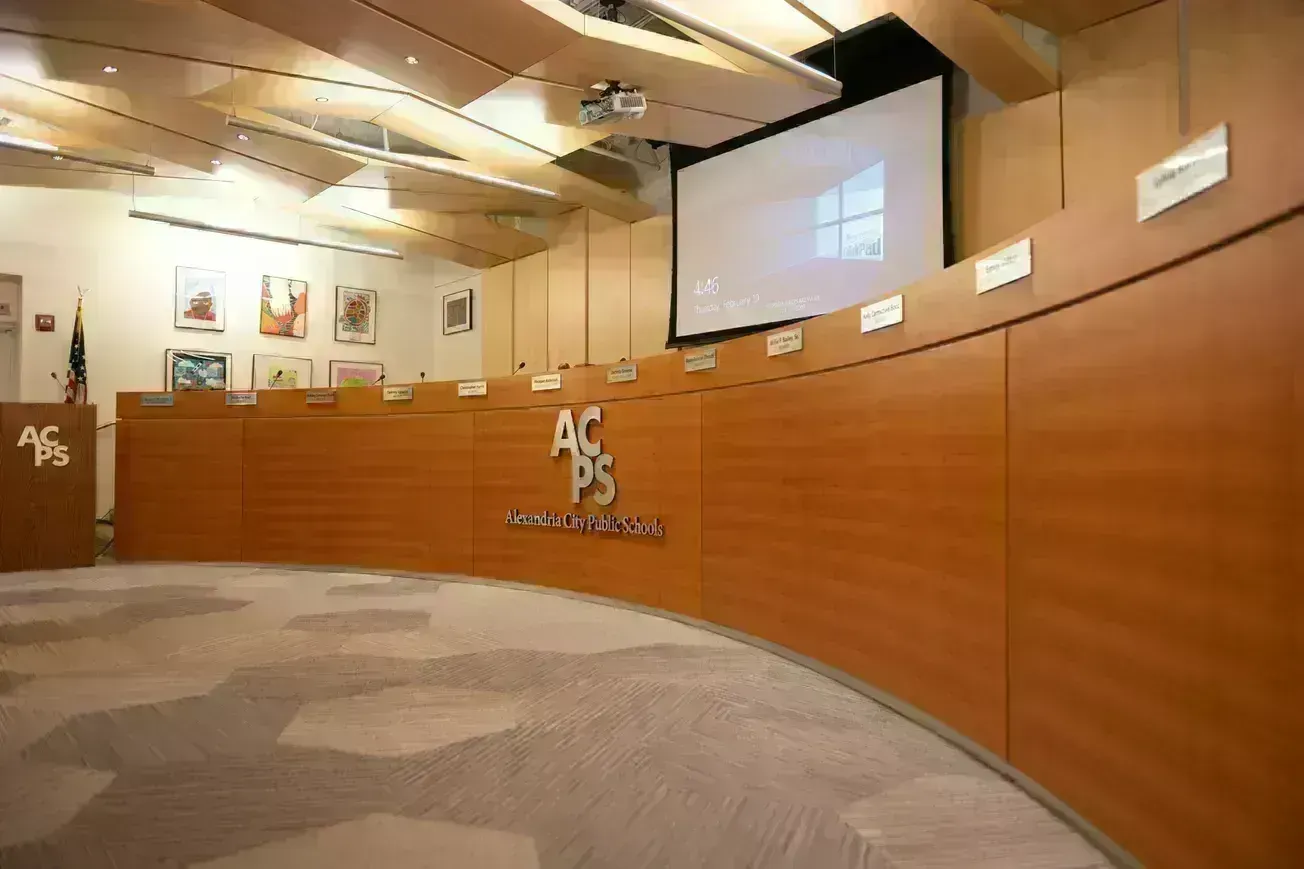
ALEXANDRIA, Va. — Any change to how Alexandria elects its School Board is now unlikely to take effect before 2030, after a joint City Council and School Board committee ruled out asking the General Assembly to act next session.
That outcome is the one School Board member Kelly Carmichael Booz warned about in April. "You only really get one chance to make that change," she told The Alexandria Brief then. "If we are not able to make this change for 2027, the clock starts all over again when the new board comes in in 2028." Both the council and the board are up for election next year.
The four members of the ad hoc committee on school board election reform agreed Tuesday that seeking changes for the 2027 election would require an emergency clause in Richmond, a threshold they said is too high to attempt.
"With an emergency clause, we would need 80 votes in the House, which is a significant lift," said Councilman Canek Aguirre, who chairs the committee. "And in the Senate, we would need 32, which is also a significant lift, considering the margins at which the parties are currently."
City staff told the committee an emergency clause requires a four-fifths majority, meaning significant support from both parties, and that the 2027 session will already carry a large city agenda. Booz said state Sen. Elizabeth Bennett-Parker had advised that even changing the term length from three years to four would trigger the clause.
"I begrudgingly agree," Booz said. "Unless we're walking out of here and we're just so unanimous and on the same page, it would be pretty risky to do an emergency clause if we're still having some disagreements."
What's on the table
The committee is weighing three changes: extending terms from three years to four, staggering them so the entire board is not elected at once, and reducing the board's size from nine members.
The board has nine members, three from each of the city's three districts, all serving concurrent three-year terms. It asked for four-year staggered terms by unanimous resolution in 2019 and again in November 2024, requests the council never formally answered. Then-Chair Michelle Rief, who was succeeded by Christopher Harris this year, asked the council in a May 18 memo to seek a charter amendment by this fall so the 2027 General Assembly could take it up. The council added the question of board size when it created the committee in June.
Staff said any year other than 2027 would follow the normal legislative process, requiring only a simple majority, with time for public hearings. A charter change could be filed as early as the 2027 session with a later effective date, avoiding the emergency clause.
ACPS Board attorney Bob Falcone said shortening the terms of sitting members to reach a new cycle sooner would likely draw legal challenges, citing a failed attempt to shorten Loudoun County School Board terms. Cutting a term voters had already awarded, he said, would raise "many strong legal arguments," including that it subverts the will of voters.
That left 2030 or later. Councilwoman Sandy Marks raised 2033, which would align with a gubernatorial election.
Under the current structure, Alexandria elects its mayor, City Council and School Board together every three years, in November. The next two are Nov. 2, 2027, and Nov. 5, 2030, according to the city's election calendar. Moving the board to four-year terms would eventually pull its elections off that shared cycle, part of what members were trying to work out. At the committee's first meeting in August, Marks said a change effective in 2030 would need to pass the 2029 session and clear a public hearing by the fall of 2028.
Board size divides the committee
Aguirre said he is "pretty adamant" about reducing the board, arguing Alexandria's nine members are more than comparable jurisdictions and that fewer seats would produce more competitive races. He said six or seven members would be workable, and that eight would create districting problems likely to draw an attorney general's review.
Aguirre noted the board was expanded in 1964 in part to bring African American representation and moved from appointed to elected in 1994, and said the districts have since produced a diverse set of candidates and winners.
Board member Abdulahi Abdalla said no one has shown that a smaller board would address the problems the committee says it wants to fix.
"I feel like that's a Pandora's box we shouldn't open just to experiment with reducing the size just to see if this would solve this," Abdalla said. "We don't have any data, we don't have any community engagement, there's no concrete proof that this would work."
Abdalla, in his first term, said the board's three standing committees are working well with nine members, and that the real problem is burnout.
"I feel like it's the dynamics and relationship that we have between school board and city council," he said. "I feel that sometimes city council can make it a little bit difficult sometimes for school board members to do their job."
He also said the previous School Board's resolution asking for changes did not include board size. That came from City Council's resolution.
Aguirre said support on council has been consistent. When the issue first came up, he said, five or six members favored a reduction, and it remained a majority after turnover.
Marks said she was not sure that's settled. "My understanding was that the resolution included that we wanted to talk about board size," she said. "But I did not hear — I didn't read in those words that the entire council was committed to shrinking the board."
Marks raised a different option: eliminating the A, B and C districts and electing all members citywide, which she said would remove the constraint that the board have an odd number of members. Booz said that would trigger Virginia Voting Rights Act scrutiny and called it too drastic.
And staggered terms
Booz and Abdalla support staggering. Marks does not. Aguirre said he wants more consistency but is unsure how to start.
Falcone, offering what he said was his own view rather than legal advice, said staggered terms help because the job is complex, part time and unstaffed, leaving new members reliant on staff. He said boards with more continuity tend to see more continuity among superintendents, and that repeated leadership changes have an educational impact, while noting he knew of no data tying board turnover itself to student outcomes.
Marks questioned the link. She asked when a superintendent last left Alexandria because of board turnover, and no one could say.
"Ultimately, that is the decision of the voter," Marks said. "It is the decision of the voter whether or not they prioritize consistency."
She argued the committee had already found other ways to address continuity, including four-year terms and a pending vote on board member pay, which Booz said must happen before Dec. 31 to apply to members elected in 2027.
Booz said the request is not new. Four School Board cycles have asked for changes based on their own experience, she said.
Booz has cited board research finding that of about 50 membership changes between 1997 and 2024, 41 involved members choosing not to seek reelection and seven involved incumbents being defeated. Rief's memo put the chance of majority turnover in a single election above 60% under the current structure.
The committee has treated board pay as outside its charge but agreed in August to note it in the final report. Members have been paid $15,000 a year since at least 2012, last among regional peers. Arlington pays $51,500, Fairfax $48,000 and Prince William $26,520. The council raised its own salaries from $37,500 to $68,000 in June 2024.
What happens next
The committee has one meeting left, tentatively Oct. 20, and must report to City Council and the School Board by Nov. 10, when it dissolves. Council can accept, reject or amend whatever it recommends.
Members disagreed about what that report should contain. Aguirre proposed presenting several scenarios with the committee's votes on each, including 3-1 splits. Marks argued for presenting only points of consensus.
"If we do that, aren't we just relitigating this conversation again, but in writing," she said.
Abdalla said four competing options would make the committee "null and void."
Aguirre said members will come to the next meeting with scenarios. If none draws at least three votes, he said, the report to council will say the committee could not reach consensus.
By his count, the committee has consensus on two things: four-year terms, and not attempting a change before 2030.
Ryan Belmore is an Alexandria resident and the founder and publisher of The Alexandria Brief. Send tips, feedback, and story ideas to ryan@alexandriabrief.com.
© 2026 Alexandria News, LLC. All rights reserved. This material may not be published, broadcast, rewritten or redistributed without permission.